Jonathan Ostery, Deputy Director of IMF Asia and Pacific Department
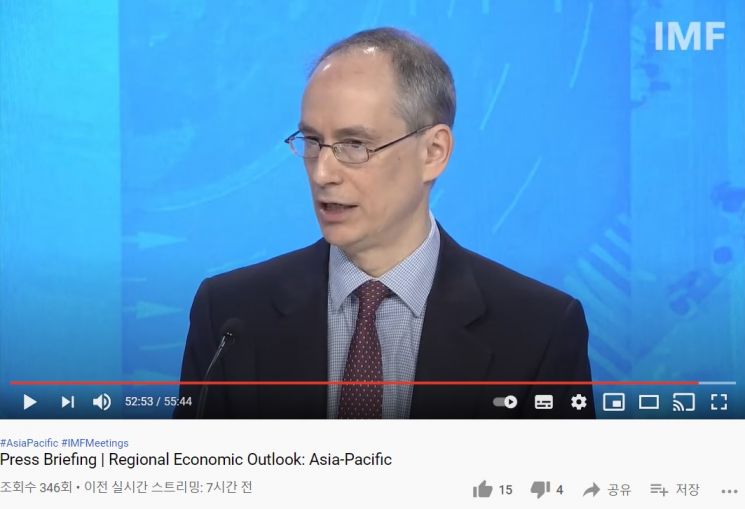 Jonathan Ostry, Deputy Director of the Asia and Pacific Department at the International Monetary Fund (IMF), is answering questions at an online press briefing on the 13th (local time).
"No Evidence of Inflation Confirmed"
"Household Debt Increased Mainly in Mortgage Loans but Remains Manageable"
[Asia Economy Reporter Kim Eun-byeol] The International Monetary Fund (IMF) stated on the 13th (local time) that the South Korean economy is recovering faster than expected, but it is not yet the time to respond by raising the benchmark interest rate. On this day, Jonathan Ostry, Deputy Director of the IMF Asia and Pacific Department, answered Asia Economy's question during an online press briefing on whether the Bank of Korea should consider raising the benchmark interest rate, saying, "We recommend maintaining the current monetary policy and not raising the benchmark interest rate." The IMF recently raised South Korea's growth forecast for this year significantly from 3.1% to 3.6%.
Deputy Director Ostry said, "South Korea had relatively very good growth last year due to appropriate monetary and fiscal policies," and "the recovery this year also seems to be generally well underway." However, he added, "There is still slack in resources that lowers cost pressures, and no evidence of inflation has been confirmed," recommending that the benchmark interest rate be maintained at around 0.50% per annum.
He emphasized the opinion that although inflation concerns are emerging as price increases are detected in various indicators, it is still too early to discuss this in South Korea. According to the Bank of Korea on this day, the import price index last month was 109.73 (2015=100), up 3.4% from the previous month and 9.0% from the same month last year. The year-on-year increase in import prices was the first in 14 months, and the rate of increase was the largest since October 2018 (11.1%). The consumer price index last month also rose 1.5% year-on-year, marking the largest increase in 14 months.
He also said it is better to maintain low interest rates from the perspective of financial stability. Deputy Director Ostry explained, "I do not recommend raising interest rates to address financial stability risks, including housing-related risks," and "While household loans have increased under the low interest rate environment, risks are limited thanks to macroprudential policies." Although household debt has risen to a level comparable to the gross domestic product (GDP), this is interpreted to mean that raising interest rates now would increase borrowers' burdens and cause more losses than gains.
© The Asia Business Daily(www.asiae.co.kr). All rights reserved.
![Clutching a Stolen Dior Bag, Saying "I Hate Being Poor but Real"... The Grotesque Con of a "Human Knockoff" [Slate]](https://cwcontent.asiae.co.kr/asiaresize/183/2026021902243444107_1771435474.jpg)











