Turbulent K-Semiconductor
US Companies' Offensive Backed by Government Support
Urgent Need for Structural Reform to Compete
[Asia Economy Reporter Kim Heung-soon] The global semiconductor shortage crisis is shaking even the industrial ecosystem. The existing order, which maintained a division of labor centered on companies with strong market dominance, has entered a period of great transformation as emerging players challenge the status quo. Representative examples include NVIDIA, a graphics processing unit (GPU) company, entering the data center central processing unit (CPU) market dominated by Intel, and Intel declaring its intention to join the semiconductor foundry market led by Taiwanese and Korean companies. Amid the aggressive push by U.S. companies backed by government support to accelerate technology development and investment, voices are emerging that call for structural reforms to help Korean companies secure competitiveness.
According to related industries and foreign media on the 14th, NVIDIA publicly revealed its plan to launch a data center CPU led by Intel the day before. Utilizing technology from ARM Holdings, a British semiconductor design company acquired last year, NVIDIA plans to introduce the data center CPU called ‘Grace’ in early 2023. Named after computer scientist Grace Hopper, the company claims that systems equipped with this product will process data ten times faster than systems combining NVIDIA’s GPU and Intel’s CPU.
According to market research firm TrendForce, Intel held a 92% share of the server CPU market last year, with U.S. AMD holding 8%. With NVIDIA joining the market dominated by these two companies, foreign media evaluated this as "NVIDIA challenging Intel’s stronghold." An industry insider said, "This can be seen as an attempt targeting next-generation platforms based on artificial intelligence (AI) operations rather than the existing market," and added, "We expect to strengthen collaboration with related companies necessary for building server processors."
On the same day, Intel countered by announcing its entry into automotive semiconductor production. It plans to produce actual semiconductors within 6 to 9 months in consultation with design companies. Earlier, Intel also announced an investment plan to build two foundry plants in the U.S. with an investment of $20 billion (approximately 23 trillion won). As of last year, the global foundry market share was led by Taiwan’s TSMC at 56.4% and Samsung Electronics at 17.7%, with the two companies accounting for over 70%. Intel CEO Pat Gelsinger predicted competition by stating, "The U.S. global semiconductor production share will expand to over 30%."
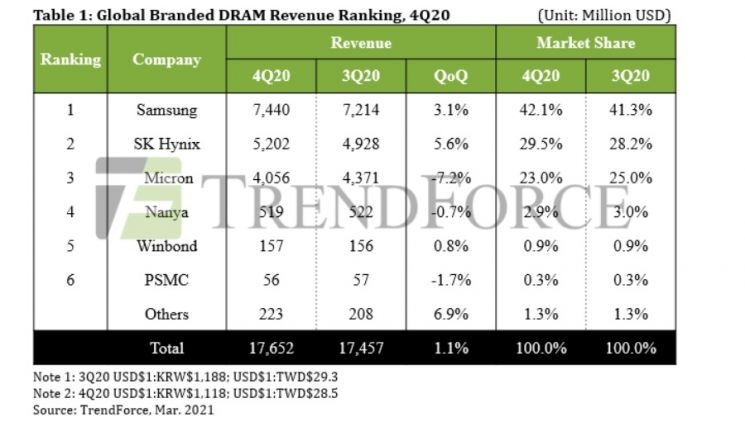
As the semiconductor ecosystem enters a period of great transformation, Korea, which leads the memory market, can no longer be complacent. As of the end of the fourth quarter last year, Samsung Electronics and SK Hynix ranked first and second in the DRAM market with shares of 42.1% and 29.5%, respectively, but fierce challenges from latecomers are expected because the entry barriers are lower than in the non-memory market.
The government’s plan to leap into a comprehensive semiconductor powerhouse by 2030 has also encountered red lights. Previously, the Korean government presented the ‘Korea Semiconductor Vision’ in 2019, a strategy to systematically nurture the semiconductor industry. An Ki-hyun, Executive Director of the Korea Semiconductor Industry Association, said, "It is time for a mid-term review to check whether the vision, which was proactively introduced amid the changing industrial landscape due to semiconductor shortages, is being implemented without setbacks," and added, "Additional support is needed to induce investment and foster not only talent but also promising small and medium-sized enterprises."
The Blue House plans to hold an expanded economic ministers’ meeting on the 15th, chaired by President Moon Jae-in, with CEOs from the semiconductor, electric vehicle, and shipbuilding sectors attending to discuss the status and response strategies for key strategic industries.
© The Asia Business Daily(www.asiae.co.kr). All rights reserved.
![Clutching a Stolen Dior Bag, Saying "I Hate Being Poor but Real"... The Grotesque Con of a "Human Knockoff" [Slate]](https://cwcontent.asiae.co.kr/asiaresize/183/2026021902243444107_1771435474.jpg)












