Market Size of 7000 Trillion Won... "Catching Two Rabbits: Profit Generation and Food Security"
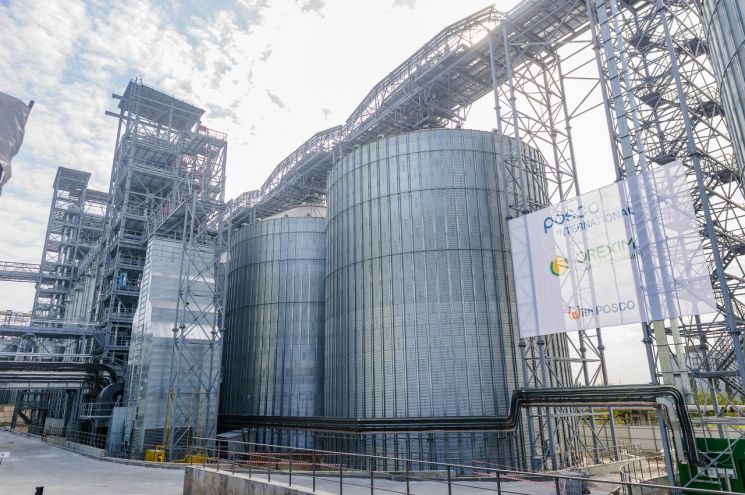
[Asia Economy Reporter Yu Je-hoon] POSCO International has announced plans to develop its food business as a core sector by 2030, aiming to become one of the global top 10 comprehensive food companies.
POSCO International revealed on the 14th that it has set a quantitative goal to expand its grain handling volume from the current 8 million tons to 25 million tons by 2030, achieving related sales of 10 trillion KRW.
Globally, agricultural and food products are among the most traded commodities, with the market size reaching $6.3 trillion (approximately 7,000 trillion KRW) as of 2018. This is 6.3 times the size of the global steel market and 3.7 times that of the automobile market. Furthermore, the world population is projected to reach 9.7 billion by 2050, indicating long-term demand growth.
Accordingly, POSCO International has decided to focus on developing the food business as a core sector. The company plans to secure profitability and expand its influence in the international grain market by strengthening connections across distribution stages such as farming, storage, processing, and logistics.
POSCO International’s grain handling volume reached 8 million tons last year, a rapid growth of about 9.5 times compared to 840,000 tons in 2015. Alongside this, to sustain growth, the company has built a food value chain extending beyond trading to include farms, processing, and logistics infrastructure. Developing and operating local businesses in food-producing countries?such as a grain export terminal in Ukraine, a rice milling plant in Myanmar, and palm oil farms in Indonesia?is part of this strategy.
POSCO International plans to continue asset investments jointly with Ukrainian grain companies to secure additional volumes and expand inland distribution networks. It is also exploring long-term collaborations with promising domestic Ag-tech (agriculture and technology) companies in line with trends in the agricultural sector.
POSCO International expects that this food business will also contribute to domestic food security. Currently, South Korea’s annual grain production is 4.5 million tons, while it imports 16 million tons of grain each year. The grain self-sufficiency rate stands at about 21%, but excluding rice, the rates for major grains such as wheat (0.7%), corn (3.5%), and soybeans (26.7%) are significantly low.
The issue is that recent global raw material price increases have led to a sharp rise in agricultural product prices, showing signs of "agflation." According to the United Nations Food and Agriculture Organization (FAO), the global food price index rose 2.1% in March compared to the previous month, marking a 10-month consecutive increase. Countries like South Korea, with low food self-sufficiency, are particularly sensitive to such fluctuations.
A POSCO International official stated, "The food business is not a declining market but a growth market with continuously expanding demand and potential for expansion into upstream and downstream industries. By expanding the food business and achieving international competitiveness comparable to major grain companies, we aim to create profits and contribute to food security, catching two rabbits with one stone."
© The Asia Business Daily(www.asiae.co.kr). All rights reserved.

















