Between Biden's US Investment Pressure and Major Exporter China...
Vice Chairman Lee Jae-yong Faces a Dilemma Amid Vacancy
[Asia Economy Reporters Heungsun Kim and Hyunjin Jung] "Our competitiveness depends on where and how you invest."
On the 12th (local time), U.S. President Joe Biden delivered a clear message to participants at the 'CEO Summit on Semiconductor Supply Chain Recovery' held via video conference at the White House. He called for more aggressive investments to strengthen the semiconductor industry within the United States and secure the country's supply chain.
Samsung Electronics, representing the domestic semiconductor industry and a key global foundry (semiconductor contract manufacturing) player, found itself unable to ignore this demand. The company faces pressure to finalize the expansion of its local foundry plant in line with Biden's directives, while also grappling with the dilemma of maintaining relations with China, a major semiconductor export market. This situation is expected to deepen concerns, especially with the absence of the top decision-maker responsible for critical decisions.
Biden Presents 'Jobs and Infrastructure' Demands
Additional Review of Austin Plant Facilities
Positive Incentive Expansion but Concerns Over Unwanted Investment Growth Due to U.S. Demands
At the meeting, President Biden urged global companies to actively invest to strengthen the U.S. semiconductor supply chain and create jobs. He also revealed that he had received a letter from 65 bipartisan members of Congress requesting semiconductor support. After the event, he held a meeting with lawmakers from both parties to discuss the 'American Jobs Plan.' By declaring the expansion of domestic production in infrastructure industries such as semiconductors, batteries, and broadband, he effectively sought cooperation from global companies to create jobs in the U.S.
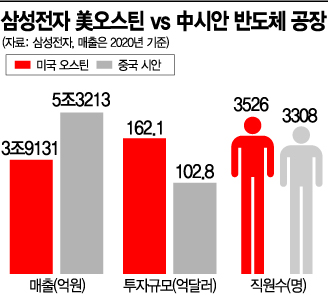
Samsung Electronics currently operates a foundry plant in Austin, Texas, and is considering building additional related facilities. Since 1998, Samsung has invested a cumulative $16.2 billion (approximately 19 trillion KRW) in the Austin plant. According to Samsung, the plant generated sales of 3.9131 trillion KRW last year, employing 3,526 people, including locals. While reviewing additional investments in Austin, Samsung has also requested a tax reduction of $805.47 million (approximately 907 billion KRW) over 20 years. This proposal includes a blueprint projecting an economic impact of $8.643 billion (approximately 10.37 trillion KRW) for Austin and an expected 2,973 direct and indirect jobs. The Biden administration's encouragement of foreign investment and potential expansion of incentives is positive in this regard.
However, Samsung cannot simply welcome this situation. With Samsung planning to become the global No. 1 in the non-memory semiconductor sector by 2030 through simultaneous domestic and overseas investments, there are concerns that it might be forced into unwanted investments due to U.S. demands. Yangpaeng Kim, a senior research fellow at the Korea Institute for Industrial Economics and Trade, noted, "From a corporate perspective, if issues such as incentive expansion are resolved, it could be a reasonable option," but added, "Since Samsung is pushing forward with a 10-year long-term plan to build a foundry plant in Pyeongtaek and expand investments, it might face a situation where it has to increase investments more than expected due to U.S. pressure."
In this context, the absence of Vice Chairman Lee Jae-yong is felt even more deeply. The fact that TSMC Chairman Liu Deyin personally attended the White House meeting also highlighted Samsung's leadership vacuum. A business insider said, "Considering the profiles and weight of the company representatives attending the White House video conference, it seems appropriate for Samsung to have Vice Chairman Lee attend," adding, "Maintaining networks with global companies and leading major decisions ultimately depend on the judgment of the top executive."
China Also Competing for Global Semiconductor Hegemony
Possibility of Additional Investment Demands Cannot Be Ruled Out
Strategic Judgment Likely Needed
China is also a key consideration in U.S. investment decisions. At the meeting, President Biden directly mentioned China, emphasizing, "There is no reason for the U.S. to wait." Having declared its semiconductor ambition in 2015 and committed to investing 1 trillion yuan (approximately 170 trillion KRW) over ten years to accelerate semiconductor hegemony, China may also demand additional investments from Samsung Electronics under the pretext of expanding the semiconductor supply chain. Recently, during the Korea-China foreign ministers' meeting, China expressed a desire for Korea to be a cooperative partner in advanced fields such as semiconductors.
Samsung currently operates its only overseas memory plant in Xi'an, China, and runs a semiconductor back-end (packaging) plant in Suzhou. The second phase of expansion investment for the Xi'an plant's second factory has been completed up to stage two, and full operation is expected from the second half of this year. The Xi'an plant's sales exceeded 5.3 trillion KRW last year, surpassing the sales of the Austin plant in the U.S. Samsung's silence on investment expansion amid active U.S. overtures is interpreted as reflecting the importance of China's position in the semiconductor supply chain.
Therefore, a balanced strategic judgment is crucial for Samsung Electronics. Experts believe that since China is an indispensable major country in the semiconductor and display industries, Samsung must balance between the U.S. and China, considering their value as production bases and markets. Recently, the semiconductor industry has requested government support in trade matters to respond proactively to the international situation surrounding semiconductors.
There are also concerns that intensified U.S.-China semiconductor hegemony competition could adversely affect Korean companies' business in China. A semiconductor industry insider said, "The U.S.-China clash is not just an industry issue but essentially a diplomatic one," adding, "It is time not only for the top executives' decisions but also for the Korean government to take the lead in directing the semiconductor industry's direction."
© The Asia Business Daily(www.asiae.co.kr). All rights reserved.
![Clutching a Stolen Dior Bag, Saying "I Hate Being Poor but Real"... The Grotesque Con of a "Human Knockoff" [Slate]](https://cwcontent.asiae.co.kr/asiaresize/183/2026021902243444107_1771435474.jpg)

















