Implemented in conjunction with the 'Coal Power Generation Cap System' to reduce greenhouse gas emissions
Power companies submit bids including fuel and fixed costs... Coal power generators phased out of the market
[Sejong=Asia Economy Reporter Kwon Haeyoung] The government will implement a price bidding system for coal power plants starting next year. With the introduction of a coal power generation cap system to limit power output for greenhouse gas reduction, the policy aims to induce price competition among surplus power generators and phase out high-cost generators from the market. However, since the price bidding system reflects climate and environmental costs, the possibility of electricity rate increases cannot be ruled out.
According to the Ministry of Trade, Industry and Energy on the 13th, starting next year, a price bidding system will be implemented that includes not only fuel costs but also environmental costs when operating coal power generators. The Korea Power Exchange is currently preparing detailed implementation plans, including the bidding method.
An official from the Ministry of Trade, Industry and Energy explained, "Until now, only fuel costs were considered when operating coal power generators, but going forward, fixed costs, operating profit margins, and other factors will also be taken into account to operate generators with higher price competitiveness first. This is a measure to limit coal power generation to reduce greenhouse gases and to naturally phase out surplus generators from the market through the price bidding system."
The government decided to introduce the bidding method to promote eco-friendly power production. Coal fuel costs are 40 KRW per kWh, cheaper than LNG (60 to 180 KRW per kWh), so coal has been regarded as a cost-efficient power source. However, as environmental friendliness and carbon reduction have become global issues, coal has transformed into a major cause of environmental destruction. Greenhouse gas emissions from coal are twice those of LNG. To reduce greenhouse gases, coal power operation must be reduced, and the government plans to stop operating high-cost generators to naturally phase them out of the market.
With the introduction of the coal power generator price bidding system next year, power generation cost calculations will no longer consider only fuel costs but will comprehensively include fixed costs such as labor and depreciation, as well as operating profit margins. For coal power generators, construction costs per plant are 4 trillion KRW, four times that of LNG, and maintenance personnel are twice as many as LNG, resulting in relatively high fixed costs, according to the Ministry. This means that generation costs will increase under the 'Price Bidding Program (PBP)' compared to the previous 'Cost-Based Pool (CBP)' system, which only considered variable fuel costs. The government had temporarily introduced CBP after the power market was established in 2001 and planned to implement the price bidding system from 2003 to activate competition among generators.
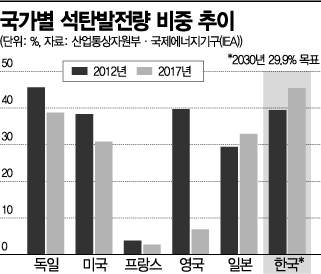
Currently, as the U.S. and Europe hint at introducing a 'carbon border tax,' the importance of climate and environmental responses is growing worldwide. The government is also establishing energy policies aiming for carbon neutrality by 2050, and as part of this, plans to reduce the share of coal power generation from 40.4% in 2019 to 29.9% by 2030. Looking at the share of coal power generation by country, Korea's was 45.4% in 2017, higher than Germany (38.7%), Japan (32.9%), the U.S. (30.8%), the U.K. (6.9%), and France (2.7%).
Currently, Lee Jangseop, a member of the Democratic Party of Korea, has proposed the 'Electricity Business Act Amendment,' including the coal power generation cap system. The Ministry of Trade, Industry and Energy plans to implement the system starting next year if the bill passes the National Assembly. However, as coal power generation is restricted, the burden of climate and environmental costs is expected to increase. Increasing LNG power generation instead of cheaper coal power generators will raise power production costs, potentially leading to higher electricity purchase costs for Korea Electric Power Corporation and electricity rate hikes.
© The Asia Business Daily(www.asiae.co.kr). All rights reserved.
!["The Woman Who Threw Herself into the Water Clutching a Stolen Dior Bag"...A Grotesque Success Story That Shakes the Korean Psyche [Slate]](https://cwcontent.asiae.co.kr/asiaresize/183/2026021902243444107_1771435474.jpg)
















