OTT Business Booms Amid COVID-19
Sales Up 123% Year-on-Year
Corporate Tax Expense Only 2.18 Billion KRW
Contrasted with 15.8 Billion KRW for Domestic Firms with Similar Sales
Network Usage Fee Dispute Under Litigation
Lack of Reinvestment in Hiring and Other Areas
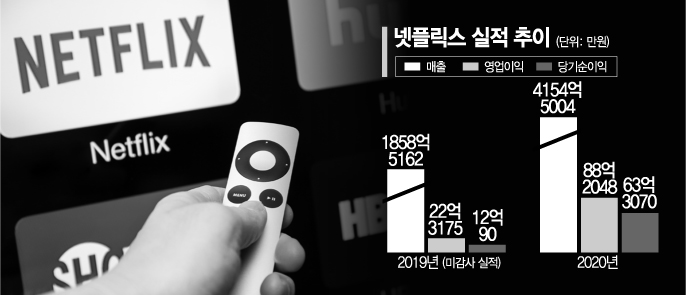
[Asia Economy Reporter Cha Min-young] Netflix, which has been criticized for tax evasion allegations and neglecting job creation, reportedly recorded sales exceeding 400 billion KRW in South Korea alone last year. Critics argue that the company only reaped the benefits of the growth in the online video service (OTT) market due to COVID-19, while shirking its responsibilities as a global corporation.
Sales Increased 123.5% Year-on-Year
According to the audit report released on the 12th by Netflix Services Korea, last year's sales amounted to 415.45 billion KRW, and operating profit was 8.82 billion KRW. This represents an increase of 123.5% and 295.5%, respectively, compared to the previous year's sales and operating profit.
Last year was a prosperous year for the OTT industry due to social distancing measures caused by COVID-19. Netflix, the world's number one OTT service company, also recorded high streaming revenue based on the rapidly increasing subscribers in Korea. Streaming revenue generated from domestic member subscriptions was 398.8 billion KRW, accounting for most of the sales. Netflix group company revenue was recorded at 16.6 billion KRW.
Domestic consumers show a high level of loyalty to Netflix. According to a WiseApp survey conducted at the end of December last year, among Koreans aged 10 and above, Netflix ranked first with 7.58 million viewers as the most used OTT app. It showed a significant gap compared to second and third place Wave (2.69 million) and TVING (2.37 million).
Corporate Tax Only About 2.18 Billion KRW
Despite high profits, Netflix paid only 2.18 billion KRW in corporate tax last year. This is a stark contrast to Hangul and Computer, a domestic IT company that recorded 400 billion KRW in sales last year and paid 15.8 billion KRW in corporate tax.
There are also allegations that Netflix deliberately lowers operating profits to evade taxes. The company reportedly reduces profits in its Korean branch, where the corporate tax rate is high at 22%, and transfers profits to overseas branches with lower tax rates through management consulting fees and other methods. The Seoul Regional Tax Office has been conducting a tax audit on Netflix since last year. Netflix stated that "it was judged impossible to make a reasonable estimate of the tax audit results" and included this in other contingent liabilities.
This kind of tax evasion is not unique to Netflix. An analysis of data submitted by the National Tax Service to Rep. Park Hong-geun of the Democratic Party revealed that 134 global IT companies, including Google, Apple, Facebook, Netflix, and Airbnb, paid only 236.7 billion KRW in value-added tax under the name of digital tax in 2019. This amount is only about half of the 450 billion KRW corporate tax paid by Naver alone.
Network Usage Fees and Job Creation Also Controversial
The issue of domestic network usage fees remains unresolved. Netflix is currently engaged in ongoing litigation with SK Broadband over network usage fees. Previously, Netflix filed a lawsuit against SK Broadband claiming non-existence of debt, refusing to pay network usage fees, and bypassed mediation by the Korea Communications Commission during the process. As of the end of last year, Netflix's traffic increased twelvefold over three years, while SK Broadband has borne hundreds of millions of KRW in costs for network quality maintenance during this period.
There are also ongoing criticisms that reinvestment efforts, such as direct employment of domestic personnel, are minimal. Rep. Jeon Hye-sook of the Democratic Party pointed out during last year's Korea Communications Commission comprehensive audit that "Netflix Services Korea has only about 70 employees." In response to criticism from the National Assembly and public opinion, Netflix expressed a willingness to cooperate early this year and announced plans to invest approximately 550 billion KRW in Korean content this year. Additionally, to promote coexistence with domestic creators, Netflix plans to hold seminars sharing editing technology know-how.
© The Asia Business Daily(www.asiae.co.kr). All rights reserved.
![User Who Sold Erroneously Deposited Bitcoins to Repay Debt and Fund Entertainment... What Did the Supreme Court Decide in 2021? [Legal Issue Check]](https://cwcontent.asiae.co.kr/asiaresize/183/2026020910431234020_1770601391.png)















