Emphasis on Domestic Semiconductor Production at Supply Chain Review Meeting
Pressure for Large-Scale Investment in the U.S. Amid Competition with China
TSMC Chairman Attends from Taiwan... Samsung Participates with Division Head Due to Absence of Chairman
[Asia Economy New York=Correspondent Baek Jong-min] As U.S. President Joe Biden officially announced a policy to expand semiconductor investment and production within the United States, the semiconductor hegemony competition originating from the U.S. is intensifying. South Korea, which has led the global market in memory semiconductors and foundry (contract manufacturing) sectors, is now facing a new crisis both internally and externally, with diagnoses pointing to disruptions in major decision-making due to the absence of heads of leading companies.
On the 12th (local time), President Biden requested CEOs of participating companies to expand semiconductor production in the U.S. during the 'Semiconductor CEO Virtual Meeting.'
The meeting was chaired by Jake Sullivan, White House National Security Advisor, and Brian Deese, Director of the National Economic Council (NEC). Commerce Secretary Gina Raimondo also attended. President Biden joined briefly in the latter part of the meeting to deliver remarks. CEOs from 19 companies attended, including Taiwan's TSMC and Samsung Electronics, the world's first and second largest semiconductor foundries, comprehensive semiconductor company Intel, and automobile manufacturers Ford and GM.
Among them, Samsung Electronics and TSMC are pursuing new expansions of their U.S. factories. At the White House invitation, TSMC Chairman Liu Deyin attended in person. Meanwhile, with Vice Chairman Lee Jae-yong absent, Samsung Electronics was represented by Choi Si-young, President of the Foundry Business Division.
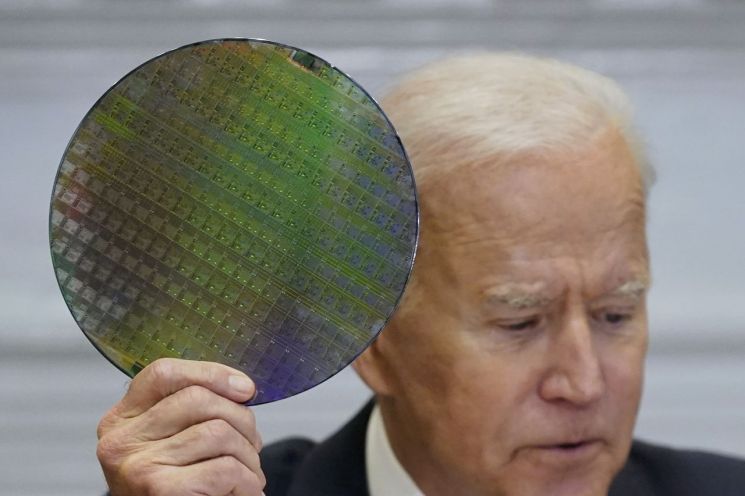
During the meeting, President Biden held up a semiconductor wafer and said, "Chips, wafers, batteries, broadband networks ? all of these are infrastructure," adding, "We are investing very aggressively, but it is not enough." He emphasized, "Our competitiveness depends on where and how talents like you invest." This was a direct pressure on Samsung Electronics to expand semiconductor production in the U.S.
The Biden administration views the decline of the U.S. share in global semiconductor production from 37% in the early 1990s to a recent 12% as a cause of the semiconductor shortage crisis, proposing the expansion of domestic production lines as the ultimate solution. President Biden also highlighted the need to win the competition against China, which is fostering its semiconductor industry under government leadership. He stressed, "China and other countries in the world are not waiting, and there is no reason for the U.S. to wait."
Immediately after the meeting, the White House stated, "Discussions were held on solutions to semiconductor supply issues as well as expanding the U.S.'s semiconductor production capacity."
© The Asia Business Daily(www.asiae.co.kr). All rights reserved.

















