Ministry of Culture, Sports and Tourism Announces Results of 'Bullet Mark Investigation' Inside and Outside Former Jeonnam Provincial Office Building
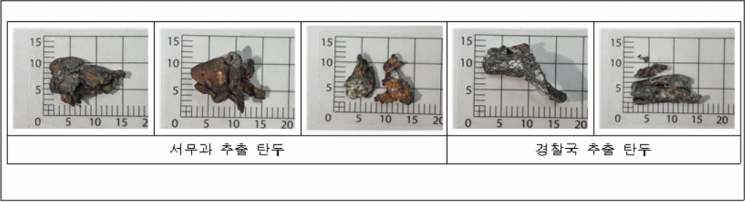 Photo of a warhead extracted from the old Jeonnam Provincial Office. (Photo by Ministry of Culture, Sports and Tourism)
[Asia Economy Reporter Choi Dong-hyun] Some bullet fragments presumed to be from the suppression of the provincial government building during the May 18, 1980 Gwangju Democratization Movement have been extracted.
The Ministry of Culture, Sports and Tourism announced on the 13th the results of the bullet mark investigation conducted around the old Jeonnam Provincial Government building from July last year to last month. During the investigation period, the ministry discovered 924 traces suspected to be bullet marks. Among these, bullet fragments embedded in 10 locations, presumed to be from the suppression at the provincial government building during May 18, were found, and 5 of these were extracted.
Additionally, the ministry analyzed the shapes of suspected bullet marks appearing in photos and videos using non-destructive inspection methods. They found 71 suspected bullet mark locations, but these had already been repaired or restored. Furthermore, 454 suspected traces requiring additional verification, such as residual component analysis, were identified. The remaining 389 traces were determined to be marks from nails or screws related to construction work.
Besides the building, it is presumed that bullet fragments are embedded in trees that have existed since 1980, including 3 bullets in the ginkgo tree in front of the main building and 2 bullets in the pine tree next to the conference room (or civil service office).
For this investigation, the ministry estimated locations of bullet marks through literature, oral histories, photos, and videos, and finalized non-destructive scientific methods applicable to the restoration of the old Jeonnam Provincial Government building with expert consultation.
In particular, with cooperation from the Ministry of National Defense, they created walls similar to those from that time at a shooting range to conduct sample shootings for bullet marks, then compared and analyzed the obtained bullet mark samples with the current walls. Subsequently, through the National Forensic Service, they cross-verified the bullet composition analysis and rifling marks on the bullet surfaces to confirm that the bullets were from M16 rifles.
The ministry plans to produce exhibition content by recording the entire bullet mark investigation process on video and will disclose it after the restoration of the old Jeonnam Provincial Government building. The 10 confirmed bullet mark traces will be treated for permanent preservation. Additional investigations and verifications will continue for the remaining 525 traces, including 71 suspected bullet marks and 454 suspicious traces. The results will be announced upon completion of the restoration work of the old Jeonnam Provincial Government building.
A ministry official stated, "Through the bullet marks confirmed in this investigation, we were able to infer the appearance of citizens just before and after their final resistance, the movement routes of the martial law troops, and the suppression methods." He added, "This result could serve as another important clue to uncover the memories of that day held by the old Jeonnam Provincial Government building, the site of the final resistance, and the truth of the May 18 incident."
© The Asia Business Daily(www.asiae.co.kr). All rights reserved.
![Clutching a Stolen Dior Bag, Saying "I Hate Being Poor but Real"... The Grotesque Con of a "Human Knockoff" [Slate]](https://cwcontent.asiae.co.kr/asiaresize/183/2026021902243444107_1771435474.jpg)
















