Seoul Mayor Oh Se-hoon Pushes for Reassessment of Official Property Prices
Opposes Government Policy in Earnest Since Taking Office
Limited Role for Seoul Mayor in Official Price Calculation
Practically Impossible to Achieve Deregulation Pledge Alone
However, Government-Seoul City 'Deal' Also Possible
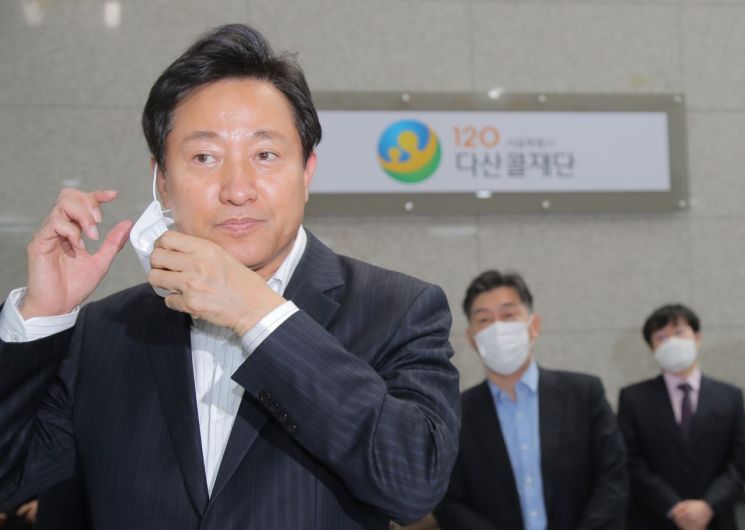 Seoul Mayor Oh Se-hoon adjusts his mask before receiving an operational status report during his visit to the 120 Dasan Call Center in Dongdaemun-gu, Seoul, on the morning of the 12th.
 [Photo by Yonhap News]
[Asia Economy reporters Moon Jiwon and Jang Sehee] The conflict between Seoul City and the government over the publicly announced property prices is becoming visible. Seoul Mayor Oh Se-hoon, who was elected riding on the public anger over real estate policies, has formed a joint front with the People Power Party and is actively opposing the increase in publicly announced property prices.
However, the prevailing analysis is that it is virtually impossible for Mayor Oh and the opposition to drastically lower the publicly announced property prices and holding taxes, which fall under government jurisdiction. While they may adjust local taxes such as property tax or find errors in the calculation of publicly announced prices to pressure the government, the final decision authority lies with the government. Therefore, the industry is focusing on how Mayor Oh will form relations with the government going forward to lead a relaxation of the publicly announced property prices.
Recalculation of Publicly Announced Prices is Virtually Impossible
According to Seoul City, the government, and the industry on the 12th, Mayor Oh has been raising pressure on the government by mentioning real estate issues daily since his inauguration on the 8th. The day before, at the People Power Party headquarters in Yeouido, Yeongdeungpo-gu, a real estate policy meeting was held with People Power Party acting leader Joo Ho-young (floor leader) and Policy Committee Chairman Lee Jong-bae attending, where they declared they would re-investigate the government's increase in publicly announced prices. This was effectively an official opposition to the government's sharp increase in publicly announced property prices.
However, Mayor Oh's role is limited. Although he announced plans to pursue a re-investigation of the publicly announced prices, it is virtually impossible to find errors in the government's calculation of publicly announced prices before June 1st of this year?the base date for imposing holding taxes such as property tax?and thereby induce a reduction in the increase rate of publicly announced prices or holding taxes. Considering the time needed for investigation and filing objections, completing such procedures within about a month and a half is unrealistic.
Even if objections are filed, the likelihood of government acceptance is low. The Ministry of Land, Infrastructure and Transport recently rebutted point by point the errors pointed out by Jeju Island and Seocho-gu regarding this year's publicly announced price calculations, maintaining that "there is no problem." For now, Mayor Oh's possible actions regarding the 'realization of publicly announced land prices' are limited to recommendations.
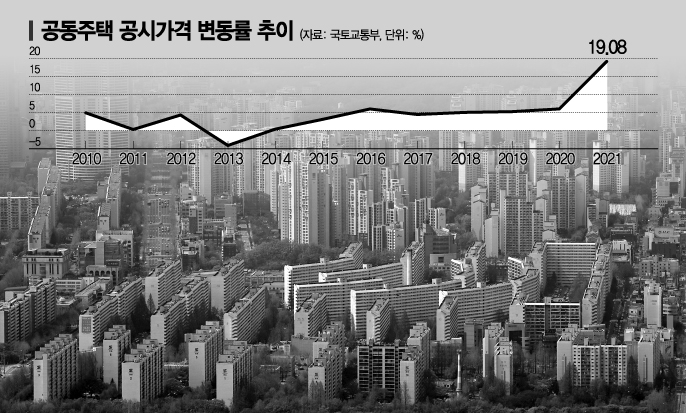
Regarding local taxes such as property tax, Seoul City may pursue partial reductions or refunds through future ordinance amendments. Previously, Seocho-gu pushed for a 50% reduction in property tax rates on one-household ownership with a standard market value of 900 million KRW or less among the district's share of property tax last year. At that time, Seoul City blocked the move, but the situation is expected to change with the new mayor.
However, this is also not easy. Property tax is collected by Seoul City and half of it is evenly redistributed to the 25 autonomous districts. Since it is a tax returned to the districts, it is difficult for the Seoul mayor to push it unilaterally. Currently, among the 25 district heads in Seoul, 24 belong to the Democratic Party, and among 109 city council members, 101 are from the Democratic Party. Moreover, the comprehensive real estate holding tax is a national tax, so without cooperation from tax authorities such as the Ministry of Economy and Finance, Seoul City cannot take action.
Government May Consider Deal to Ease Tax Burden
Government cooperation is essential for adjusting publicly announced prices and holding taxes. The Ministry of Land, Infrastructure and Transport, the competent authority, holds a negative stance toward Mayor Oh's challenges regarding publicly announced prices. The government announced a roadmap last November to gradually raise publicly announced prices to about 90% of market prices in the long term, and revising this immediately after Mayor Oh's election would be tantamount to admitting policy failure, making it unlikely.
However, with the presidential election next year, if competition to ease real estate regulations intensifies, there may be some compromise between Seoul City and the government. The government also needs Seoul City's cooperation to promote public-led development under the 2·4 plan, so a 'deal' may be reached in the future. Related ministries such as the Ministry of Land, Infrastructure and Transport are reportedly already considering adjusting the scope of tax or health insurance premium reductions in anticipation of an excessively high increase in publicly announced prices next year. The Ministry of Economy and Finance is also said to be open to adjusting the pace of the roadmap for realizing publicly announced prices.
© The Asia Business Daily(www.asiae.co.kr). All rights reserved.


















