March Unemployment Benefits Paid 1.179 Trillion Won... Second Highest After July Last Year’s 1.1885 Trillion
Clear Decline in Employment Insurance Subscribers in Face-to-Face Service Sectors Hit Hard by COVID-19
Accommodation and Food Services See Subscriber Drop for 11 Consecutive Months Since May Last Year’s -3,000
Youth Employment Insurance Subscribers Slightly Increase... Growth Smaller Than Middle-Aged and Older Groups
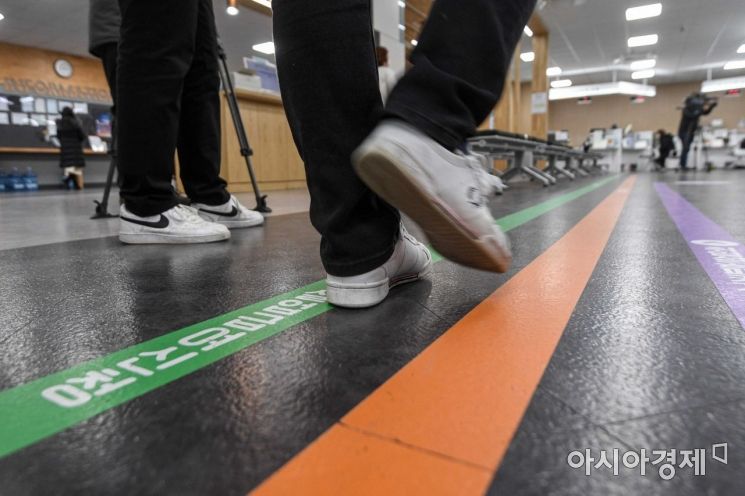 On February 3rd, amid the deepening employment shock caused by the prolonged COVID-19 pandemic, a citizen visiting the Nambu Employment Center in Yeongdeungpo-gu, Seoul, is seen moving toward the unemployment benefits application consultation desk. Photo by Jinhyung Kang aymsdream@
[Sejong=Asia Economy Reporter Moon Chaeseok] Last month, unemployment benefit payments exceeded 1 trillion won for the second consecutive month. This was the second highest amount ever, following the record high paid in July last year. Although the number of employment insurance subscribers in the service sector slightly increased, the accommodation and food service industries, which were directly hit by COVID-19, showed a continuous decline for 11 months since May last year.
According to the March labor market trends announced by the Ministry of Employment and Labor on the 12th, the amount paid for job-seeking benefits last month was 1.179 trillion won. Following the 1.0149 trillion won recorded last month, which exceeded 1 trillion won for the first time in five months, the trend continued for two consecutive months. This is the second highest record after the all-time high of 1.1885 trillion won in July last year.
Since April last year, the monthly payment amount has exceeded 900 billion won. The number of new job-seeking benefit applicants was 149,000, an increase from 110,000 last month. However, it was less than the record high of 212,000 in January. Job-seeking benefits are allowances to support the job search activities of the unemployed and constitute the majority of unemployment benefits, commonly referred to as unemployment benefits. They are funded by the employment insurance fund. This year’s budget for job-seeking benefits is 11.3486 trillion won.
Last month, the number of employment insurance subscribers was 14.079 million, an increase of 322,000 (2.3%) compared to the same month last year. In February, the increase was only 192,000 compared to the same month a year earlier, approaching the record low of 169,000 in January, but last month showed some improvement. The number of manufacturing subscribers was 3.58 million, up 32,000 (0.9%) from the same month last year. The monthly increase in manufacturing subscribers had been negative for 16 consecutive months from September 2019 to December last year but turned positive with 5,000 in January and 22,000 in February this year. In the electronics and telecommunications sector, due to increased exports of semiconductors, computers, mobile phones, and home appliances (TVs, refrigerators, washing machines, etc.), the number of subscribers increased by 10,600 last month, marking a four-month consecutive increase.
The number of employment insurance subscribers in the service sector was 9.624 million, an increase of 266,000 (2.8%) compared to the same month last year. This was largely influenced by increases in health and welfare (110,000) and public administration (38,000), which are related to government and local government job projects. Kim Youngjoong, Director of Employment Policy at the Ministry of Employment and Labor, explained, "The service sector, which was most affected by COVID-19 in face-to-face services, showed some improvement as the decline narrowed due to increased expectations for vaccination and economic recovery."
However, employment insurance subscribers in face-to-face service industries directly hit by COVID-19 still showed a clear decline. Accommodation and food services decreased by 35,000, and arts and sports by 4,000 each. In particular, accommodation and food services have shown a continuous decline for 11 months since May last year (-3,000). However, the decrease was somewhat smaller than in February (-59,000). The monthly decrease in employment insurance subscribers in accommodation and food services was smaller than the previous month for the first time in nine months since July last year. Director Kim said, "Last month, the decrease in employment insurance subscribers centered on hotels, resort condos, and Korean restaurants significantly narrowed, showing some improvement."
Looking at the trend in the increase of employment insurance subscribers by age group, the increase was mainly among middle-aged and older adults: 199,000 for those aged 60 and over, 101,000 for those in their 50s, and 20,000 for those in their 40s. Among the youth, those in their 30s decreased by 27,000, while those aged 29 and under increased by 30,000. This suggests that the employment shock caused by COVID-19 was concentrated more on the youth than on middle-aged and older adults. However, this was an improvement compared to February, when those in their 30s decreased by 48,000 and those aged 29 and under by 9,000. Director Kim said, "As the population in their 30s decreases, the number of insured persons increases. For those aged 29 and under, when looking in detail, the population under 24 decreases, but others increase, affecting the number of insured persons."
The labor market trends announced monthly by the Ministry of Employment and Labor target regular and temporary workers among employment insurance subscribers. Special employment types (SETs), freelancers, self-employed, and ultra-short-time workers are excluded.
© The Asia Business Daily(www.asiae.co.kr). All rights reserved.

















