Sharp Increase in Adult Video Usage Among Elementary Students... 1 in 3 Watched in the Past Year
Concerns Over Digital Sexual Crimes Rising... Majority of Victims and Perpetrators Are Teens
Experts: "Help Establish Proper Sexual Awareness Through Sex Education Rather Than Control"

[Asia Economy Reporter Joo-mi Lee] It has been revealed that the number of elementary school students watching obscene videos is increasing. Most of them experience such things before establishing proper sexual values, raising concerns that they may commit digital sex crimes. Experts suggest that teenagers, who inevitably become familiar with digital technology, should improve the problem through appropriate education rather than unconditional control.
According to the "2020 Youth Media Use and Harmful Environment Survey" announced by the Ministry of Gender Equality and Family on the 23rd of last month, 33.8% of 4th to 6th-grade elementary students reported having watched adult videos in the past year. This means that one out of three early teenagers has viewed harmful videos during their early adolescence. Considering that this figure increased by 14 percentage points from 19.6% in 2018 over two years, the seriousness is evident.
As a result, concerns are growing that elementary students watching adult videos could increase the likelihood of digital sex crimes in the future. According to the same survey, about 41% of teenagers, including elementary students, accessed adult videos through "internet portal sites, internet live broadcasts, and video sites." These channels have long been criticized for lacking sufficient regulation despite excessively provocative content.
For example, internet personal broadcasts distributed on platforms like YouTube and AfreecaTV are subject to the "Act on Promotion of Information and Communications Network Utilization and Information Protection" rather than the "Broadcasting Act," resulting in looser review regulations compared to general broadcasting. When elementary students, who are accustomed to online environments from a young age, enjoy stimulating and violent adult content, there is a risk of establishing distorted adult perceptions. This is why there is a high concern that elementary students could become not only victims but also perpetrators of digital sex crimes under distorted sexual concepts.

Teenagers are already the main targets of digital sex crimes. According to the Digital Sex Crime Special Investigation Headquarters (Special Investigation Unit) of the National Police Agency last year, 62% of victims in specific digital sex crime cases were teenagers. This means that six out of ten victims were adolescent teenagers.
In July of the same year, a former English teacher in his 30s produced a total of 1,293 sexually exploitative materials targeting 44 teenagers through KakaoTalk open chat rooms and distributed 88 of them on internet sites. Among the victims was a 5th-grade elementary student (12 years old), and it was revealed that some victims were even arranged for prostitution, causing public outrage.
Notably, teenagers are also active as perpetrators of digital sex crimes. The Special Investigation Unit arrested 3,575 suspects of digital sex crimes that year, with teenagers accounting for 30%. Among the main culprits of the so-called "Nth Room case," which shocked society with large-scale group sexual exploitation video trading, was "Taepyeongyang" A, who was 16 years old. A, who was 15 at the time of the crime, was sentenced in January to an indeterminate sentence for juveniles of 10 years maximum and 5 years minimum.
The reality that teenagers have become both victims and perpetrators of digital sex crimes is analyzed to be due to their young age, when proper sexual concepts have not yet been established. While teenagers, familiar with the internet, are at relatively higher risk of exposure to crimes due to the nature of digital sex crimes conducted online, it is argued that they have difficulty coping with and preventing crimes under proper adult perceptions. This is why managing teenagers' interest in adult videos, which could instill distorted sexual awareness, is necessary.
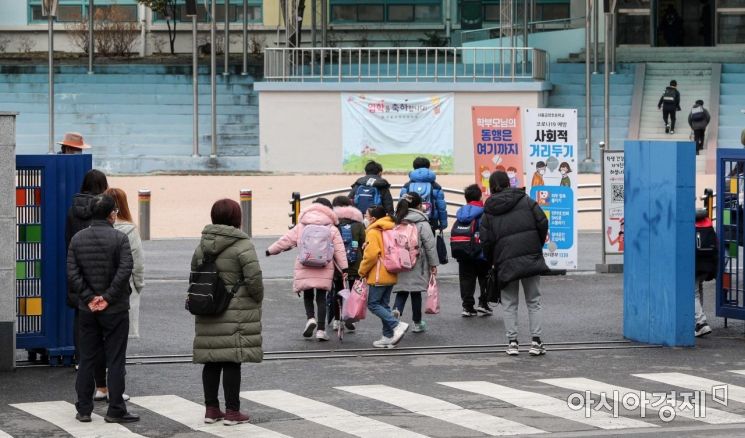 Elementary school students going to school. A survey revealed that one in three elementary school students has experience watching adult videos. The photo is unrelated to specific expressions in the article.
Some voices suggest that instead of unconditional sanctions, healthy sexual awareness should be established through sex education. Since teenagers' sexual curiosity is natural, it is argued that they should be guided in the right direction through active sex education rather than being controlled. Additionally, the balloon effect, where teenagers watch adult videos through other means to avoid sanctions, cannot be ruled out.
In the "Youth Sex Education Demand Survey Study" report (2018) conducted by the Korean Women's Development Institute, researcher Young-joo Cho pointed out, "Treating sex only as a problem, taboo, or risk does not consider the changing experiences and practices of youth," and "Rather, satisfying curiosity about sex through unofficial channels can lead to distorted perceptions, views, and practices regarding sex."
Experts also emphasized the importance of sex education over control. Deok-im Kang, team leader at the Seoul Metropolitan Jungnang Youth Sexual Culture Center, stated, "Digital culture such as the internet is already closely related to our daily lives, so it is realistically difficult to control," and suggested, "Sex education should be provided to establish proper sexual awareness."
She added, "Sexual curiosity during childhood and adolescence is a natural phenomenon, but due to adults' perception that sex is shameful or should be hidden, children's curiosity is sometimes not properly resolved," and pointed out, "In such cases, children try to satisfy their curiosity through the internet, increasing the likelihood of encountering provocative content."
© The Asia Business Daily(www.asiae.co.kr). All rights reserved.



















