Fine Dust Reduction Project Implemented from December Last Year to March This Year
‘Good Days’ Increased by 18, ‘Bad Days’ Decreased by 17, ‘High Concentration Days’ Decreased by 7
Support for Low-Emission Old Diesel Vehicles and Operation o
[Asia Economy Yeongnam Reporting Headquarters Reporter Kim Yong-woo] The air quality in the sky of Busan has improved. The concentration of fine dust has decreased due to fine dust management.
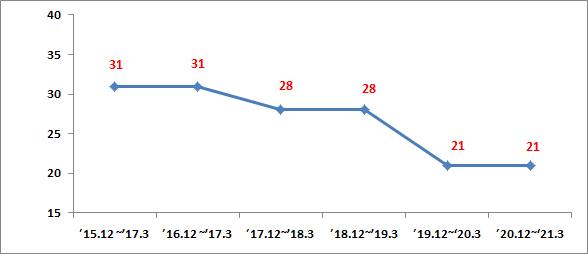
Busan City (Mayor Park Hyung-jun) announced on the 12th that by implementing the '2nd Fine Dust Seasonal Management System' from December last year to the end of March this year, the average concentration of ultrafine dust (PM-2.5) improved by 16% compared to the average concentration during the same period over the past three years.
During the 2nd seasonal management period, the ultrafine dust concentration was 21㎍/㎥, which is 4㎍/㎥ (16%) lower than the average concentration of 25㎍/㎥ over the past three years. Despite the yellow dust warning in March this year (104㎍/㎥), the concentration was the same as during the 1st period.
Also, compared to the past three years, the number of 'good days' for ultrafine dust during the 2nd period increased by 18 days (from 29 to 47 days). The number of 'bad days' decreased by 17 days (from 22 to 5 days). The number of 'high concentration days' also decreased by 88% (from 8 to 1 day), indicating an overall improvement in air quality.
It was analyzed that meteorological conditions such as a decrease in cumulative precipitation compared to the past three years (322.7 → 213.0 mm), similar average wind speed (3.2 → 3.3 m/s), and the yellow dust originating from the Mongolian Plateau causing a yellow dust warning from March 29th negatively affected the reduction of fine dust.
During the 2nd seasonal management period, Busan City supported the reduction of emissions from old diesel vehicles (early scrapping of 5,000 vehicles, installation of diesel particulate filters on 2,000 vehicles).
In addition, the city promoted fine dust reduction projects including ▲distribution of 11,418 eco-friendly home boilers ▲strengthening of sulfur content standards in ship fuel oil (from 3.5% to 0.5%) ▲participation of 1,899 ships in the slow-speed sailing program ▲inspection of 666 air emission business sites with 47 violations detected ▲inspection of 1,065 construction sites with 43 violations detected ▲inspection of emissions from 76,176 vehicles with 204 violations detected ▲cleaning of 210,878 km on 27 concentrated management roads ▲inspection of indoor air quality at 336 facilities used by fine dust vulnerable groups and multi-use facilities with 3 violations detected ▲operation of 75 fine dust information alert devices (traffic lights, electronic display boards).
Mayor Park Hyung-jun of Busan said, “Despite the worst yellow dust occurrence in March, good results were achieved thanks to the cooperation of citizens,” and added, “We will carefully analyze the effects of the fine dust seasonal management system implemented this year, as well as domestic and international emission changes due to meteorological impacts, to prepare an effective fine dust seasonal management system.”
© The Asia Business Daily(www.asiae.co.kr). All rights reserved.