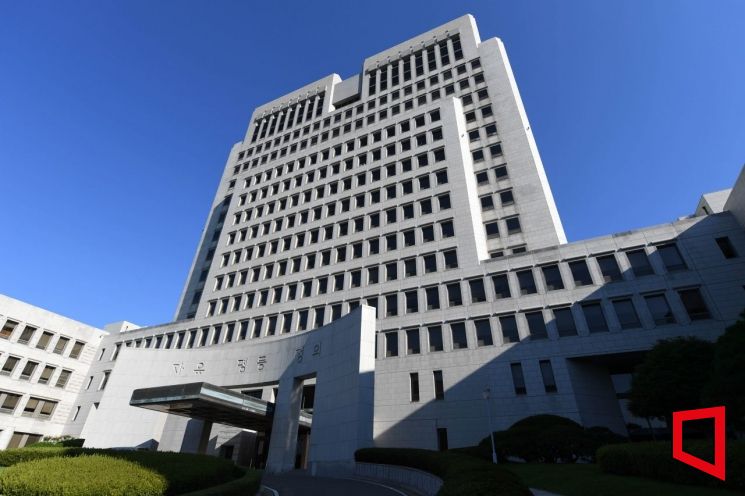
 Supreme Court, Seocho-dong, Seoul. Photo by Honam Moon munonam@
[Asia Economy Reporter Kim Daehyun] The Supreme Court has ruled that it was wrong for the court to deliver a verdict without accepting a request to resume arguments on issues that were not addressed after the conclusion of the trial.
On the 12th, the Supreme Court's Third Division (Presiding Justice Lee Dongwon) announced that it overturned the lower court's ruling, which dismissed Hong's claim for the return of unjust enrichment against the Pyeongtaek Godeok Regional Housing Association, and remanded the case to the Suwon District Court.
In 2015, Hong signed a membership contract with the Pyeongtaek Godeok Regional Housing Association to receive an apartment and paid the member contributions. Later, the association notified him that he was disqualified as a member due to a clause stating that members must maintain non-homeownership status until move-in and can only own one house with an exclusive area of 85㎡ or less. However, they explained to him that there would be no problem if he sold his owned house and rewrote the membership contract.
Accordingly, Hong sold his owned house in 2016, but in 2017, the association excluded him from the member list as an ineligible person and obtained approval for changes to the regional housing association.
The first trial ruled in favor of Hong, ordering the association to pay him 77 million won. The court judged that the second contract made in 2016 was originally invalid as it granted membership status to Hong, who was not qualified as a member.
On the other hand, the second trial dismissed his claim, stating, "Hong's argument, which assumes the validity of the first contract cancellation agreement, cannot be accepted." Since the cancellation of the initial contract with the association did not go through the general meeting resolution process, the first contract is still valid.
The Supreme Court ruled to re-examine the case. Hong had requested to resume arguments regarding the association's "preliminary claim," which they had denied entirely after the appellate trial concluded, but the second trial court did not accept this request.
Previously, the association had made a preliminary claim that "even if the first contract was not canceled, if it was canceled, a refund is possible within the scope after deducting penalties," so Hong's request to resume arguments was intended to recover at least part, if not all, of the amount.
The court stated, "The lower court should have resumed arguments to sufficiently examine whether the first contract remains effective and whether to add causes of claim by the plaintiff, but it failed to conduct the necessary examination, which affected the judgment," and thus overturned and remanded the case.
© The Asia Business Daily(www.asiae.co.kr). All rights reserved.
















