From mid-December this year, pallet unloading transactions for the last direct transaction item, 'Baechu', will begin to improve the logistics system and advance transactions... Seoul Agro-Fisheries & Food Corporation requests active understanding and cooperation from Garak Market shippers and distributors, stating that sufficient communication and consultation will be conducted during the remaining period to resolve issues among stakeholders as much as possible.
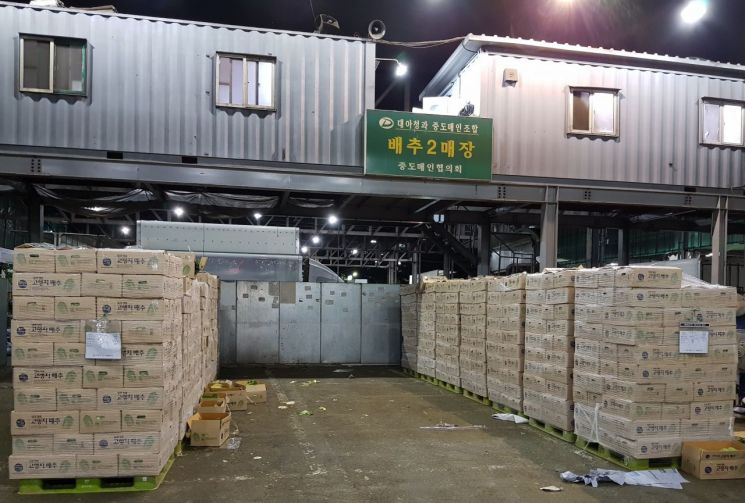
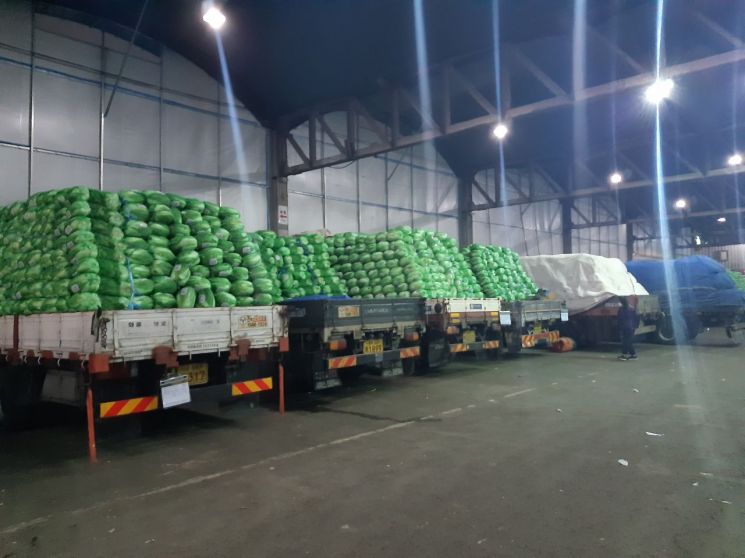
[Asia Economy Reporter Jong-il Park] Seoul Agro-Fisheries & Food Corporation (President Kim Kyung-ho) announced that from mid-December this year, it will fully implement pallet unloading transactions for ‘baechu’ (Korean cabbage), the last item in the Garak Market’s on-vehicle transactions.
The corporation has been implementing unloading transactions for on-vehicle transaction items annually since 2017 to improve the logistics system of Garak Market and modernize the outdated trading practices.
Following radish, onion, and young radish in 2017, unloading transactions for green onion, cabbage, and large green onion were promoted in 2018, and these items have now fully settled into unloading transactions.
The last unloading transaction item, baechu, was discussed starting in 2018 and was scheduled for implementation in 2019; however, due to sharp conflicts among stakeholders, price collapses, and the COVID-19 pandemic, the full implementation was delayed by about three years from the original plan.
Unloading transactions at Garak Market have led to positive changes in the wholesale market trading environment, including revolutionary improvements in market logistics, better working conditions for dock labor union members, and increased convenience for buyers.
As a result of unloading transactions for existing items such as radish and onion, the average waiting time for transport vehicles was drastically reduced from 12 hours to within 20 minutes, significantly speeding up logistics flow within the market.
Additionally, auction hall usage efficiency increased, and the unloading time per 5-ton vehicle was greatly reduced from 90 minutes (with 4 workers) to within 20 minutes (with 1 forklift operator).
Most importantly, unloading transactions abolished the unfair trading practice known as ‘jae’ for on-vehicle transaction items. ‘Jae’ is a premodern trading custom where, due to difficulty in product appraisal during vehicle-unit auctions and issues like binding, a fixed quantity is uniformly applied at a second-grade price.
With the abolition of the ‘jae’ practice through unloading transactions, Garak Market has improved trading reliability, reduced the number of price correction cases through activation of pallet-unit auctions, and in some items, transaction unit prices have increased.
To ensure smooth unloading transactions for baechu, the corporation has formed the ‘Baechu Logistics Improvement Promotion Council’ since 2018 and continues to consult with various stakeholders.
While all distribution entities?shippers, intermediate wholesalers, and wholesale market corporations?agree on the principle of implementing unloading transactions, opinions differ on detailed implementation methods among each party.
Shippers demand the implementation of unloading transactions after preparing alternatives such as volume control and price support measures, while intermediate wholesalers require perfect corrugated box shipments that do not require rework within the market as a prerequisite for unloading transactions.
Regarding the main contentious issues of baechu unloading transactions, the corporation plans to propose the best solutions through sufficient communication and consultation with stakeholders before full implementation in December.
Kang Sung-soo, head of the corporation’s Logistics Improvement Team, stated, “Baechu pallet unloading transactions are a task that must be promoted within this year to improve the logistics system and advance trading, and we ask for the active understanding and cooperation of shippers and distributors.”
Meanwhile, the Garak Market ‘Vegetable Building 2,’ scheduled for completion in 2023, will introduce temperature control facilities to protect product quality, and all items will only be tradable in pallet units.
Therefore, corn and garlic, which are currently voluntarily implementing pallet transactions, will also fully implement pallet unit transactions from next year.
© The Asia Business Daily(www.asiae.co.kr). All rights reserved.
![Clutching a Stolen Dior Bag, Saying "I Hate Being Poor but Real"... The Grotesque Con of a "Human Knockoff" [Slate]](https://cwcontent.asiae.co.kr/asiaresize/183/2026021902243444107_1771435474.jpg)

















