Independent and Minor Party Conscience Voting... Expressing Opinions and Gaining a Sense of Efficacy
[Asia Economy Reporter Park Jun-yi] The most attention-grabbing point in the April 7 by-election was the voting sentiment of people in their 20s. According to the joint exit poll conducted by the Joint Prediction Survey Committee (KEP), which includes the three broadcasters KBS, MBC, and SBS, on the 7th, 72.5% of males aged 20 and under chose Oh Se-hoon as the Mayor of Seoul, but among females aged 20 and under, 44% chose Park Young-sun, the Democratic Party candidate, showing a split in voting sentiment. Notably, 15.1% of females aged 20 and under supported minor party or independent candidates. Among all voters, the only group that cast more than 10% of their votes for other candidates was females aged 20 and under.
While everyone shouted 'Judgment on the regime,' they shouted 'Eradicate sexual crimes'
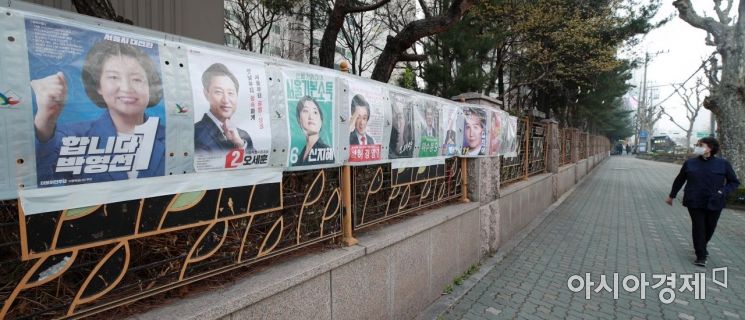 On the 26th, ahead of the April 7 by-election, election posters of the Seoul mayoral candidates were posted on a street in Yeongdeungpo-gu, Seoul. Photo by Hyunmin Kim kimhyun81@
What caught the attention of women in their 20s was the 'female candidate.' This was catalyzed by the sexual misconduct cases involving former Seoul Mayor Park Won-soon and former Busan Mayor Oh Keo-don. As a result, their voting sentiment split into 'never voting for a male candidate' and 'never voting for the ruling party (Democratic Party) that nominated candidates involved in sexual violence.' This is the background behind the 15.1% who chose independent or minor party candidates.
The sexual misconduct cases of the previous mayors were the cause of this by-election, but the main issue during the election was the 'judgment on the regime.' The opposition focused on criticizing the government's and ruling party's failures in real estate policies and the Korea Land and Housing Corporation (LH) scandal, while the ruling party heatedly accused opposition candidates of speculation allegations, drawing attention to the confrontation between the ruling and opposition parties. The opposition pointed out the 'sexual misconduct of former mayors from the ruling party,' but this was more to strengthen the judgment on the regime rather than to remind voters of the core issue. Meanwhile, some women's organizations and female candidates revisited the essence of the by-election throughout the campaign. One women's organization mentioned the special nature of this by-election and hung a banner saying, "Why is the Seoul mayoral by-election held? We vote for gender equality," but the National Election Commission disallowed it.
While the judgment on the regime was the mainstream narrative, some women in their 20s did not forget the necessity of a 'gender equality vote.' Three days before the election, on the 4th, high school student Yeom (19) said, "I will vote for a mayor who cares about women's rights issues," adding, "Even if they cannot change much, I expect at least attempts like attracting many counseling centers for sexual violence victims." College student Kim (23) also said, "I don't expect the candidate I vote for to become mayor," and added, "In a situation where the previous mayor resigned due to a sexual harassment case, women who are angry showed that they can raise their voices to this extent by casting their votes."
Professor Choi Hang-seop of the Department of Sociology at Kookmin University interpreted, "For women in their 20s, male candidates were likely perceived as negative entities," and "They showed their will through voting that they believe neither the People Power Party nor the Democratic Party candidates would properly protect the victims."
'Accumulated anger' of women in their 20s, little by little, slowly
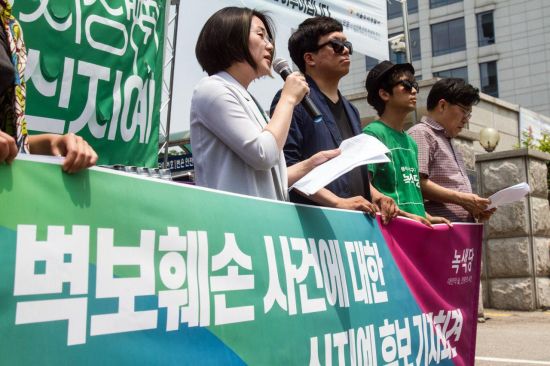 Green Party Seoul mayoral candidate Shin Ji-ye held a press conference on June 6, 2018, in front of the Suseo Police Station in Seoul, urging the police to investigate the repeated vandalism of her election posters. [Provided by Shin Ji-ye Candidate Election Headquarters=Yonhap News]
 Photo by photo@yna.co.kr
(End)
This is not the first time women's anger has been expressed through principled voting. Three years ago, in the Seoul mayoral election, Shin Ji-ye, a feminist candidate from the Green Party, received 82,874 votes, achieving 1.67% of the vote and ranking fourth. Considering she was a minor party candidate and was criticized by anti-feminists throughout the campaign, this was a remarkable achievement.
In this election, Kim Jin-ah, the Women's Party candidate, who ranked fourth with 33,421 votes (0.68%), became an alternative for some women in their 20s. Kim's platform focused solely on women's issues. She detailed policies on women's safety and gender equality, such as launching a women's violence response organization and securing 50% of female executives in Seoul city public institutions. Regarding the election results, Lee Ji-won and Jang Ji-yu, co-representatives of the Women's Party, issued a statement saying, "Women are no longer satisfied with a few lines of token women's policies inserted in campaign materials," and added, "Women proudly gave the Women's Party candidate Kim Jin-ah the achievement of ranking fourth in votes, boldly reborn as political agents."
Experts believe that these voters cast principled votes knowing their votes might be wasted but wanted to express their voices. Professor Jeong Soon-dul of Ewha Womans University’s Department of Sociology said, "Women in their 20s seem to have cast principled votes out of dissatisfaction that the serious issue of sexual violence is not well recognized," and added, "Although the candidate is from a minor party and has low recognition, it can be interpreted as casting votes to express their opinions."
There is also an analysis that the expectation that voting itself can solve problems led to principled voting. Professor Kim Yoon-tae of Korea University’s Department of Sociology said, "As a sign of dissatisfaction with the current regime, women in their 20s likely chose female candidates who can implement more women-friendly policies such as female employment, welfare, care, and public safety," and diagnosed, "In the past, due to the psychology of avoiding wasted votes, they did not vote for minor parties, but the current generation tends to gain political efficacy through principled voting."
© The Asia Business Daily(www.asiae.co.kr). All rights reserved.

















