Jeju Renewable Energy Output Control 3 Times in 2015 → 77 Times Last Year
UK and Germany Also Control 4-5% of Wind Power Output
Government Converts Surplus Power to Hydrogen and Thermal Energy and Transmits to Mainland
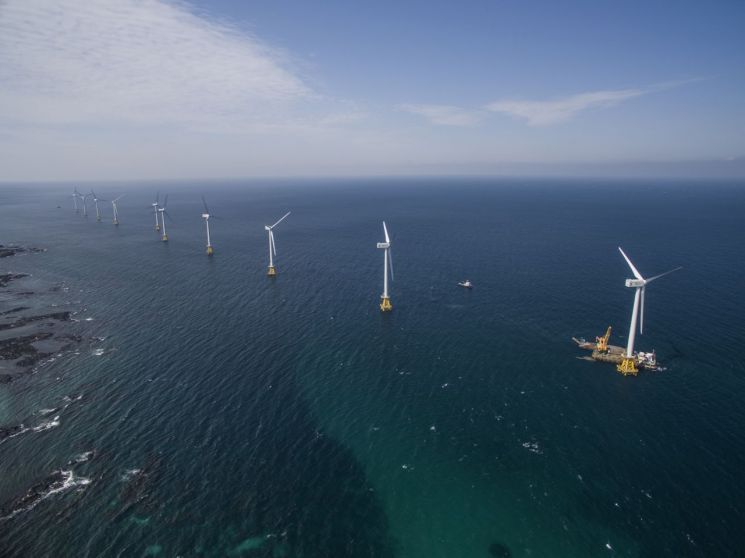
[Sejong=Asia Economy Reporter Kwon Haeyoung] In Jeju Island, renewable energy such as solar and wind power is being produced in excess of demand. The government plans to convert the surplus electricity into hydrogen and thermal energy for utilization, and transmit it to the mainland to alleviate the oversupply issue. The problem of renewable energy output limitation is expected to become a challenge that our government must solve for carbon neutrality by 2050.
According to the Ministry of Trade, Industry and Energy on the 10th, the proportion of renewable energy generation output in Jeju Island was 16.2% last year. As renewable energy facilities have increased in Jeju Island, this proportion has steadily risen from 9.3% in 2015, 13.2% in 2017, to 14.4% in 2019.
The problem is the oversupply of renewable energy power in Jeju Island. This is due to the significant increase in renewable energy facility deployment in the process of promoting the 'Carbon-Free Island 2030' initiative, which aims to meet 100% of Jeju Island's power demand with renewable energy by 2030. While power shortages cause blackouts, oversupply can also overload the power system and cause blackouts. To prevent this, the number of renewable energy output control events in Jeju Island increased significantly from 3 times in 2015 to 77 times last year. Output control leads to losses for renewable energy operators. Above all, the surplus renewable energy power issue is urgent to resolve as it could spread to all regions during the 2050 carbon neutrality implementation process.
Of course, this issue is not limited to Korea. Major overseas renewable energy countries also implement output limitations due to power oversupply. Germany implemented output control accounting for 4.36% of total wind power generation in 2016, and the UK implemented 5.64% output control.
The government is exploring various ways to utilize surplus electricity to minimize renewable energy output control in Jeju Island.
The Ministry of Trade, Industry and Energy, together with Jeju Provincial Government, plans to increase renewable energy acceptance capacity by minimizing essential operation generators, installing energy storage systems (ESS) for grid stabilization, and #1 HVDC reverse transmission, aiming to minimize output control this year. Technologies such as P2G (Power to Gas) converting surplus renewable energy to hydrogen, P2H (Power to Heat) converting it to heat, and V2G (Vehicle to Grid) using electric vehicles as ESS will be prioritized in Jeju Island to discover new flexible resources.
Lee Hohyun, Director of Energy Innovation Policy at the Ministry of Trade, Industry and Energy, said, "Since power supply and demand must be balanced at all times, controlling generators according to power demand is a common practice applied not only to renewable energy but all power plants," adding, "We will review cost-effective output control measures not only through short-term plans to minimize renewable energy output control but also through mid- to long-term compensation principles, detailed plans, and improvements in related market systems."
© The Asia Business Daily(www.asiae.co.kr). All rights reserved.
![From Hostess to Organ Seller to High Society... The Grotesque Scam of a "Human Counterfeit" Shaking the Korean Psyche [Slate]](https://cwcontent.asiae.co.kr/asiaresize/183/2026021902243444107_1771435474.jpg)
















