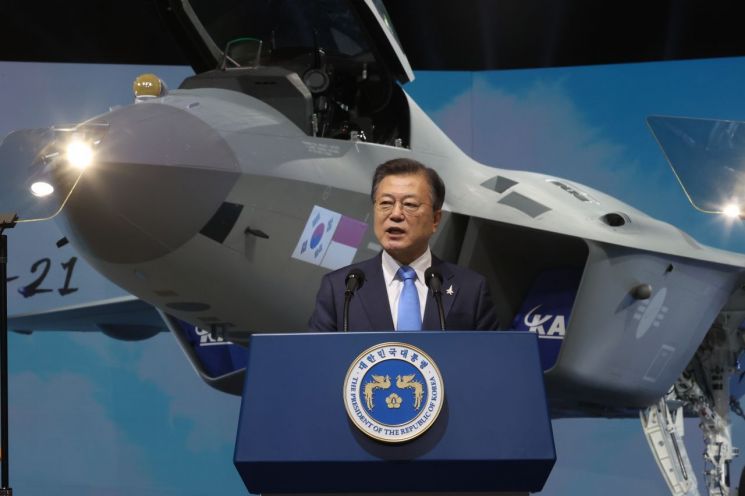
 President Moon Jae-in is delivering a commemorative speech at the Korean Fighter Jet Boramae (KF-21) prototype delivery ceremony held on the 9th at the fixed-wing division of Korea Aerospace Industries (KAI) in Sacheon, Gyeongnam. (Sacheon=Yonhap News)
[Asia Economy Yang Nak-gyu, Military Specialist Reporter] The Korean fighter jet (KF-X), which will protect the airspace over the Korean Peninsula, has finally revealed its 'complete form.' On the afternoon of the 9th, President Moon Jae-in also attended the rollout ceremony of the first KF-X prototype at the Korea Aerospace Industries (KAI) production plant in Sacheon, Gyeongnam.
Developed as a 4.5-generation fighter jet, the KF-X will replace the Air Force's aging F-4 and F-5 fighters. The KF-X system development project, including development costs of 8.6 trillion won, has a total project cost of 18.6 trillion won, making it known as the 'largest project since the founding of the armed forces.' With the completion of development, Korea will become the 13th country in the world to develop an indigenous fighter jet.
On this day, President Moon said in his commemorative speech, "The KF-21 prototype, independently developed by us, has finally revealed its dignified presence," adding, "It has set a historic milestone in the development of the aviation industry."
He continued, "Our advanced fighter jet, made with our technology, will enter full-scale mass production after ground and flight tests," and introduced, "We plan to deploy 40 units by 2028 and a total of 120 units by 2032."
However, President Moon Jae-in was not always supportive of the KF-X development. On October 30, 2015, when he was an opposition party lawmaker, he expressed negative opinions at a National Defense Committee plenary meeting, saying, "Shouldn't the KF-X project plan be reconsidered? We should review the plan, rework it, and reallocate the budget accordingly."
He also raised concerns about the U.S. not transferring core technologies, stating, "Even if individual technologies are developed, can we integrate them with the airframe? Will it take more time? Will it cost more? If necessary, will we have to import those technologies from abroad? We need to review this comprehensively. The basic premise has collapsed, but now they want to brush it off by saying 'We can develop it independently, so please proceed as is.' How can that be possible?"
At that time, even lawmakers from the ruling party, Saenuri Party, voiced opposition. Yoo Seung-min, then a Saenuri Party lawmaker, said, "Are the people spending huge budgets at the Defense Acquisition Program Administration, the Agency for Defense Development, and the Air Force deceiving even the president?"
Similarly, the late Jeong Du-eon, chairman of the National Defense Committee and also from the Saenuri Party, criticized, "The U.S. took 10 years, France 15 years, and the Eurofighter more than 10 years. What makes us so excellent that we can finish everything in just a few years?"
Opposition from national institutions regarding project feasibility was also strong. In 2003, the Korea Institute for Defense Analyses (KIDA) and in 2007, the Korea Development Institute (KDI) consecutively released research results stating the project was not feasible, which led to widespread skepticism within the military. However, in 2009, a feasibility analysis commissioned by the Defense Acquisition Program Administration to Konkuk University showed the opposite result, stating the project had 'economic feasibility,' which revitalized the project.
In December 2010, a budget of 44.1 billion won was allocated, and exploratory development was conducted from 2011 to 2012. In November 2013, the Joint Chiefs of Staff confirmed the required operational capability (ROC), deployment timing, and quantity, making the project appear to be progressing smoothly. However, in April 2015, the U.S. notified a policy of non-transfer of technology for four core pieces of equipment necessary for KF-X development: AESA (Active Electronically Scanned Array) radar, IRST (Infrared Search and Track), EO TGP (Electro-Optical Targeting Pod), and RF jammer (Radio Frequency jamming equipment), causing the project to face difficulties again. Ultimately, it was decided to develop the system integration technology for these four core devices domestically, with the possibility of seeking assistance from third countries if necessary.
© The Asia Business Daily(www.asiae.co.kr). All rights reserved.
![Clutching a Stolen Dior Bag, Saying "I Hate Being Poor but Real"... The Grotesque Con of a "Human Knockoff" [Slate]](https://cwcontent.asiae.co.kr/asiaresize/183/2026021902243444107_1771435474.jpg)
















