Protesters Loot Shops and Set Buses on Fire... Over 50 Police Injured
Opposition to Northern Ireland Protocol Introducing Customs Checks in Trade with UK
The Guardian "Political Instability Heightened Since Brexit"
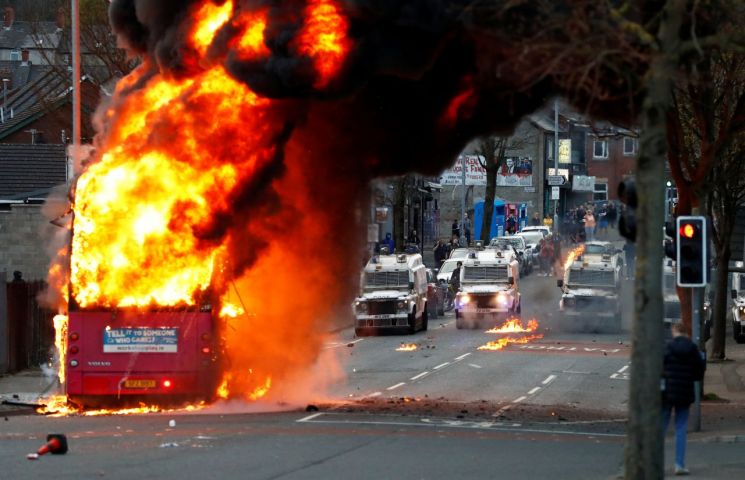
[Asia Economy Reporter Kim Suhwan] Violent protests by unionist forces advocating unity with the United Kingdom in Northern Ireland have continued for a week, causing increasing chaos with over 50 police officers injured. The large-scale protests stem from concerns that Northern Ireland's isolation will deepen following Brexit (the United Kingdom's withdrawal from the European Union (EU)).
The protests, which began on the 2nd in major cities including the capital Belfast, have continued for a week. Violent incidents occurred at the Peace Wall, which separates the residences of unionist and nationalist forces, and some protesters set fire to street trash bins and car tires and assaulted journalists.
With buses burning and looting spreading amid the protests, violence against police officers has also increased, leading to assessments that this is the worst violence in Northern Ireland in decades. The Northern Ireland police authorities held an emergency meeting recently and stated in a press release that the "(violence against police officers) is very shocking and a desperate situation."
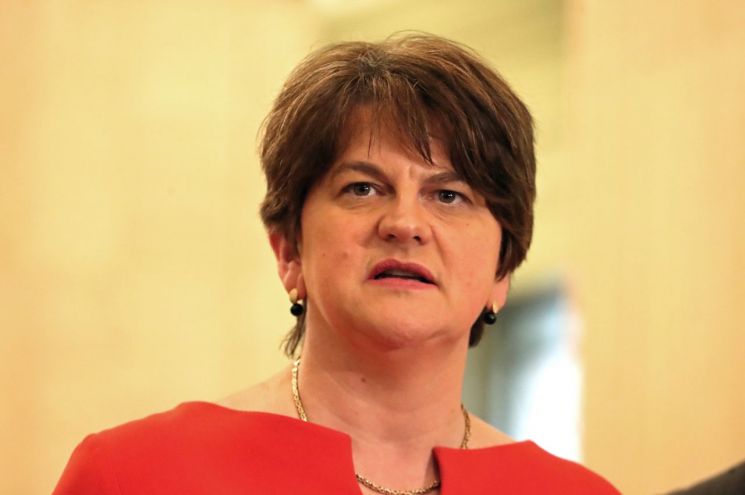
Arlene Foster, the First Minister of Northern Ireland, criticized the situation, saying, "This is not a protest but an attempted murder and acts of looting," and added, "(The protesters) cannot represent our society."
Economic Damage Concerns from Brexit Behind the Protests
Analysis suggests that the protests were initiated mainly by unionist forces. In fact, the protests occurred primarily in Derry and Newtownabbey, areas mainly inhabited by residents advocating unionism.
Since the UK officially left the European Union (EU) through the Brexit agreement at the end of last year, opposition sentiment has spread mainly among Northern Ireland's unionist forces. Northern Ireland was a region where the majority of voters chose to remain in the EU in the 2016 Brexit referendum. It is understood that Northern Ireland judged that strengthening economic exchanges with the EU would also bring significant benefits to itself.
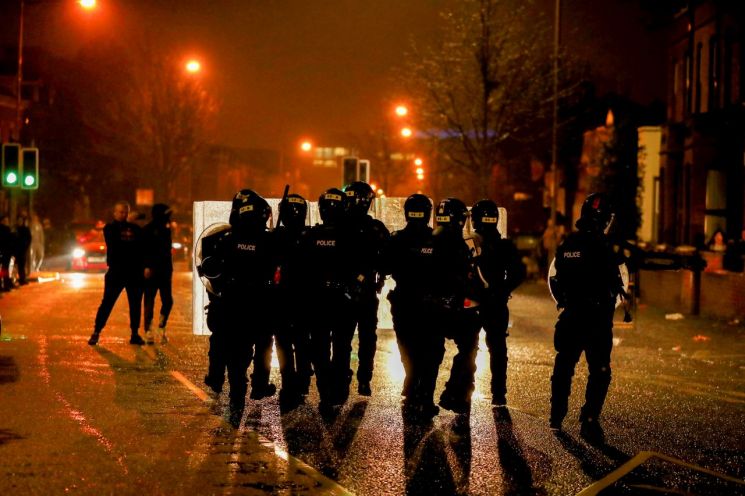 On the 7th (local time), police officers were patrolling the streets in Belfast, the capital of Northern Ireland. Belfast, UK ? Photo by Reuters
In fact, Northern Ireland has been investing EU subsidies into domestic infrastructure development. In 2019, the EU provided ?320 million (approximately 500 billion KRW) in subsidies for Northern Ireland's agriculture and fisheries industries.
However, with the UK's Brexit, Northern Ireland found itself in a difficult position after leaving the EU customs union. There were concerns that the economic benefits gained through EU subsidies and free trade would be offset.
Unionist Anger Fueled by the Northern Ireland Protocol
 On the 8th (local time), a citizen opposing the Northern Ireland Protocol held a solo protest in Belfast, the capital of Northern Ireland. Belfast, UK ? Photo by Reuters
Currently, Northern Ireland is a separate country from Ireland, but goods and people move freely between the two without customs or border checks. Northern Ireland and Ireland are economically integrated as if they were one country, contributing to the revitalization of Northern Ireland's economy.
However, the Northern Ireland Protocol, agreed upon between UK Prime Minister Boris Johnson and the EU during the Brexit negotiations, has become an obstacle again.
According to the protocol, Northern Ireland is recognized as part of the UK territory but remains in the EU single market and must comply with EU trade regulations. Consequently, all goods exported from mainland UK to Northern Ireland are subject to complex customs procedures as if they were being exported to an EU member state.
The Northern Ireland Protocol was pushed forward at the EU's request. As the UK left the EU, Northern Ireland was required to introduce strengthened customs procedures at the border with Ireland, an EU member state. However, the UK, concerned about Northern Ireland's economic downturn, pursued the 'Internal Market Act' to nullify this. The EU strongly opposed this as a violation of the withdrawal agreement, and eventually, the protocol was established as a compromise to introduce customs procedures at the Northern Ireland border.
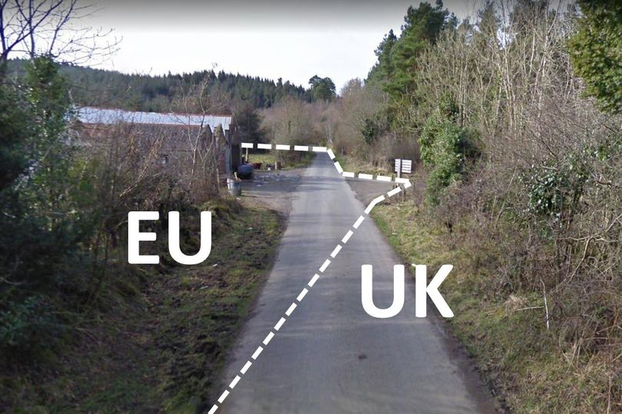 A photo that sarcastically marked Northern Ireland, part of the UK territory, as EU territory to highlight the fact that EU regulations apply there under the Northern Ireland Protocol, sparking controversy online.
 [Photo by Twitter]
As a result, Northern Ireland left the EU along with the UK but also faced trade barriers with mainland UK. This led unionists in Northern Ireland, who desire free movement with the mainland, to rebel.
Unionists, who prioritize union with the UK, expected free trade with mainland UK even after Brexit, but when this became impossible, opposition against the UK government grew. Naomi Long, Northern Ireland's Justice Minister, criticized Prime Minister Johnson, saying he was "dishonest" and "deceived the people who wanted free trade with the UK."
Government's Lukewarm Response to Separatist Forces Delivered a Final Blow to Anger
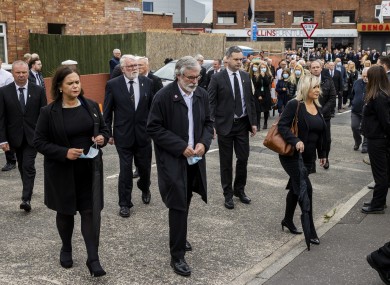 Last June, nationalist Sinn F?in party leaders in Northern Ireland, along with separatist forces, attended the funeral of Bobby Storey, a leader of the Provisional Irish Republican Army (IRA) across Ireland.
 [Photo by Twitter capture]
Furthermore, the government's lack of action regarding senior Sinn F?in officials attending the funeral of Bobby Storey, a former leader of the Irish Republican Army (IRA), in June last year added fuel to unionists' dissatisfaction. The IRA was an armed group advocating Irish nationalism that carried out terrorist acts against the UK government and Northern Ireland unionists who wanted to remain part of the UK during the 20th century.
During the COVID-19 pandemic, when the government was enforcing strict social distancing policies, hundreds gathered at the funeral, led by Sinn F?in officials, sparking calls for punishment. However, the government's failure to penalize them angered unionists, who had long harbored resentment toward Sinn F?in.
There is analysis that a diplomatic solution is essential to calm the Northern Ireland protest situation. Irish Prime Minister Miche?l Martin has called for an emergency meeting between the Northern Ireland and UK governments. Northern Ireland Secretary of State Louise Haigh said, "The current political conflict can be resolved within the political sphere."
The Guardian reported, "The current situation is worsening instability in Northern Ireland's political landscape," and warned, "If not properly resolved, it could lead to significant changes in the relationship between Northern Ireland and the UK government."
© The Asia Business Daily(www.asiae.co.kr). All rights reserved.
!["The Woman Who Threw Herself into the Water Clutching a Stolen Dior Bag"...A Grotesque Success Story That Shakes the Korean Psyche [Slate]](https://cwcontent.asiae.co.kr/asiaresize/183/2026021902243444107_1771435474.jpg)


















