Feeling Deprived by Soaring House Prices
"Housing Unaffordable, Life Feels Threatened"
But How Can They Vote for the Ruling Party?
Neoliberal Capitalism Kids
More Sensitive to Livelihood Than Ideology
"The Current Ruling Party Failed to Solve This"
Anti-Ruling Party Vote Amid Job Insecurity and Housing Crisis
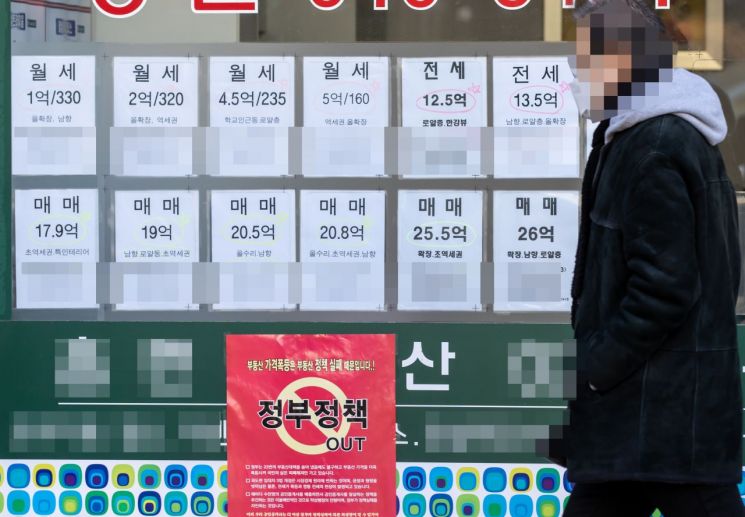
[Asia Economy Reporters Koo Chae-eun, Geum Bo-ryeong, Park Joon-yi] Kim Jung-min (32), who is active in a real estate cafe under the nickname ‘Burin-i (real estate investment beginner) who wants to keep living in Seoul,’ voted for the opposition party (People Power Party) candidate in this Seoul mayoral election. Since university, Kim has been interested in finance to the extent of participating in ‘Investment Research Club,’ ‘Real Estate Society,’ and ‘Value Investment Club,’ diligently saving and investing, but due to skyrocketing housing prices, he has been living in half-lease apartments in Seoul for 10 years. After work, he studies investment by watching economic YouTube channels like ‘Sinsa Imdang’ and joining stock-related online chat rooms. Every weekend, he visits non-regulated areas for field surveys and studies redevelopment pre-sale rights. Kim said, “The parent generation can save money and expect to own a home, but we say ‘Isaengmang’ (this life is ruined). Although I study investment hard because my salary cannot approach housing prices, I feel deep skepticism. I want to escape competition and winner-takes-all, but the current ruling party seems unable to solve this problem.”
Park Sung-hyun (29), who said, “Clothing and food can be endured, but housing is too hard,” also voted for the People Power Party candidate. The reason was ‘housing issues.’ Park, who got married last October, lives in a redevelopment apartment with a 200 million KRW deposit and 800,000 KRW monthly rent. The old apartment has rusted water and severe drafts, costing over 1 million KRW monthly including rent. Park said, “I never considered myself conservative. I just feel like my life is threatened because I can’t secure housing, and I got angry seeing rent rise and money lose value. How could I vote for the ruling party?”
Conservative? Progressive? Whatever, where is my home?
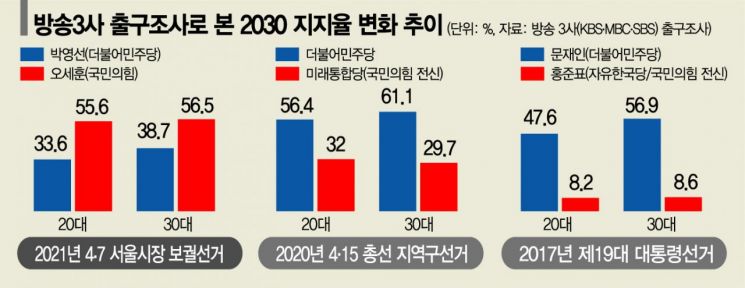
Is the ‘anger toward the ruling party’ among young people, which was clearly shown in the April 7 by-elections, really synonymous with ‘disillusionment with progressives’? First, let’s look at their voting tendencies. According to exit polls by three broadcasters for the 21st general election a year ago (for constituencies), people in their 20s supported the Democratic Party by 56.4%, and those in their 30s by 61.1%. In the 2017 presidential election, the ruling party candidate Moon Jae-in was chosen by 47.6% of people in their 20s and 56.9% of those in their 30s. This shows that the long-held belief that young people are more progressive than middle-aged groups still holds. However, in this election, the 20s and 30s gave only 33.6% and 38.7% support to Democratic candidate Park Young-sun, and 40.7% and 44.4% to the same party’s Kim Young-choon for Busan mayor.
The 2030 generation is a victim of neoliberalism’s baptism and the structure of competition and winner-takes-all, yet they have internalized it. Born between the 1980s and 2000s, they are called ‘Millennials,’ ‘MZ Generation,’ or ‘people born in the 90s.’ They are a de-ideologized and de-politicized generation, distant from factional logic like conservative-progressive conflicts. They are familiar with markets, finance, and consumption from a young age and express their desires boldly through social networking services. They sometimes call themselves ‘Janatgoe (monsters born of capitalism).’
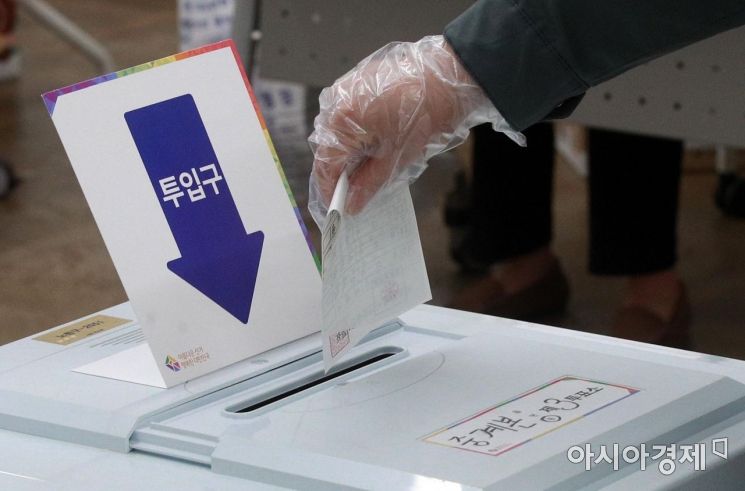 On the 7th, when the by-election was held on April 7, citizens were voting at the 3rd polling station in Junggye-bon-dong, Nowon-gu, Seoul. Photo by Hyunmin Kim kimhyun81@
They witnessed the foreign exchange crisis experienced by their parents’ generation and faced employment stagnation due to the 2008 financial crisis and the 2020 COVID-19 job crisis after graduating from university. They also saw apartment prices skyrocket due to prolonged low interest rates and abundant liquidity. This environment makes the 2030 generation sensitive to voting based on ‘their own interests,’ or ‘survivalism.’ This contrasts with those aged 40 and above in South Korea, including the ‘86 generation’ who are the mainstream of progressive parties, who have internalized the progressive-conservative framework. Political commentator Lee Jong-hoon analyzed, “Whether it’s 20-somethings who find it hard to even dream of owning a home or 30-somethings hesitating over ‘panic buying,’ they could not support the current ruling party. The 2030 generation, threatened in their very ‘survival’ by accelerated polarization, likely made choices sensitive to the advantages and disadvantages of competition and their own interests rather than factional logic.”
Especially, the core of the 2030 youth’s alienation from public sentiment lies in real estate issues. Last month, the median price of apartments sold in Seoul was 973.33 million KRW. The median price means the price exactly in the middle when all apartments sold in Seoul are lined up. The average monthly disposable income per household, meaning money available for consumption or savings, is 4.257 million KRW. This means that if one lives breathing for 20 years, they could challenge buying a median-priced apartment in Seoul. For the 2030 generation just stepping into society, Seoul apartments have become an unreachable dream. Keywords like ‘Byeorakgeoji’ (suddenly poor due to rising housing prices), ‘Yeongkkeul’ (borrowing to the soul), and ‘Bittoo’ (debt-financed investment) have come to symbolize them.
Young people chose conservatism? It’s just an analysis of ‘factional logic,’ but actually it’s a ‘livelihood hardship’ vote
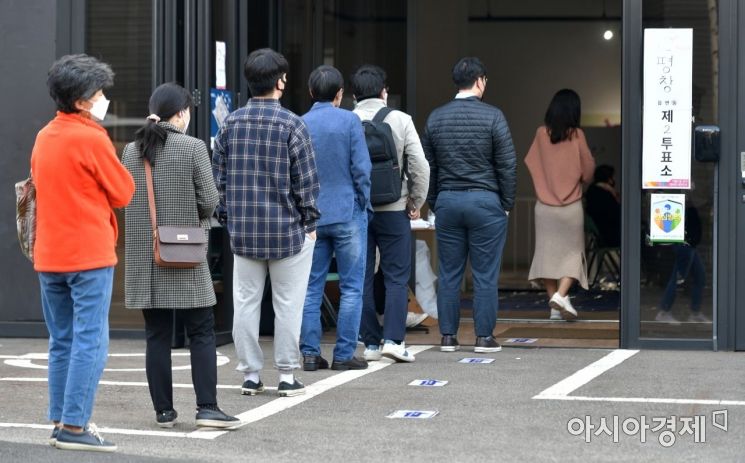 On the 7th, the day of the April 7 by-elections, citizens are lining up to vote at the Pyeongchang 2 polling station set up at Geumboseong Art Center in Jongno-gu, Seoul. Photo by Yoon Dong-ju doso7@
This analysis makes it difficult to interpret the election results as a ‘conservatism shift of the 2030 generation.’ It means that rather than a progressive-conservative framework, the reality of the young generation’s difficult life and the polarization caused by the loss of asset-building ladders have materialized as rebellion against the ‘current power (whether progressive or conservative).’ Um Kyung-young, head of the Era Research Institute, said, “The 20s today have only experienced the Democratic Party and Moon Jae-in government,” adding, “It can be seen as venting anger at the Democratic Party without evaluating past conservative parties.” Professor Kim Yoon-tae of Korea University’s Sociology Department diagnosed, “The 2030 generation is not a group strongly affiliated with a specific party and cannot be simply described as progressive or conservative. Rather, they expressed dissatisfaction toward the ruling party because the current government failed to solve youth employment insecurity and housing difficulties.” Professor Park Sang-chul of Kyonggi University’s Graduate School of Political Studies also said, “Whether progressive or conservative parties, they will gain the youth’s choice only when they politically respond to the voices of young people.”
© The Asia Business Daily(www.asiae.co.kr). All rights reserved.



















