Previous Day Trading Value 16.834 Trillion KRW
Increased Trading Volume Raises Expectations for Box Range Breakout
Supported by Stable Interest Rates and Exchange Rates
Foreign Capital Inflow for 6 Consecutive Trading Days
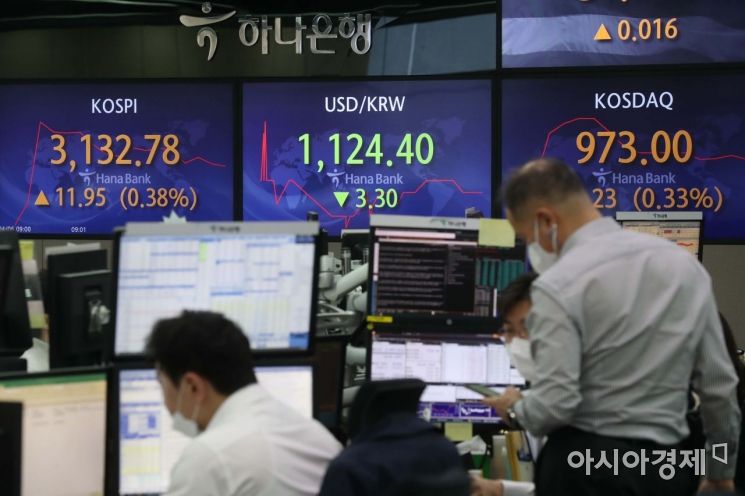 On the 6th, dealers are working in the dealing room of Hana Bank in Euljiro, Seoul. On this day, the KOSPI index started at 3,123.80, up 2.97 points (0.10%) from the previous trading day, showing an upward trend. Photo by Moon Honam munonam@
[Asia Economy Reporter Junho Hwang] The KOSPI trading value recorded its highest level in over a month. Trading volume also increased, raising the possibility of breaking out of the box range. This is the result of individual and foreign investors steadily injecting funds as concerns over interest rate hikes disappear and the exchange rate stabilizes. As market investment sentiment (investor sentiment) recovers, there is a growing outlook that it is necessary to closely monitor the impact of Bitcoin price adjustments and the sharp rise in domestic COVID-19 cases on the stock market.
Trading Value on the 8th: 16.834 Trillion KRW
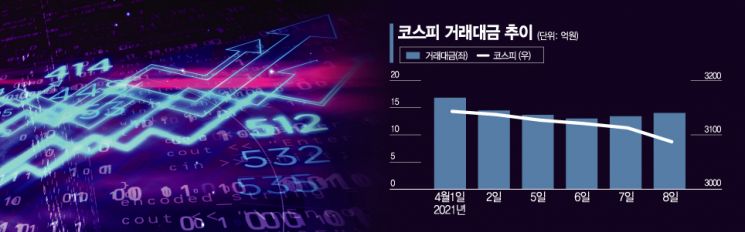
According to the financial investment industry on the 9th, the KOSPI trading value on the previous day was recorded at 16.834 trillion KRW, the highest in 27 trading days since February 26. The average daily trading value this month is about 13.7 trillion KRW. Trading volume (as of the 7th) also reached 1.98477 billion shares, the highest level since March 3 last month.
This is the result of easing concerns over possible interest rate hikes, which had been the biggest factor weakening investor sentiment since the beginning of the year. The yield on the U.S. 10-year Treasury note fell from 1.743% at the end of last month to 1.6289% on the 9th, stimulating investor sentiment. Rising market interest rates tend to prompt base rate hikes. When the base rate increases, liquidity shrinks, reducing funds flowing into the stock market and exerting downward pressure.
In early February, following U.S. President Biden’s announcement of a large-scale fiscal policy, market interest rates rose due to increased inflation expectations. However, the Federal Reserve, the U.S. central bank, has focused its monetary policy on resolving employment instability caused by COVID-19, leading to interest rate stabilization.
The stabilization of the exchange rate is also positively affecting the stock market. Due to strong export recovery in sectors excluding semiconductors last month, the KRW-USD exchange rate dropped from 1,126 KRW at the end of last month to 1,116 KRW on the 8th.
Ahn Jaekyun, a researcher at Korea Investment & Securities, said, "We expect U.S. bond yields to stabilize downward in the second quarter of this year," adding, "There is also a possibility that the U.S. 10-year Treasury yield will fall below 1.6% during the second quarter."
Foreign Investors’ Net Buying for 6 Consecutive Trading Days

As the attractiveness of risk assets increases, foreign capital has been continuously flowing in since the beginning of this month. Foreign investors have net purchased 2.3465 trillion KRW this month, maintaining net buying for six consecutive trading days. This is the longest net buying streak since 13 consecutive trading days in November last year. At that time, the inflow of foreign capital led the KOSPI to an upward trajectory and served as a catalyst for reaching 3,000 points earlier this year.
This return of foreign investors is creating a virtuous cycle that brings individual investors back to the stock market. On the 8th, individuals net purchased 320.3 billion KRW, the highest level this month. This contrasts with the 926.9 billion KRW sold in a single day on the 2nd.
Seo Sangyoung, a researcher at Mirae Asset Securities, forecasted, "Considering the rise in international oil prices and the weak dollar (strong KRW), the improvement in foreign investor demand is expected to continue." Choi Yujun, a researcher at Shinhan Financial Investment, analyzed, "Although the increase in domestic COVID-19 cases to 700 (as of the 8th) may pose a burden on the stock market, it is also important to closely watch whether individual trading volume increases due to recent Bitcoin price adjustments."
© The Asia Business Daily(www.asiae.co.kr). All rights reserved.



















