Government Meets Industry After Four Months of Supply Crisis
Semiconductor Industry's Proposals Flood the Meeting
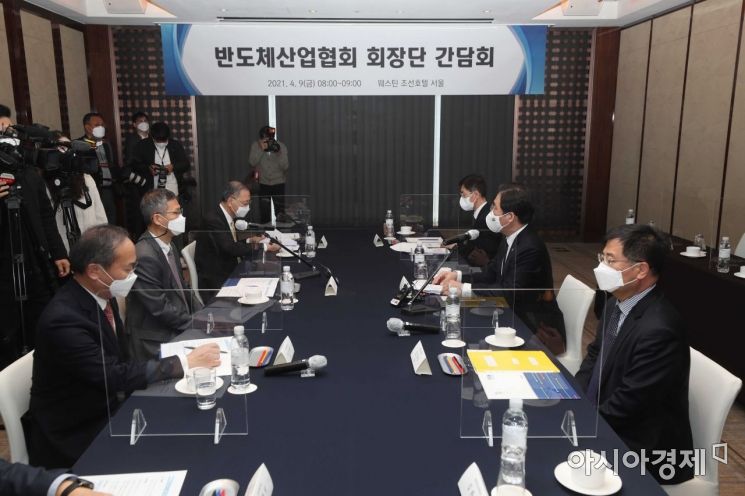 Sung Yun-mo, Minister of Trade, Industry and Energy (center right), is speaking about semiconductor support measures at the Semiconductor Industry Association Chairman's Meeting held on the 9th at the Westin Chosun Hotel in Jung-gu, Seoul. Photo by Moon Ho-nam munonam@
[Asia Economy Reporters Heungsun Kim and Hyunjin Jung] Amid the semiconductor shortage crisis originating from the United States impacting the domestic industry, both the public and private sectors have agreed that South Korea, as a global semiconductor production hub, must contribute to the global economic recovery through stable supply and also strengthen efforts to pioneer new markets such as next-generation power semiconductors and artificial intelligence (AI) semiconductors.
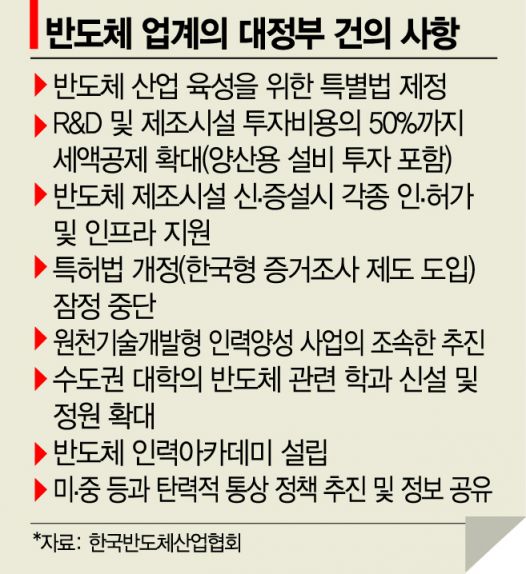
At a meeting held on the morning of the 9th, chaired by Sung Yun-mo, Minister of Trade, Industry and Energy, semiconductor company CEOs requested the government to focus on four major areas for the development of the semiconductor industry: ▲expanding tax credit incentives for manufacturing facility construction ▲training and supplying excellent talent ▲stabilizing the domestic semiconductor supply chain ▲trade support aligned with rapidly changing international circumstances. In particular, the industry emphasized the urgent need to enact a 'Special Act for the Promotion of the Semiconductor Industry' to ensure the effectiveness of such a 'package support plan.'
Government Also Agrees on the Need for 'Talent Development'
"Labor Shortage Hampers Industry"
Requests for Establishing and Expanding Semiconductor Departments
During the meeting, the government and the semiconductor industry reached a consensus on the necessity of talent development. Lee Jung-bae, who began his term last month as chairman of the Korea Semiconductor Industry Association and is also a Samsung Electronics executive, stressed, "For the sustainable development of the semiconductor industry, a comprehensive government-level support system for semiconductor workforce training is essential." Lee Seok-hee, CEO of SK Hynix, also noted, "Discussions mainly focused on workforce training."
The Semiconductor Industry Association proposed to the government measures to expand science and engineering personnel by establishing new semiconductor-related departments and increasing enrollment quotas at universities in the Seoul metropolitan area, as well as creating and expanding semiconductor-related computer and software (SW) departments. They also urged the prompt implementation of the ‘Source Technology Development-Oriented Workforce Training Project’ targeting graduate students in master's and doctoral programs to cultivate research personnel. Establishing a ‘Semiconductor Workforce Academy’ specializing in practical training to address labor shortages in small and medium semiconductor companies was also suggested as an alternative.
There were also calls for bold government support to build additional domestic semiconductor manufacturing facilities. The Semiconductor Association’s leadership repeatedly requested expanding tax credits to cover up to 50% of research and development (R&D) and manufacturing facility investment costs.
Additionally, detailed proposals included ▲support for various permits and infrastructure such as power, water supply, and wastewater treatment facilities when constructing or expanding semiconductor manufacturing facilities ▲investment and infrastructure support for silicon and next-generation power semiconductor manufacturing facilities ▲flexible application of related laws such as the Chemical Substances Control Act and the Serious Accidents Punishment Act that regulate semiconductor manufacturing facility construction and operation ▲ensuring sufficient supply and usage systems for renewable energy to achieve carbon neutrality ▲and establishing strategic development programs to build a foundation for next-generation power semiconductor manufacturing.
It was also added that the government should actively communicate with the U.S. and Chinese governments, which dominate semiconductor hegemony, to promote trade policies that allow domestic semiconductor companies to focus on stable business operations.
Intensifying International Competition in the Semiconductor Industry
Calls for Whole-of-Government Support
Emphasis on the Need for Effective Legislation
The reason the public and private sectors have belatedly come together to devise countermeasures is that amid the recent global semiconductor supply chain restructuring, competing countries such as the United States, China, and Japan are aggressively securing leadership by leveraging massive government support. Facing a situation where the semiconductor industry has escalated into a competition for hegemony among nations, the domestic semiconductor industry is requesting support to survive against global companies.
The Biden administration in the United States, emphasizing supply chain security following the semiconductor shortage caused by COVID-19, is focusing on attracting production facilities back to the country. In particular, it has established strong incentive policies such as a 40% tax exemption on semiconductor facility investments. On this day, White House Press Secretary Jen Psaki stated, "The government as a whole is focusing at the highest level on this issue (semiconductor chip shortage)" and added, "We plan to meet with U.S. companies on the 12th to discuss this."
Besides the U.S., China has declared its so-called 'Semiconductor Rise,' aiming to increase its semiconductor self-sufficiency rate to 70% by 2025, pushing forward investments worth approximately 170 trillion won. The European Union (EU) has also recognized the growing need for semiconductor independence and decided to support semiconductor manufacturing technology development projects exceeding 67 trillion won.
Within the industry, there is a strong voice emphasizing the importance of enacting a special law. Considering that the semiconductor industry requires whole-of-government support and that the competition is with global companies rather than domestic ones, there is a judgment that legislation is necessary to accelerate policy speed and effectiveness.
An industry insider said, "To implement tax credits, infrastructure support, and establish semiconductor-related departments for talent development, not only national support but also consensus among related ministries is required," adding, "To ensure these policies are effective, enacting a Special Act for the Promotion of the Semiconductor Industry is absolutely necessary."
© The Asia Business Daily(www.asiae.co.kr). All rights reserved.
![From Bar Hostess to Organ Seller to High Society... The Grotesque Con of a "Human Counterfeit" [Slate]](https://cwcontent.asiae.co.kr/asiaresize/183/2026021902243444107_1771435474.jpg)

















