4000 Locations, 400 More Added in Q1
Ice Cream Discount Store Sales Increase
Convenience Stores Say "Price Tag System Should Be Expanded Further"
[Asia Economy Reporter Lim Hye-seon] Since the COVID-19 pandemic made non-face-to-face interactions a daily routine, unmanned ice cream discount stores have rapidly emerged as one of the major distribution channels. After expanding their product range with various processed foods, these stores have gained price competitiveness due to the absence of separate labor costs, gradually encroaching on the convenience store market.
4,000 Ice Cream Discount Stores
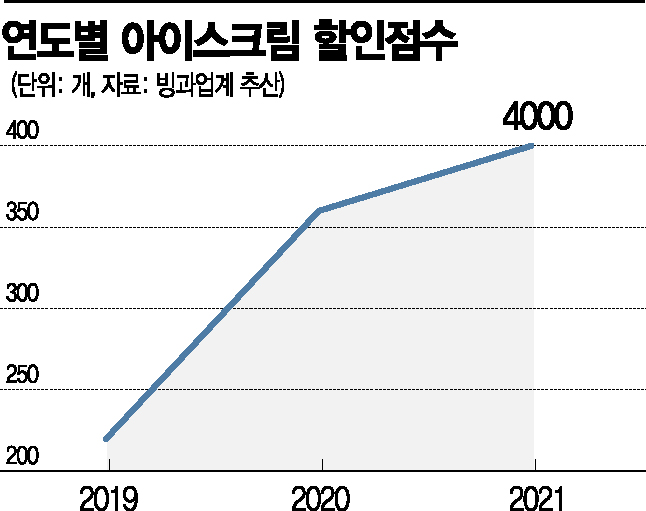
According to the ice cream industry on the 9th, the number of ice cream discount stores is currently estimated at 4,000. The number of discount stores is rapidly increasing. It rose from 2,200 in 2019 to 3,600 last year, with an additional 400 opening in the first quarter of this year alone.
The share of ice cream discount stores in the ice cream industry's sales is also increasing. For Binggrae, the sales proportion from ice cream discount stores grew from 8.4% in 2019 to 14.0% last year, the only distribution channel to show growth. Meanwhile, convenience stores decreased from 29.5% to 27.4%. Lotte Confectionery also saw its discount store sales share exceed 10% for the first time. Currently, the sales share by distribution channel for ice cream companies is highest in general retail stores (50%), followed by convenience stores, ice cream discount stores, SSM, and marts.
An industry insider explained, "Since the COVID-19 outbreak, consumers have preferred non-face-to-face services, leading to a significant increase in sales through online sales and unmanned ice cream discount stores." Binggrae and Lotte Confectionery, the two major players in the ice cream industry, each saw about a 10% growth in ice cream sales last year compared to the previous year.
Controversy Over Similar Convenience Stores
Unmanned ice cream discount stores have low initial investment costs (around 50 million KRW) and management costs (unmanned systems), making it easy to cross the startup threshold. They are also advantageous in store management. No staff is needed, and sales representatives from each ice cream company manage the freezers, restocking inventory as needed. A discount store official explained, "With low management costs, we reduced distribution margins and lowered product prices," adding, "Ice cream prices at discount stores are around 400 to 500 KRW." The supply price from ice cream companies to distribution channels ranges from 250 to 400 KRW.
Convenience stores point out that the proliferation of ice cream discount stores is fueling excessive competition. The convenience store industry established a voluntary agreement in 2018 to limit nearby store openings and prevent oversaturation. However, the rapid increase of ice cream discount stores, which resemble convenience stores, is undermining the purpose of this voluntary agreement.
A convenience store official stated, "Ice cream prices have always been inconsistent, but competition between distribution channels could erode consumer price trust," and argued, "The price monitoring system should be expanded further." Ice cream companies have been expanding the price monitoring system items since 2019 to enhance price reliability. The price monitoring system requires prices to be displayed and sold at the indicated prices. Currently, most ice creams on the market lack price tags, and discount rates vary by distributor. Although the open price system was abolished, recommended retail price labeling remains a recommendation, so final prices are still set by the sellers.
If the price monitoring system expands, the competitiveness of ice cream discount stores may decline. An ice cream discount store official said, "If the monitoring system is fully implemented, the price advantage, which is the discount store's strength, will disappear," adding, "We need to develop competitiveness that can survive even without the discount store label."
© The Asia Business Daily(www.asiae.co.kr). All rights reserved.

















