Evolving into a "Second Home"... Nursing Facilities
Elderly residents at a nursing home in Chungnam A embark on joyful memory trips every month. As outdoor activities became difficult due to COVID-19 and other factors, leading to increased feelings of depression, the nursing home planned a cognitive reminiscence program to help residents recall past memories. The elderly wore school uniforms and took photos against classroom backgrounds or enjoyed classic movies together, revisiting happy moments from their past. This memory trip also helped them regain vitality in their daily lives. The nursing home plans to continue operating this program while continuously developing customized programs to improve the quality of life for its elderly residents.
Nursing facilities are changing. Shedding the past stigma of being a "modern-day Goryeojang," they are transforming into a "second home" with high-quality medical services, strengthened management, and systematic care programs.
According to the Ministry of Health and Welfare on the 9th, in the first-ever public nursing hospital operation evaluation conducted last year, a total of 32 hospitals scored an average of 77 out of 100 points. In an evaluation involving research institutions and civic groups, 10 hospitals received the highest grade for providing services through connections with other local institutions, and 18 hospitals were rated excellent. None were rated as "inadequate."
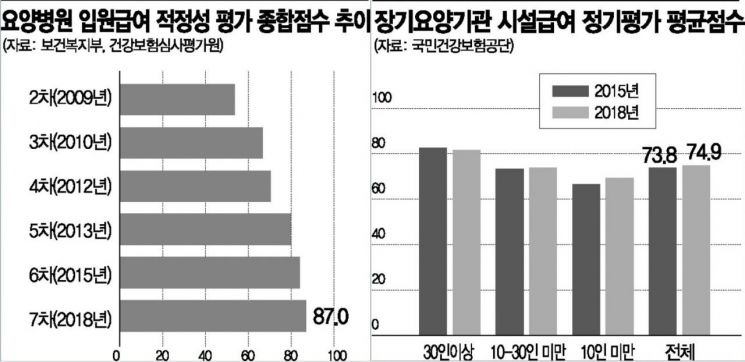
Indicators reflecting the service level of nursing facilities have been steadily improving. The Ministry of Health and Welfare and the Health Insurance Review & Assessment Service have conducted appropriateness evaluations of inpatient benefits at nursing hospitals since 2008, clearly confirming improvements in medical services. The comprehensive score, which was 53.5 points in the second evaluation in 2009, rose by 62.6% to 87 points in the seventh evaluation in 2018. This improvement is attributed to securing additional full-time medical staff and enhancing the quality of medical care, which improved the daily living abilities of inpatients. The regular evaluation scores for facility benefits at long-term care institutions such as nursing homes, conducted by the National Health Insurance Service, also increased by 1.1 points to 74.9 in 2018 compared to the previous evaluation in 2015. The "beneficiary rights protection" area, which assesses whether institutions provide services respecting individuals, saw an increase of 1.6 points in the raw score.
In particular, efforts to raise emotional satisfaction by providing various programs for inpatients, beyond facility improvements, are notable. One example is the Incheon Yerang Nursing Home, which operates a silver sports program for one hour each week. Elderly residents gather to participate in simple exercises like ring toss and more uncommon sports activities such as curling, feeling revitalized. In addition to silver sports, this nursing home offers various customized programs including singing and horticulture classes, as well as brain and cognitive programs. At Gimhae Veterans Nursing Home, a resident self-governing committee is operated, and the opinions from the committee are actively used to improve nursing home services. A representative from a nursing home in Gyeonggi Province said, "Through our own programs, not only does the satisfaction of admitted elderly increase, but as word spreads, the number of discharges decreases and the facility’s popularity rises, achieving a win-win effect."
In response to the COVID-19 pandemic that began last year, some facilities have strengthened infection control systems to address vulnerabilities. Jeongae-won, an elderly nursing facility located in Pohang, expanded disinfection and divided the facility into five zones to prohibit movement between them in line with the COVID-19 situation last year. Additionally, they implemented measures to alleviate concerns of family members due to visitation bans by using apps that allow real-time monitoring of the elderly residents’ conditions.
Ki Pyung-seok, president of the Korean Association of Nursing Hospitals, stated, "We are continuously discussing various measures to improve the quality of life for inpatients, including medical services."
© The Asia Business Daily(www.asiae.co.kr). All rights reserved.

















