Minister Sung Yun-mo of the Ministry of Trade, Industry and Energy and Semiconductor Association Chairmen Meeting
Responding to the Expanding US 'Semiconductor Rise'... Industry Proposes Enactment of a Special Act for Semiconductor Industry Development
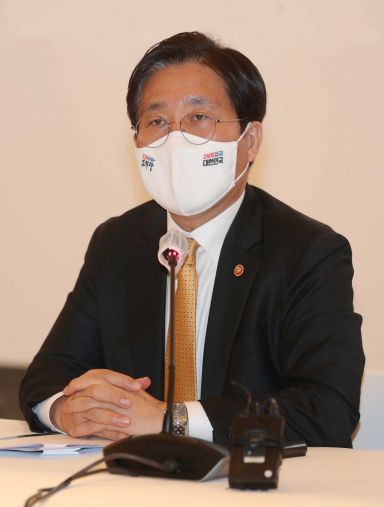 Sung Yun-mo, Minister of Trade, Industry and Energy, is speaking at the "White Bio Solidarity Cooperation Council Launch Ceremony" held on the 2nd at the Grand Hyatt Seoul in Yongsan-gu, Seoul. Photo by Moon Ho-nam munonam@
[Sejong=Asia Economy Reporter Kwon Haeyoung] The government will announce the 'K-Semiconductor Belt Strategy' next month, which includes expanding investment tax credits and support measures for the domestic semiconductor industry. This is to fully support Korean semiconductor companies such as Samsung Electronics and SK Hynix, which possess world-class competitiveness, in response to the 'semiconductor rise' efforts by countries including the United States, which is reorganizing the global semiconductor supply chain.
On the 9th, Sung Yun-mo, Minister of Trade, Industry and Energy, held a meeting with the Semiconductor Association chairpersons at the Westin Chosun Hotel in Sogong-ro, Jung-gu, Seoul, and announced plans to present comprehensive semiconductor support measures. Industry representatives attending included Lee Jung-bae, Chairman of the Semiconductor Association (Executive Vice President of Samsung Electronics), Lee Seok-hee, President of SK Hynix, Choi Chang-sik, Vice Chairman of DB HiTek, Heo Yeom, Chairman of Silicon Mitus, and Lee Chang-han, Vice Chairman of the Semiconductor Association.
Minister Sung stated, "At the government level, we are preparing a strategy to establish Korea as the world's leading advanced semiconductor manufacturing global factory and to leap forward as a comprehensive semiconductor powerhouse," adding, "We will reflect industry requests and establish comprehensive policies that can provide practical help to strengthen our semiconductor industry ecosystem, which will be announced soon."
The K-Semiconductor Belt Strategy to be unveiled next month will include expanding incentives such as investment tax credits and regulatory rationalization. It will also encompass various support measures including infrastructure support for power and water, research and development (R&D) investment, and workforce training. Currently, the tax credit for facility investment is up to 6% for large corporations, but the industry is requesting an expansion to 50%.
Currently, governments worldwide, including the Biden administration in the United States, are rolling out semiconductor industry promotion policies. The U.S. is leading the semiconductor rise by expanding the tax credit for semiconductor manufacturing equipment investment costs to 40%. Europe is investing 50 billion euros, and China is exempting corporate taxes.
Before the meeting, the semiconductor industry unusually submitted an 'Industry-to-Government Proposal for the Development of the Semiconductor Industry,' requesting full support. The proposal included expanding R&D and manufacturing facility investment tax credits to 50%, nurturing and supplying excellent talent to lead the semiconductor super-gap, supporting the stabilization of the domestic semiconductor supply chain, and actively responding to the rapidly changing international situation surrounding the semiconductor industry. They also requested the enactment of a 'Special Act for Semiconductor Industry Promotion.'
During the meeting, the government and semiconductor industry focused on discussing issues and countermeasures related to the global semiconductor supply chain. They shared recent major trends such as the global semiconductor supply shortage and major countries' semiconductor industry promotion policies, and exchanged opinions on future responses including domestic investment expansion and government support measures.
Minister Sung emphasized, "Recently, the semiconductor industry faces competition not only between companies but also between countries, so it is time for the government and the private sector to join forces to overcome the current crisis," adding, "To build a stable supply chain including expanding memory and foundry production capacity, active private investment expansion and solidarity and cooperation to revitalize the industrial ecosystem are necessary."
© The Asia Business Daily(www.asiae.co.kr). All rights reserved.

















