Conflict Arises Over Blocking Ground-Level Sidewalk Access in Apartment Complex
Most Domestic Apartment Parking Lots Lower in Height Than Delivery Vehicles
Concerns Over Worsening Working Conditions for Delivery Workers
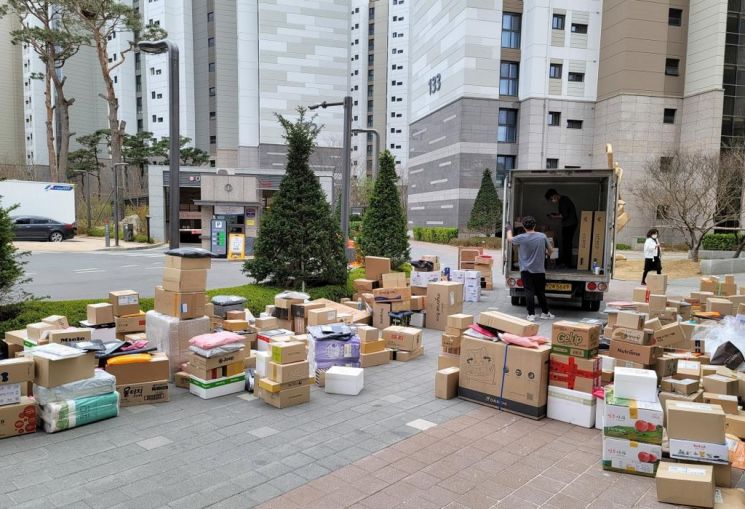 On the 2nd, delivery boxes were piled up at the back gate of an apartment complex in Gangdong-gu, Seoul. / Photo by Yonhap News
[Asia Economy Reporter Lim Juhyung] Recently, conflicts have deepened between apartment management and delivery drivers as some apartments in Seoul have blocked delivery vehicles from entering the complexes. Some voices suggest that residents should directly discuss and reach a compromise with delivery drivers.
On the 1st, the residents' representative organization of an apartment complex in Gangdong-gu, Seoul, issued a ban on delivery vehicles entering the ground-level sidewalks. This decision was made due to concerns that vehicles traveling on the sidewalks could cause facility damage and safety accidents. As a result, delivery drivers have been leaving packages at the apartment entrances, causing a pile-up of delivery items in front of the entrances.
Residents are asking for cooperation in controlling access for safety reasons. According to an official document, "Please be informed that from the 1st, entry of delivery vehicles on the ground floor is completely restricted," emphasizing that "the ground-level sidewalks are for pedestrian use, not for vehicles. Continuous damage to facilities caused by delivery vehicles has been occurring."
Residents explained, "(The restriction on delivery vehicle access) is merely a refusal of transportation that does not comply with entering the underground parking lot," and added, "Please be aware that the delivery companies and drivers were sufficiently notified in advance that entry is possible through the underground parking lot."
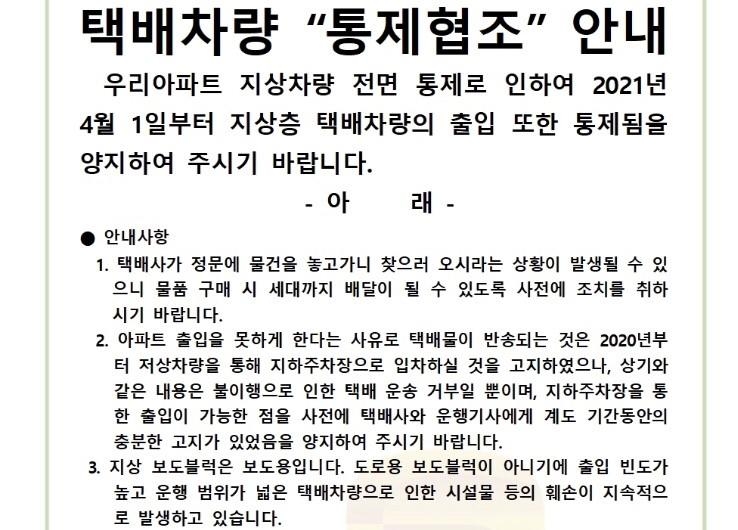 Notice Prohibiting Delivery Vehicles from Entering Ground-Level Walkways within Apartment Complexes. / Photo by Yonhap News
However, delivery drivers claim that using the underground parking lot is practically impossible. Most standard delivery trucks, known as 'topcha,' have a height of about 2.5 meters. In contrast, the height limit for underground parking entrances is 2.3 meters, making it impossible for typical topcha trucks to enter.
Previously, the government amended the Housing Act in 2019 to raise the effective height of underground parking to 2.7 meters. However, apartments built before the amendment still have underground parking heights of 2.3 meters.
There is an option to modify or replace topcha trucks with low-floor vehicles, but since delivery drivers are classified as special employment workers, all such costs must be borne by the drivers themselves. This is why some apartment complexes' requests to change trucks cannot be fulfilled.
There are also concerns that low-floor vehicles worsen delivery drivers' working conditions. A netizen who identified as a former delivery driver wrote on the online community 'Bobaedream' that "working with vehicles that can enter underground parking requires constantly bending over while carrying packages," adding, "This causes tremendous stress and physical exhaustion."
Given this situation, delivery drivers leave packages at the apartment complex entrances and then leave instead of transporting them through the underground parking. Residents have to come out to the entrance to move the packages themselves, causing inconvenience. To reduce discomfort and minimize conflicts, a solution between apartment residents and delivery drivers is necessary.
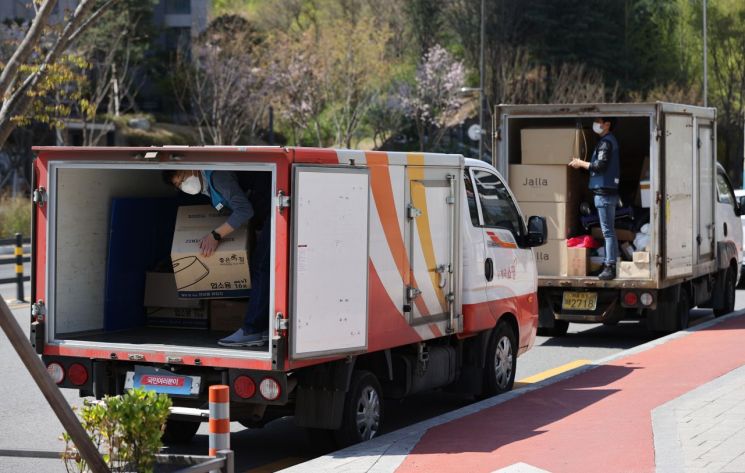 On the morning of the 8th, delivery workers participating in the press conference of the National Courier Workers' Union of the Korean Confederation of Trade Unions Service Federation compared regular delivery vehicles with low-floor delivery vehicles. / Photo by Yonhap News
This situation also occurred in 2018. At that time, when some apartment complexes in the metropolitan area banned delivery vehicles from entering ground-level areas, delivery drivers and companies protested by stopping delivery services or ceasing doorstep deliveries, leading to a delivery crisis.
As conflicts between residents and delivery drivers continue, some voices call for compromise. Last year, in an apartment complex in Yeonsu-gu, Incheon, residents and delivery drivers negotiated and reached a compromise on ground-level pedestrian usage times and accessible roads.
In October 2018, when the first apartment delivery crisis occurred, an apartment in Dasan New Town, Namyangju, Gyeonggi Province, resolved conflicts by adopting a so-called 'hub delivery' method, where deliveries were made to specific locations inside the apartment complex.
© The Asia Business Daily(www.asiae.co.kr). All rights reserved.
!["I'd Rather Live as a Glamorous Fake Than as a Poor Real Me"...A Grotesque Success Story Shaking the Korean Psyche [Slate]](https://cwcontent.asiae.co.kr/asiaresize/183/2026021902243444107_1771435474.jpg)


















