'Vegetarianism' Established as a Trend Beyond Preference
Seoul Schools Designate 'Vegetarian Meal Days' Twice a Month
Experts Say "Increasing Number of People Empathize with Eco-Friendly Consumption"
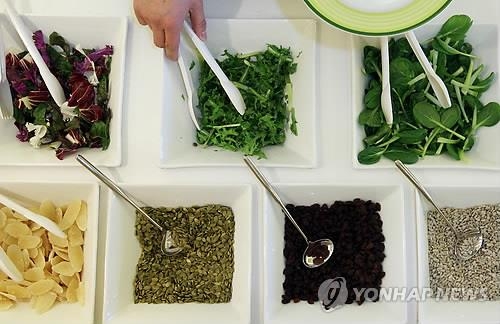
[Asia Economy Reporter Kang Juhee] # Office worker Park Mo (29) recently started "intermittent vegetarianism." She sets two "vegetarian days" a week and cooks meals without meat. Park said, "Since I started vegetarianism, the symptoms of indigestion have improved a lot," adding, "I feel very satisfied because I can care for the environment a bit more and maintain my health through moderate vegetarianism." She especially enjoys posting her cooked dishes on social media (SNS) and sharing recipes.
Recently, the number of people practicing intermittent vegetarianism like Park has been increasing. Amid the global crisis brought on by COVID-19, the trend toward safe and healthy food and eco-friendly consumption has become more than a preference?it has established itself as a consumer trend.
In particular, the number of "flexitarians" (flexible+vegetarian), who combine meat consumption with vegetarian meals rather than eating only vegetarian food, is growing. Strict vegetarianism involves practical constraints and difficulties, so people consume meat flexibly depending on the situation. According to the Korea Vegetarian Union, the domestic vegetarian population was estimated at 1.5 million last year. This is a tenfold increase compared to about 10 years ago in 2008 (150,000 people).
Reducing meat consumption is known as the easiest way to reduce greenhouse gas emissions in daily life. The United Nations (UN) Food and Agriculture Organization (FAO) identified "meat eating" as a major cause of climate change in 2006. According to this, livestock farming emits 18% of global greenhouse gases, which is higher than the 13.5% emitted by all global transportation. In other words, the more meat consumption is reduced and vegetarianism increased, the more greenhouse gas emissions can be reduced.
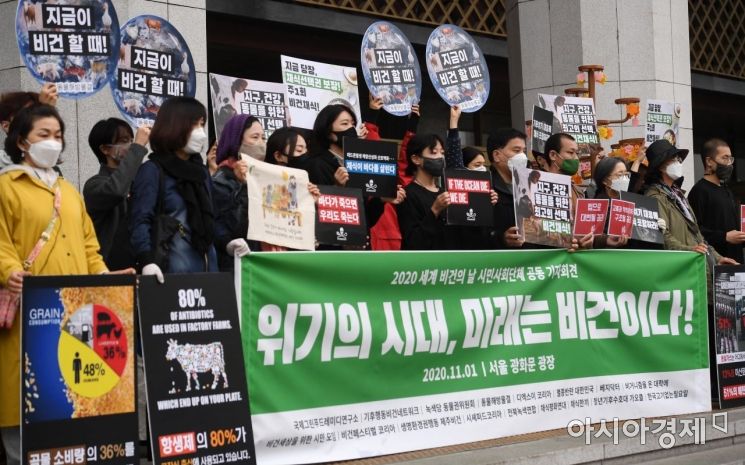 Members of civic groups including Animal Liberation Wave held a press conference last November in front of Sejong Center for the Performing Arts in Jongno-gu, Seoul, urging participation in vegan diets for climate and environmental reasons. Photo by Kim Hyun-min kimhyun81@
Influenced by this social trend, the domestic vegetarian-related market is also growing. The number of restaurants specializing in vegetarian food has increased, and even franchise cafes and fast-food outlets sell vegetarian sandwiches and vegetarian hamburgers.
Choi Mo, a 20-something office worker who identifies as a flexitarian, said, "With the increase in non-face-to-face activities, I naturally ate a lot of delivery food, but I felt that continuing this lifestyle would harm my health, so I started intermittent vegetarianism as a way to change my habits." He explained, "Rather than strictly forcing vegetarianism, adjusting my diet as much as I can seems to be a way to maintain vegetarianism longer."
Local governments are also introducing various systems and policies to support vegetarianism. The Seoul Metropolitan Council discovered 948 vegetarian restaurants in Seoul in January and published them online. On the 5th, it designated "Vegetarian Day," the first of its kind in a national council. It also passed a "Vegetarian Ordinance" aimed at creating an environment where vegetarian options are available anytime and anywhere in Seoul.
 Ulsan Metropolitan Office of Education produced a video about vegetarian meals on the 26th of last month and released it on YouTube.
 Photo by Ulsan Office of Education
Public education institutions such as schools are also increasingly recommending vegetarian meals. According to the Seoul Metropolitan Office of Education on the 8th, all schools in Seoul will implement "vegetarian meals" twice a month starting this month.
This was prepared with the intention of protecting the environment by reducing meat consumption, as excessive meat-centered eating habits have been identified as a cause of the climate crisis. Accordingly, schools in Seoul will operate "Green Meal Days" twice a month starting this month, and some schools will pilot a vegetarian option system by installing "Green bars."
Not only Seoul but also many education offices in Incheon, Chungbuk, Gyeongnam, Ulsan, and others are already implementing intermittent vegetarianism or encouraging vegetarian meals.
Experts predict that the vegetarian culture will grow further as more people empathize with ethical and eco-friendly consumption.
Lee Wonbok, representative of the Korea Vegetarian Union, said, "In the past, there was a belief that vegetarianism had to be strictly followed, but recently, more people enjoy vegetarianism flexibly according to their circumstances." He explained, "The increase in pet owners and growing concerns about the climate crisis have led more people to consider safe and eco-friendly food. In that process, vegetarianism is emerging."
He added, "The climate crisis caused by greenhouse gases cannot be solved without addressing what we use daily, especially meat consumption," emphasizing, "I believe it is more important that the overall number of people aiming for vegetarianism increases rather than just one vegan."
© The Asia Business Daily(www.asiae.co.kr). All rights reserved.



















