485 Cases in the Seoul Metropolitan Area, Daejeon, Ulsan, Busan, etc. on 'Emergency Alert'
Weight on 'Escalation' in Social Distancing Adjustment Announcement on the 9th
Minimal Effect of Strengthened Quarantine Measures... "Macroscopic and Comprehensive Measures Needed"
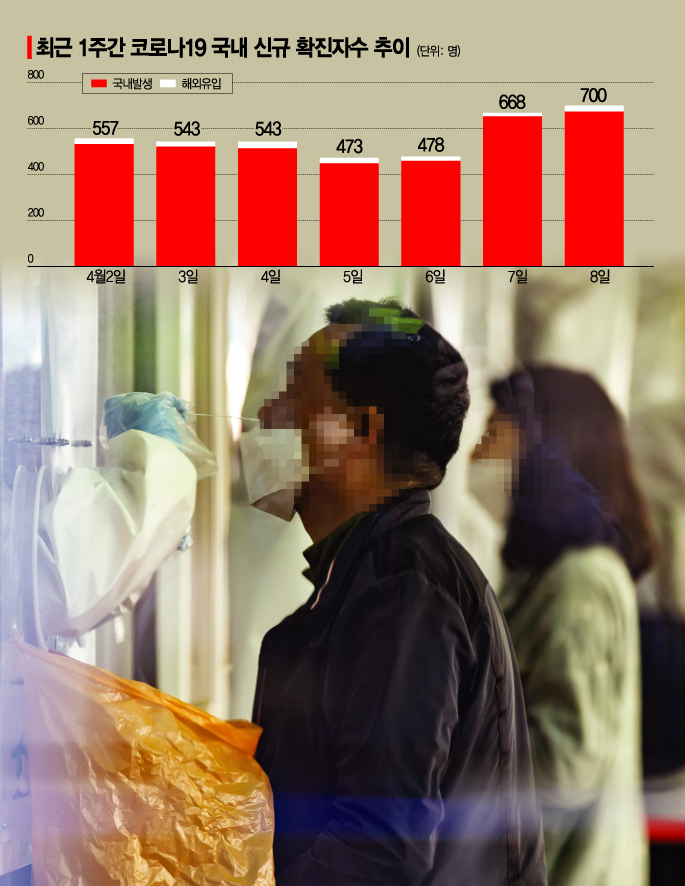
[Asia Economy Reporter Kim Ji-hee] ‘478 → 668 → 700’. As the number of confirmed COVID-19 cases in South Korea continues to surge daily, the country has entered the phase of the ‘4th wave’. Just two weeks ago, the daily confirmed cases were in the 400s, rising to the mid-500s last week, and this week the number has increased to 700, showing a steep upward trend.
According to the Central Disease Control Headquarters on the 8th, as of midnight, the number of new domestic COVID-19 cases was 674 from local transmission and 26 from overseas inflow. The number of locally transmitted cases increased by 21 from the previous day (653), bringing the total confirmed cases to 700. This is the first time in three months since January 7, when the peak of the previous 3rd wave began to subside (869 cases), that the daily cases have reached the 700s.
◆Simultaneous outbreaks in the metropolitan and non-metropolitan areas= By region on this day, Seoul reported 239 cases, Gyeonggi 223, and Incheon 23, totaling 485 cases in the metropolitan area, accounting for 72% of all local transmissions. Although the metropolitan area still accounts for a high proportion, the non-metropolitan areas cannot be considered safe. Cases continue to emerge nationwide, including 51 in Busan, 25 in Daejeon, 24 in Jeonbuk, 18 in Chungnam, and 13 in Ulsan.
Even in the non-metropolitan areas where social distancing level 1.5 is applied, the number of confirmed cases is increasing, indicating that the spread is expanding nationwide. Until early this week, health authorities stated that in non-metropolitan areas, confirmed cases were concentrated in some cluster infections and that they would control the spread quickly through epidemiological investigations, but this now seems difficult. The recent spread is accelerating. On the previous day, 49 additional cases related to a Daejeon Dong-gu academy cluster were identified during contact tracing, and in Ulsan, the Jung-gu call center has emerged as a new cluster infection source. Regarding the cluster infection originating from a Busan entertainment bar, since the first confirmed case on the 24th of last month, related cases have exceeded 300 over two weeks.
The metropolitan area, which still accounts for a high proportion of total confirmed cases, is key to finding hidden sources of infection. Since more than 200 cases per day have been reported for a long time, there are likely many unidentified cases. On this day, 114 cases were confirmed through temporary screening centers in the metropolitan area. This accounts for 23.5% of local transmissions in the metropolitan area and 16.9% of all new local confirmed cases. Approximately one in four confirmed cases overall have unknown infection routes. The infection reproduction number, which can gauge the future spread of infection, remains above 1.0 nationwide, indicating ongoing epidemic expansion.
◆Accumulated fatigue causes ‘prevention measures’ to lose effectiveness= Although there are more risk factors than at the time of entering the 3rd wave, the scope for strengthening prevention measures has rather narrowed. Above all, it is analyzed that the fatigue from prevention measures has reached its limit due to the prolonged inability to lift high-intensity measures during the stagnation period following the 3rd wave.
The government hinted at introducing effective prevention measures for about a month since last month when daily confirmed cases remained in the 400-500 range, but the effects were hardly seen. Recently, the government strengthened prevention rules by requiring all visitors, not just representatives, to register their entry at restaurants and cafes, but evaluations indicate that these rules are not well followed on site. Prime Minister Chung Sye-kyun reiterated his intention to announce additional measures for prevention both yesterday and today. He said, "If we fail to stop the current spread, we face a ‘precarious’ crisis where the 4th wave could become a reality," and "The government will focus on preparing effective prevention measures."
For now, the government plans to expand diagnostic testing to quickly identify hidden infections and curb the spread. Along with this, the social distancing level to be announced on the 9th is also expected to be raised. Professor Jeong Jae-hoon of Gachon University College of Medicine’s Department of Preventive Medicine pointed out, "It is true that without public awareness of the crisis, it is difficult to expect the effectiveness of prevention, but raising the prevention level itself sends a signal to the public," adding, "Considering the recent trend of confirmed cases, we have clearly entered the 4th wave, so at minimum, the measures relaxed during the easing of distancing should be restored, and more comprehensive and macro-level prevention measures should be considered."
© The Asia Business Daily(www.asiae.co.kr). All rights reserved.

















