Joint Research Results of Dr. Eunmi Hwang's Team at KIST and Professor Kyungho Seok's Team at Kyungpook National University
[Asia Economy Reporter Kim Bong-su] A study has found that directly administering anti-inflammatory agents in the early stages of brain injury, such as stroke or trauma, can accelerate recovery by more than twice as fast.
The Korea Institute of Science and Technology (KIST) announced on the 8th that Dr. Eunmi Hwang's team at the Brain Science Institute, in collaboration with Professor Kyung-ho Seok's team at Kyungpook National University School of Medicine, newly confirmed that a binding between two proteins (Hevin-Calcyon) is necessary for the recovery process of adult brain injury, and that this binding plays a crucial role in the early stages of recovery.
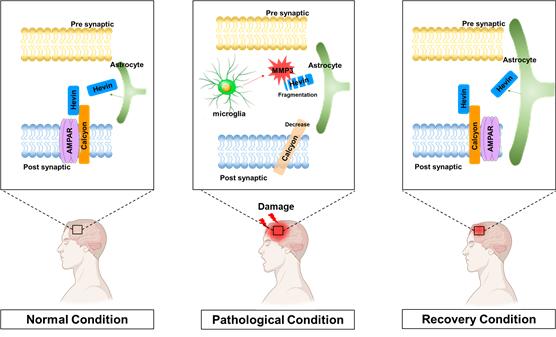
The research team discovered the binding between Hevin, a protein secreted by brain glial cells whose characteristics had long been unknown, and Calcyon, a reactive protein, and scientifically confirmed that this binding plays a very important role in the recovery process of nerve cells.
Nerve cells are generally known to be directly involved in the functional aspects of the brain, and the recovery of nerve cells is considered essential for treating brain diseases. The research team confirmed that increasing the Hevin-Calcyon binding in the brain rapidly generates more connection sites between nerve cells, leading to early recovery of impaired brain functions. They also found that while these proteins are observed in their bound form in normal brain tissue, the amount of bound proteins is significantly reduced in patients with traumatic brain injury.
The Kyungpook National University research team used an animal model of brain injury to systematically observe the recovery process through the bound proteins. They discovered that enzymes induced by the inflammatory response occurring in the early stages of brain injury degrade Hevin, thereby inhibiting the Hevin-Calcyon binding. In animal experiments where brain injuries typically recover in about four weeks, direct administration of anti-inflammatory agents to the injury site accelerated recovery to within 2-3 weeks, whereas additional administration of inflammatory proteins delayed recovery. This revealed that a deficiency in the Hevin-Calcyon binding during the critical early recovery phase may hinder effective repair processes.
.
Dr. Eunmi Hwang stated, “Since inflammatory responses commonly occur not only in brain injuries but also in degenerative brain diseases, it is clear that the Hevin-Calcyon binding should be considered when treating these brain disorders,” adding, “This could lead to the development of treatments for intractable brain diseases related to synapse formation disorders in the future.”
The results of this study were published in the latest issue of the international journal ‘Cell Death & Differentiation.’
© The Asia Business Daily(www.asiae.co.kr). All rights reserved.

















