152 Stations, 157 Trains Left Unattended for 3 Years
Seoul Metro Wins in Both Trial and Appeal
Court Orders "Equipment Removal by Management Company"
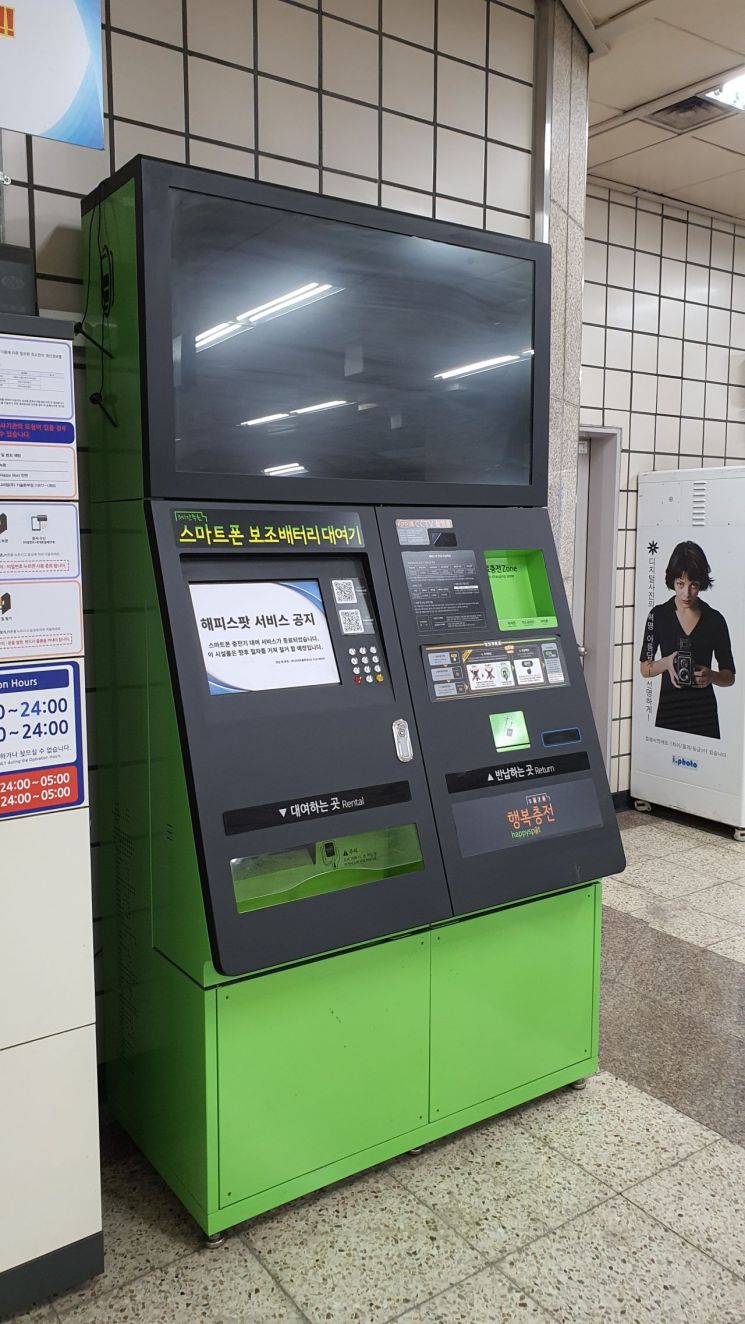
[Asia Economy Reporter Kim Daehyun] "The service has been terminated. This facility is scheduled to be dismantled in the future."
This is the notice attached to the abandoned smartphone auxiliary battery rental device ‘Happy Spot’ inside a station on Seoul Subway Line 7. A total of 157 Happy Spot devices, occupying one side of the passage in a suspended state, are abandoned in 152 stations on Seoul Subway Lines 5 to 8. It was a service that lent batteries for free through unmanned rental machines, but the service was discontinued three years ago.
Seoul Metro and auxiliary battery company A signed a business partnership agreement and management operation contract in 2016, expecting advertising revenue, but the two sides have been repeatedly litigating for three years over the ‘removal of devices.’
In 2018, when company A did not respond to requests to resume service citing ‘circumstances with the server management company,’ Seoul Metro notified the termination of the contract and requested the removal of the devices. On the other hand, company A countered with a lawsuit claiming the return of settlement payments. According to the management operation contract, Seoul Metro was supposed to bear 300 million KRW, part of company A’s expenses.
Both the first and second trials ruled in favor of Seoul Metro. The 37th Civil Division of the Seoul Central District Court (Presiding Judge Kim Intaek), which handled the first trial, dismissed company A’s lawsuit against Seoul Metro claiming settlement payments and other claims, and the following year accepted Seoul Metro’s lawsuit against company A for building eviction.
The court ruled, "Company A must dismantle and deliver the unmanned rental machines and related facilities installed in each station and pay approximately 75 million KRW to Seoul Metro." In September last year, the second trial court also upheld this ruling and dismissed company A’s appeal. It was deemed reasonable to view that company A agreed to bear the costs related to facility construction necessary for the business under the contract.
Despite more than a year passing since the second trial ruling, the devices remain abandoned because company A is undergoing business closure procedures. A Seoul Metro official said, "After winning the second trial, we wanted to handle the devices somehow and even sent a certified letter to company A, but since they have already filed for business closure, there is no channel to communicate, making the situation frustrating."
Separately from this lawsuit, Seoul Metro has been pushing for device seizure, appraisal, and auction processing through the courts since March. The jurisdictional courts are quite diverse, but the process is currently underway starting with the Seoul Western District Court since March.
© The Asia Business Daily(www.asiae.co.kr). All rights reserved.

















