G20 Finance Ministers and Central Bank Governors Meeting
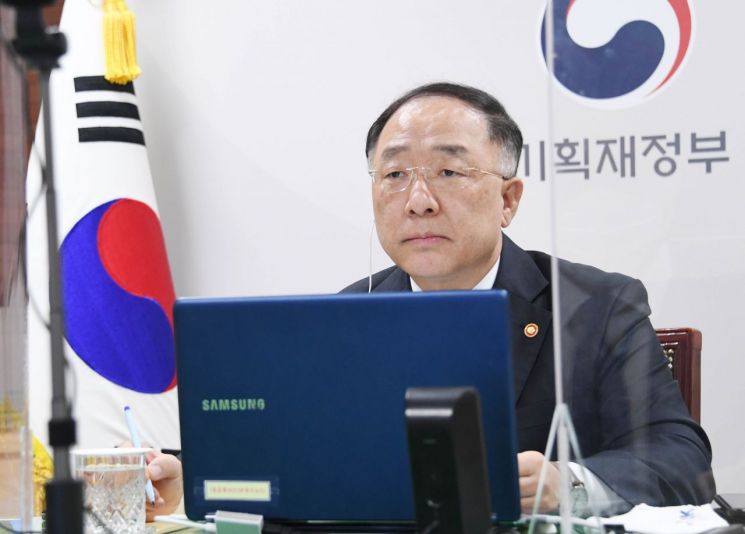 Hong Nam-ki, Deputy Prime Minister and Minister of Economy and Finance, participating in the '2nd G20 Finance Ministers and Central Bank Governors Meeting.' The meeting was held virtually. (Photo by Ministry of Economy and Finance)
[Sejong=Asia Economy Reporter Moon Chaeseok] Hong Nam-ki, Deputy Prime Minister and Minister of Economy and Finance, emphasized on the 8th that "efforts for structural reform, including securing medium- to long-term fiscal soundness, must be pursued simultaneously."
Deputy Prime Minister Hong made this remark during a leading statement at the G20 Finance Ministers' Meeting, where he attended as a co-chair country of the International Financial System Working Group. He stated, "The G20 must continue short-term expansionary macroeconomic policies to overcome the pandemic crisis while preparing for the post-COVID era." He also stressed the restoration of a rules-based multilateral trading system and the promotion of digital and low-carbon economic transitions.
Deputy Prime Minister Hong's comments on medium- to long-term structural reforms relate to emerging risk factors such as "disparate recovery rates among countries," "financial market instability," and the "rise of protectionism" during the global economic recovery process. He mentioned the need for three harmonized efforts: structural reform, economic recovery between advanced and developing countries, and macroeconomic policy coordination among countries.
Hong said, "From the past global financial crisis recovery process, we learned two lessons: that macroeconomic policy coordination among countries is essential, and that we must be careful to prevent increased financial market volatility from hindering real economic recovery." He added, "We must continue expansionary macroeconomic policies until the crisis is fully overcome, while being cautious to avoid spillover effects between advanced and developing countries."
Regarding recent concerns about inflation and increased financial market volatility due to rising U.S. Treasury yields, he expressed support for the International Monetary Fund's (IMF) decision to include language reviewing capital flow liberalization to mitigate cross-border capital flow volatility.
Member countries agreed to extend the debt service suspension period for low-income countries, originally scheduled to end in late June, until the end of this year. To enhance capital liquidity for low-income countries plunged into economic crisis by the COVID-19 pandemic, they also agreed on a general allocation of $650 billion (approximately 728 trillion won) in IMF Special Drawing Rights (SDR). This SDR allocation is the first to be pursued since the 2009 global financial crisis.
Deputy Prime Minister Hong expressed gratitude, saying, "I thank the member countries for pushing forward the debt suspension extension and the $650 billion IMF SDR general allocation," and emphasized, "I hope the G20 will actively participate in the implementation process going forward."
© The Asia Business Daily(www.asiae.co.kr). All rights reserved.

















