Vaccination for Health and Special Education Teachers Scheduled on the 8th Postponed
Possible Impact on Second Quarter Vaccination
Over 700 Cases Cast Shadow on Middle School Attendance Expansion
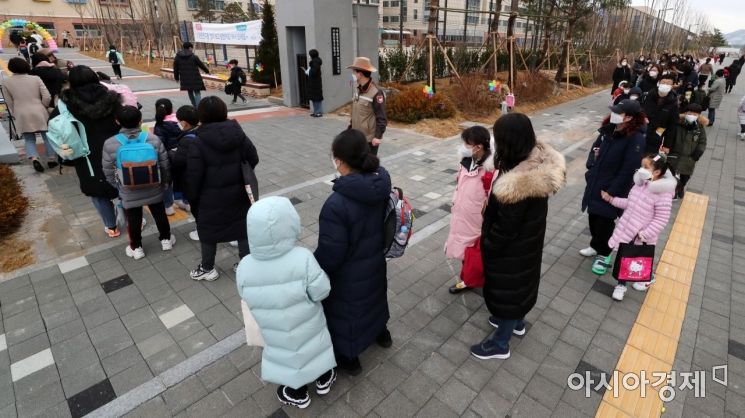 On the morning of the 2nd, when the new semester's first day of school for elementary, middle, and high schools in the 2021 academic year began, students lined up to measure their temperature before going to school at Gangbit Elementary School in Gangdong-gu, Seoul. Photo by Joint Press Corps
[Asia Economy Reporter Han Jinju] The expansion of in-person classes has encountered obstacles just one month after the start of the semester. COVID-19 vaccinations for health and special education teachers have been postponed, and there is even talk of raising social distancing levels.
The Ministry of Education and the Korea Disease Control and Prevention Agency decided on the 8th to temporarily suspend COVID-19 vaccinations planned for special and health education workers. Initially, the Ministry of Education planned to start vaccinating health and special education teachers, followed by kindergarten, daycare, and grades 1-2 teachers and childcare workers in May, with vaccinations for grade 12 students and their teachers scheduled for the second quarter.
The delay in vaccination resumption inevitably affects future schedules. Even though the infection rate within schools is relatively low, it is difficult to indefinitely postpone vaccinations for school staff while daily in-person classes continue. However, since grade 12 students are to receive the Pfizer vaccine, this vaccination delay issue is not expected to impact them.
As the number of confirmed COVID-19 cases surged to the 700s, expanding in-person attendance for middle school students has also become difficult. Since the new semester began in March, grades 1-2 and grade 12 students have been attending daily as exceptions to classroom density rules, but middle school students have had relatively fewer in-person days.
An official from the Ministry of Education explained, "We considered expanding in-person attendance for middle school students under the current infection and regional transmission trends, but with infections rising now, it is difficult to discuss expansion. There is even talk of adjusting social distancing levels rather than just revising the system, so we must wait until the situation calms down."
However, the Ministry of Education and health authorities report that infections within schools have not significantly increased compared to last year's outbreak. According to analysis by Professor Choi Eunhwa of Seoul National University, the infection rate in March was 3.49 per 100,000 people, lower than the overall population infection rate of 5.84 per 100,000. The proportion of infections occurring within schools was 11.3%, lower than household infections (55.5%) and community infections (19.4%). However, over the past three weeks, the proportion of confirmed cases among school-age children has slightly increased: ages 13-15 rose from 20.2% to 23.1%, and ages 16-18 from 24.0% to 24.6%.
© The Asia Business Daily(www.asiae.co.kr). All rights reserved.

















