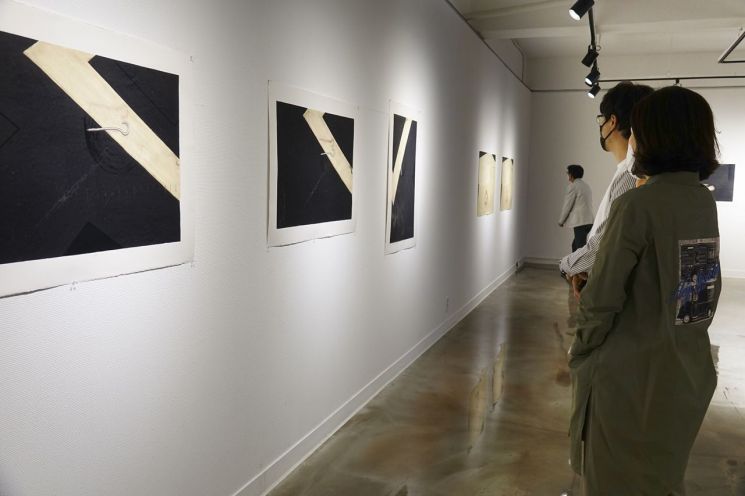
[Asia Economy Honam Reporting Headquarters Reporter Lee Gwan-woo] Gwangju University Hosim Art Museum is holding the "Seo Jeong-bong Lithograph Exhibition" until the 29th.
The late artist Seo Jeong-bong graduated from Chosun University College of Fine Arts in 1988, completed the printmaking research course at Tama Art University in Japan, and then graduated from the Printmaking Department of the Graduate School of Formative Arts at Sungshin University.
Starting with his first solo exhibition in 1998, he actively participated in numerous exhibitions both domestically and internationally, including Japan, Taiwan, Seoul, and Busan.
The artist's works are created using the lithograph technique, where images are drawn on a stone plate and printed through planographic printing.
It is easy to mistake this for woodblock printing, where images are carved with a knife on a block, but his works were produced using planographic lithography that utilizes the repulsion between water and oil.
The artist visualized the rules of everyday life to express the standardized values of modern society. He is known as an artist who formalizes time, space, and daily objects into a sculptural language and interprets them in his own way.
This exhibition features lithograph works created around 2000, before the artist's passing, and is part of the Gwangju University Hosim Art Museum collection.
When looking at the print works, numbers such as 2/10 or 12/30 can be seen. This indicates (work number)/(total number of works), which is called an edition.
Printmakers set the total number of works based on the printing quality that can be produced from the original plate, following the principle of leaving a minimum edition.
The reason editions exist in printmaking is that prints are inherently reproductions, so this information is recorded at the bottom of the work.
Accordingly, editions are recognized as individual works.
Choi Jun-ho, director of Gwangju University Hosim Art Museum, said, "We hope visitors can experience the charm of lithography and the difference in editions, which are rare to see in Korea, at the Hosim Art Museum."
© The Asia Business Daily(www.asiae.co.kr). All rights reserved.

















