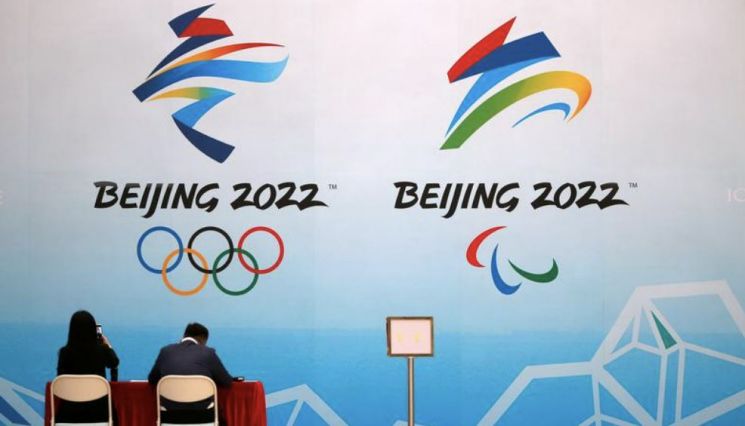
[Asia Economy Reporter Yujin Cho] The White House stated on the 7th (local time) that it is not discussing a joint boycott of the Beijing Winter Olympics in China. Earlier, the U.S. State Department had mentioned the possibility of discussing a joint boycott with allied countries over China's human rights abuses, but backtracked amid controversy.
White House Press Secretary Jen Psaki said at a press briefing that day, "Our position on the Olympics has not changed," adding, "We have never discussed and are not discussing any joint boycott with allies or partners."
She emphasized that while the U.S. closely consults with allies at all levels to define common interests and establish joint approaches, "there are no ongoing discussions about any changes in our plans related to the Beijing Olympics."
The controversy was sparked by State Department spokesperson Ned Price's remarks at a press briefing the previous day, which suggested that the U.S. might discuss a boycott with allied countries.
When asked by reporters whether the U.S. would join allies in a joint boycott of the Beijing Olympics, Price said, "That is something we definitely want to discuss," adding, "I cannot provide a specific timeline, but discussions are ongoing."
He also stated, "The issue of not participating in the Olympics is not something the U.S. should handle alone but should be addressed in solidarity with all allied countries." During his responses, he also mentioned the human rights abuses against the Uyghur ethnic group in Xinjiang, China.
Subsequently, an anonymous senior State Department official corrected Price's remarks, and Price himself tweeted shortly after the briefing that "nothing has been decided regarding the Beijing Olympics," but the controversy did not subside.
Chinese Foreign Ministry spokesperson Zhao Lijian responded by saying, "Politicizing sports goes against the Olympic spirit," while U.S. Olympic and Paralympic Committee (USOPC) Chair Susan Lyons clearly opposed the boycott, stating, "I do not believe that young American athletes should be used as political pawns."
Although the U.S. government appeared to backtrack on some statements and take a step back, it has consistently hinted at the possibility of executing a boycott of the Beijing Olympics. In February, White House Press Secretary Jen Psaki suggested the possibility of a boycott when asked about U.S. participation in the Beijing Olympics, saying, "(The U.S. participation in the Beijing Olympics) has not been finally decided," and "We will seek guidance from the U.S. Olympic Committee."
Regarding that statement, CNBC analyzed that "this remark differs from the earlier position this month that 'there is no change in participation plans,'" and U.S. media also rated the possibility of a U.S. boycott of the Beijing Olympics as high. CNBC also cited a report from the political consulting firm Eurasia Group, stating there is a 60% chance that the U.S., along with Canada, the United Kingdom, and Australia, will engage in a diplomatic boycott by not sending government delegations or downgrading the level of their delegations to the Olympics.
Earlier, Republican lawmakers also urged a boycott of the Beijing Olympics, citing China's human rights abuses against the Uyghur ethnic group in Xinjiang. Republican Senator Rick Scott submitted a resolution in February calling on President Joe Biden to reconsider the host city of the Winter Olympics due to the genocide of the Uyghurs and to withdraw from the Beijing Winter Olympics.
© The Asia Business Daily(www.asiae.co.kr). All rights reserved.

















