G20 Finance Ministers and Central Bank Governors Issue Statement
Shift from 'Weak Dollar' of Trump Era to 'Strong Dollar' Policy
Agreement to Resolve Digital Tax Disputes
Yellen Advocates for US and Global Corporate Tax Increases in Media Op-Ed
[Asia Economy New York=Special Correspondent Baek Jong-min] The Group of Twenty (G20), including South Korea, has agreed to find solutions for setting a minimum corporate tax rate and imposing digital taxes by mid-year. This effectively signals that the corporate tax rate hikes triggered in the United States will spread globally.
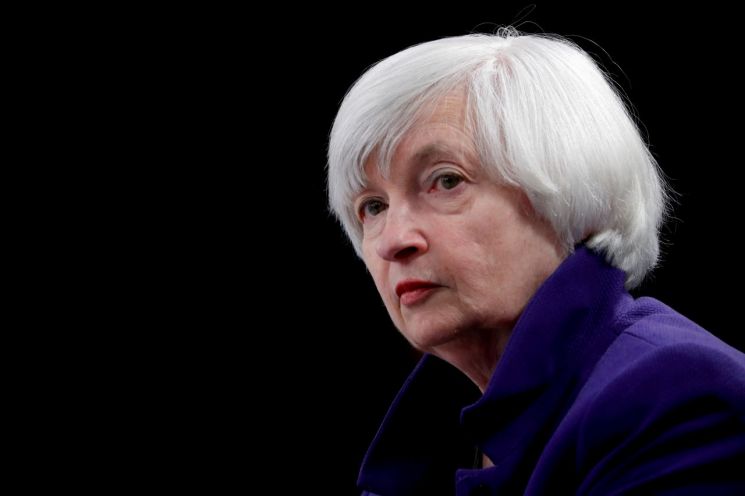
Janet Yellen, U.S. Treasury Secretary who has taken the lead on raising corporate tax rates, also advocated the necessity of raising the U.S. corporate tax rate and introducing a global minimum corporate tax rate through an op-ed.
According to Bloomberg News, on the 7th (local time), during the spring meetings of the International Monetary Fund (IMF) and the World Bank (WB), G20 finance ministers and central bank governors held a virtual meeting and issued a statement containing these points.
In the statement, they declared their continued cooperation for a fair, sustainable, and modern international tax system regarding tax agendas.
This statement suggests that major countries are forming consensus on the internationally led minimum corporate tax rate proposed by the United States.
Janet Yellen emphasized the need to raise the minimum corporate tax rate at the G20 level in relation to the U.S.-led corporate tax rate hike. The global minimum corporate tax rate the U.S. hopes for is 21%.
Yellen also stressed the necessity of raising both the U.S. corporate tax rate and the global minimum corporate tax rate in an op-ed for The Wall Street Journal (WSJ) on the same day.
She argued, "The U.S. should compete for talented workers, cutting-edge research, and advanced infrastructure instead of competing with Switzerland and Bermuda on tax rates." She criticized U.S. tax cuts for failing to bring jobs back to America and only shrinking the tax base.
Yellen stated, "The destructive race to the bottom on corporate tax rates will end only when major countries stop cutting rates and agree to introduce a global minimum tax rate," adding, "We have participated in negotiations through the Organisation for Economic Co-operation and Development (OECD), which includes strong incentives for other countries to join."
She explained, "For example, multinational corporations operating in the U.S. that shift profits to tax havens will face sanctions."
Yellen emphasized the need for international tax increases, saying, "The tax-cutting competition has neglected competition based on technological and infrastructure strengths. It was a self-destructive competition," highlighting the necessity beyond just the U.S.
She warned, "If we do not reform the tax system now, over $2 trillion in U.S. corporate taxes will be lost overseas in the next decade."
Resolution of Digital Tax Conflicts Also Anticipated... Removal of Trump-Era Remnants Encouraging Weak Dollar
There was also a principled agreement to resolve the issue of imposing digital taxes on global 'digital giants,' which had been a source of conflict between the U.S. and Europe.
The statement urged the 'Inclusive Framework,' a multilateral consultation body of over 140 countries for comprehensive implementation of the Base Erosion and Profit Shifting (BEPS) measures, to address unresolved issues by the set deadline. The Inclusive Framework has been discussing digital tax imposition and the global minimum corporate tax rate.
This statement also further removed remnants of the Trump administration. The term "combating protectionism," which had been deleted since 2017, was revived, and the importance of climate change was emphasized by stating, "Addressing climate change and promoting environmental protection are increasingly urgent."
The term "stable exchange rates" was replaced with "exchange rates reflecting fundamental factors." The statement also included the expression, "We will refrain from competitive (exchange rate) depreciation and will not set exchange rate targets for competitive purposes."
Major foreign media evaluated this as reflecting hopes for a "strong dollar," emphasized by Yellen, in contrast to the "weak dollar" policy pursued by former President Trump.
On the same day, G20 ministers reaffirmed their commitment not to prematurely withdraw stimulus measures despite improved economic outlooks following the COVID-19 pandemic.
They also agreed on the need to strengthen health systems and ensure fair, easy access to affordable COVID-19 vaccines.
© The Asia Business Daily(www.asiae.co.kr). All rights reserved.

















