For the convenience of transportation-vulnerable pedestrians... Conducting a survey on the pedestrian environment for the disabled across all city roads
Disabled individuals directly walk to inspect the pedestrian environment... Checking actual inconveniences faced by transportation-vulnerable pedestrians
[Asia Economy Reporter Lim Cheol-young] The Seoul Metropolitan Government announced on the 8th that it conducted a comprehensive survey of pedestrian inconveniences across all sidewalks (1,671 km) in the city to create a safe and "walkable Seoul" for all citizens.
Since conducting a survey in the Gangbuk area in 2019, Seoul completed a two-year citywide survey of sidewalk conditions by finishing the Gangnam area survey in 2020. During this period, Seoul has installed mobility convenience facilities for transportation-vulnerable groups according to relevant regulations and carried out prompt repairs to create a safe and convenient walking environment for these groups.
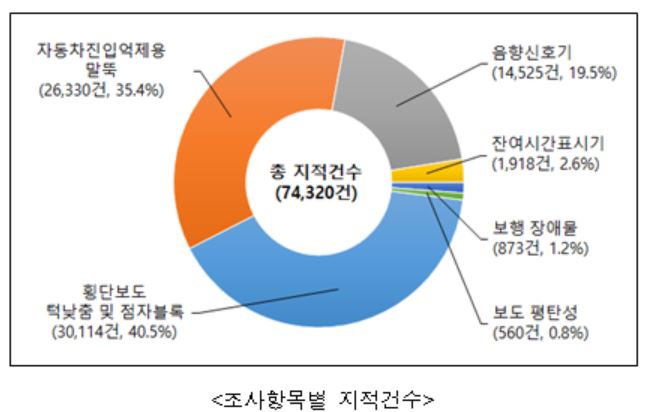
The survey was conducted over two years by dividing the city into Gangbuk and Gangnam areas. A total of 52 field surveyors, including 27 people with disabilities from the Korea Disabled People's Association (Seoul branch), conducted on-site inspections. The survey items included five facilities: ① sidewalk flatness and obstacles, ② crosswalks (curb ramps, tactile blocks), ③ audible signals for the visually impaired, ④ pedestrian signal countdown timers, and ⑤ bollards to prevent vehicle entry. The survey focused on items that did not meet installation standards or were judged to cause inconvenience during actual walking.
The results showed a total of 74,320 cases (44 cases per km) that did not meet installation standards or caused inconvenience to transportation-vulnerable pedestrians. Seoul plans to sequentially repair facilities that can be immediately maintained among the identified inconveniences. Going forward, the city will prioritize repairs in urgent areas through consultations with disability organizations.
In particular, curb ramps and tactile blocks at crosswalks are directly linked to the safety of the most vulnerable groups among transportation-vulnerable people, such as the visually impaired and wheelchair users. Since 2016, Seoul has secured a separate budget for focused maintenance of these facilities and completed major repairs. The city plans to continue selecting areas with high pedestrian traffic of transportation-vulnerable groups for maintenance.
Additionally, Seoul stated that it will standardize the survey methodology by supplementing this first-ever comprehensive survey. It will institutionalize the full survey of mobility convenience facilities for transportation-vulnerable groups on sidewalks by including it in the tasks of the legally mandated five-year plan for improving mobility convenience for transportation-vulnerable groups in Seoul. This will enable systematic management and maintenance.
Hwang Bo-yeon, Director of Urban Transportation at Seoul City, said, "This survey is significant because people with disabilities directly investigated pedestrian inconveniences, reflecting their felt difficulties proactively." He added, "We will strive not only to maintain and manage existing mobility convenience facilities but also to review considerations for transportation-vulnerable groups from the design and construction stages before facility installation to create a sidewalk environment where everyone can walk comfortably."
© The Asia Business Daily(www.asiae.co.kr). All rights reserved.
![Clutching a Stolen Dior Bag, Saying "I Hate Being Poor but Real"... The Grotesque Con of a "Human Knockoff" [Slate]](https://cwcontent.asiae.co.kr/asiaresize/183/2026021902243444107_1771435474.jpg)
















