KCCI to Host ESG Management Forum on the 8th
Discussion on Policy Directions and Evaluation Indicators for Expanding ESG Management
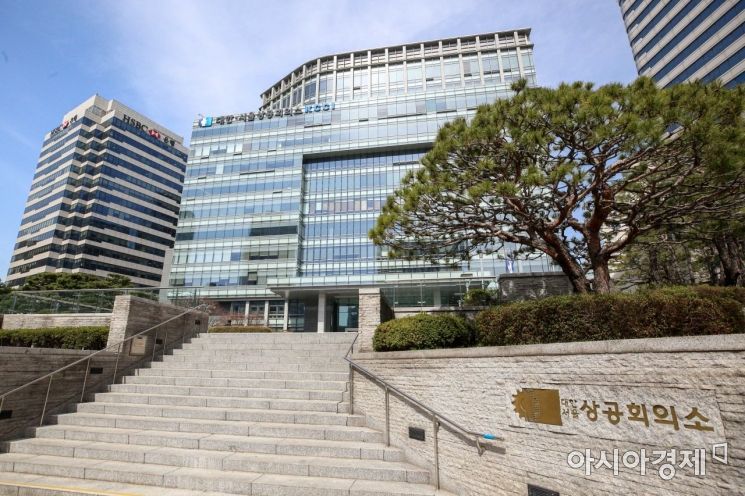 The Korea Chamber of Commerce and Industry in Jung-gu, Seoul, where the Commerce Day ceremony was held on the 31st. Photo by Jinhyung Kang aymsdream@
[Asia Economy Reporter Hwang Yoon-joo] The Korea Chamber of Commerce and Industry (KCCI) gathered experts in one place to strengthen the domestic industry's response capabilities to ESG (Environment, Social, and Governance), which is a global issue, and to discuss risk management and policy support methods related to ESG.
On the 8th, KCCI announced that it held the '1st KCCI ESG Management Forum' jointly with the Ministry of Trade, Industry and Energy and the law firm Hwawoo, discussing policy directions and evaluation indicators for the spread of ESG management.
Attendees at the forum included Woo Tae-hee, Executive Vice Chairman of KCCI; Kang Kyung-sung, Director of Industrial Policy at the Ministry of Trade, Industry and Energy; Lee Hyung-hee, Chairman of SK SV Committee; Ban Won-ik, Executive Vice Chairman of the Korea Federation of Medium-sized Enterprises; Yang Won-jun, Executive Director of POSCO; Lee Byung-hoon, Executive Director of Hyundai Motor Company; Lee Seon-joo, Executive Director of KT; Yoo Won-moo, Director of Pulmuone’s Right Mind Management Office; Lee Jae-hyuk, Professor at Korea University; and Kim Sun-woo, Director of the Next Generation Convergence Technology Institute, among others.
Companies Should Focus on Achieving Substantive ESG Outcomes Rather Than Symbolic Activities
The first presentation was delivered by Kim Dong-soo, Head of the Sustainable Management Promotion Team at the Korea Productivity Center (KPC), on the topic of 'Global ESG Latest Trends and Response Tasks.'
Kim analyzed, "Considering the high interest of stakeholders in SG, the enactment of related laws, and the emergence of various ESG service companies, it is reasonable to see that ESG is entering a stage where it is becoming the standard for corporate management and investment."
In particular, Kim emphasized, "Companies should focus on achieving ESG outcomes rather than symbolic activities. Many companies establish ESG committees, but the establishment itself should not be the goal. The key is whether the committee functions to proactively manage ESG risks and identify new business opportunity factors."
ESG Evaluation Should Not Be Detached from the Actual Situation of Companies... Globalization of Indicators Is Necessary
The second presenter, Lawyer Lee Geun-woo from the law firm Hwawoo, said, "Domestic companies that perform ESG tasks well utilize overseas standards such as GRI (Global Reporting Initiative) guidelines, SASB (Sustainability Accounting Standards Board), and TCFD (Task Force on Climate-related Financial Disclosures), while also addressing domestic issues specialized in Korea, such as fair trade and win-win growth."
Lee stated, "ESG evaluation should not be too detached from the actual situation of companies. Since it is ESG in domestic companies, domestic issues inevitably must be included, but it is necessary to approach this from the perspective of globalization of evaluation standards." He added, "Companies just starting ESG should not try to be perfect from the beginning but should respond step-by-step realistically, considering investor demands, internal needs, and legal system reflections."
It Is Important to 'Monetize' ESG Activities into Monetary Value to Accurately Measure Each Company's Situation
The final presentation was given by Na Seok-kwon, Director of the Center for Social Value Enhancement Studies (CSES), on the topic of 'Current Status of ESG and Corporate Responses.'
Director Na emphasized 'measurement' as a way for companies to respond to ESG. Quoting management scholar Peter Drucker's phrase, "If you can't measure it, you can't manage it," he said, "It is important to recognize where each company stands by monetizing ESG activities into monetary value through measurement."
He also advised, "Efforts to measure ESG are the minimum small change that companies must prioritize. Companies should choose a surfing strategy to overcome the big wave of ESG."
Participants: "ESG Should Not Become Another Regulation or Burden... Approach from the Perspective of Incentive Policies"
During the subsequent open discussion, participants unanimously agreed that to spread ESG management, the approach should be from the perspective of support providing incentives rather than regulations that burden companies.
Presiding over the meeting, Executive Vice Chairman Woo said, "Globally, ESG is becoming an essential condition for corporate survival, and this is an unavoidable trend for domestic companies as well. Companies need to recognize ESG, which has emerged as a new rule on the global management stage, not as a burden but as a new opportunity. For this, the approach should be through providing incentives such as policy finance rather than regulations."
Meanwhile, KCCI plans to hold additional 'KCCI ESG Management Forums' in the future to review major issues such as ESG-related investment and disclosure.
© The Asia Business Daily(www.asiae.co.kr). All rights reserved.
![Clutching a Stolen Dior Bag, Saying "I Hate Being Poor but Real"... The Grotesque Con of a "Human Knockoff" [Slate]](https://cwcontent.asiae.co.kr/asiaresize/183/2026021902243444107_1771435474.jpg)
















