Presiding over the 33rd Economic Central Disaster and Safety Countermeasure Headquarters and the 11th New Deal Related Ministers' Meeting
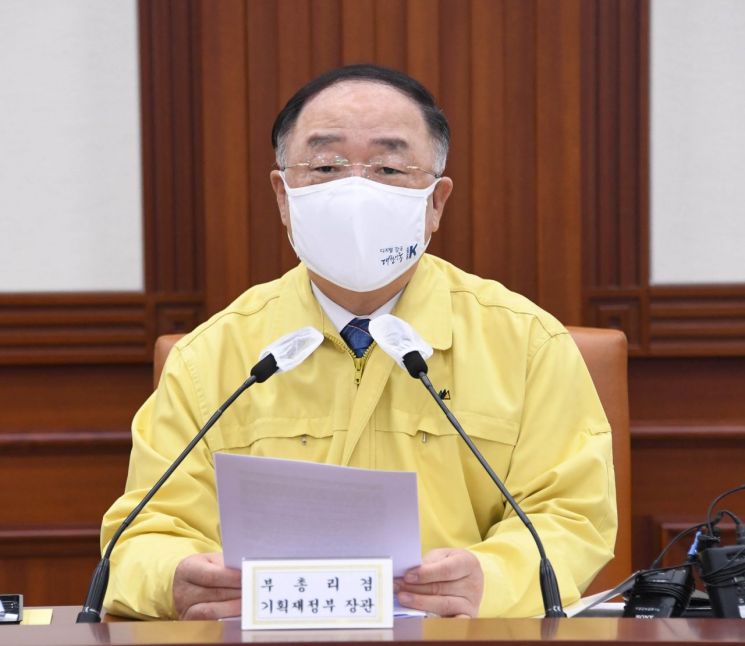 Hong Nam-ki, Deputy Prime Minister and Minister of Economy and Finance, is delivering opening remarks while presiding over the '33rd Emergency Economic Central Countermeasures Headquarters Meeting and the 11th Korean New Deal Related Ministers' Meeting' held on the 7th at the Government Seoul Office in Gwanghwamun, Seoul.
[Sejong=Asia Economy Reporter Kim Hyunjung] Hong Nam-ki, Deputy Prime Minister and Minister of Economy and Finance, recently announced that in response to rising inflation concerns, the government will apply a 0% emergency tariff quota on imported grains, promote early shipment of agricultural, livestock, and fishery products, and implement discounted releases of non-ferrous metals as part of a full-scale response.
On the 7th, Deputy Prime Minister Hong presided over the 33rd Economic Central Disaster and Safety Countermeasure Headquarters meeting and the 11th New Deal Ministers' Meeting at the Government Seoul Office in Gwanghwamun, Seoul. He stated, "While expectations for economic recovery are rising, domestic and international inflation concerns are spreading, potentially becoming a constraint on economic recovery," adding, "We will closely monitor global inflation trends to ensure that prices do not pose a risk to economic management in the second quarter, and domestically, we will focus on stabilizing living costs."
He explained, "In March, consumer prices rose by 1.5% due to domestic supply conditions of agricultural and livestock products, increases in oil prices, and rising import prices such as international grain prices, expanding upward pressure on prices," and added, "Although the possibility of the annual consumer price increase exceeding 2% is quite limited, we plan to proactively manage and prepare for a temporary increase in the second quarter due to base effects by actively utilizing stabilization measures by major items and sectors."
Accordingly, the government will focus on importing and early shipment of agricultural, livestock, and fishery products, while implementing emergency tariff quota measures on raw materials and discounted releases of stockpiled goods. To stabilize prices early, an additional 15 million eggs will be imported, early shipment of onions and green onions will be encouraged, and 3,000 tons of stockpiled cabbage damaged by cold waves will be flexibly released.
Furthermore, a 0% emergency tariff quota will be temporarily applied until the end of the year on some imported grains such as feed corn. Import procedures will be improved to expedite customs clearance of international grains, including allowing onboard sample collection, and discounted releases of 1-3% will be promoted for stockpiled non-ferrous metals. While managing public utility fees such as gas charges stably, the government also plans to lower loan interest rates for food raw material purchase funds to support the dining-out industry.
On the same day, Deputy Prime Minister Hong also explained the strategy for promoting smart green industrial complexes during the meeting. He said, "Starting with the Saemangeum area and three national pilot industrial complexes, we will establish a total of 35 smart green industrial complexes by 2030," adding, "We will actively apply the Industrial Complex Simplification Act to shorten the approval period for industrial complex development plans, improve systems such as allowing direct renewable energy power trading within industrial complexes to ensure smooth power supply to data centers, and provide benefits such as priority land supply and reduced sale prices."
© The Asia Business Daily(www.asiae.co.kr). All rights reserved.
![Clutching a Stolen Dior Bag, Saying "I Hate Being Poor but Real"... The Grotesque Con of a "Human Knockoff" [Slate]](https://cwcontent.asiae.co.kr/asiaresize/183/2026021902243444107_1771435474.jpg)










