Hyundai Motor to Suspend Operations at Ulsan Plant 1 for One Week Starting Today
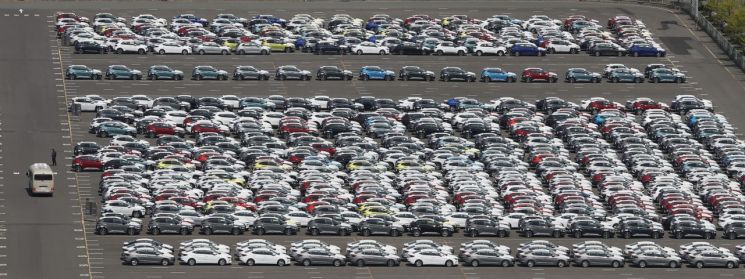
[Asia Economy Reporter Yu Je-hoon] The 'April crisis' triggered by automotive semiconductors has become a reality. Following Korea GM, which has started production cuts due to semiconductor supply shortages, even Hyundai Motor is showing signs of a chain reaction of production halts. The industry is scrambling to secure semiconductor inventory, but since the supply shortage is a global issue, there are concerns that such situations may continue for the time being.
According to the industry on the 7th, Hyundai Motor will suspend operations at Ulsan Plant 1 for a week from today until the 14th. Ulsan Plant 1, with an annual production capacity of 300,000 units, manufactures the Ioniq 5, Kona, Veloster, and others.
The shutdown of Ulsan Plant 1 began due to disruptions in the production of drive motors used in the Ioniq 5, followed by a 'final blow' caused by a shortage of automotive semiconductors such as microcontroller units (MCUs). The industry expects that this shutdown will cause production delays of about 6,500 units of the Ioniq 5 and about 6,000 units of the Kona.
The factory shutdowns are spreading like dominoes. Hyundai Motor is reportedly discussing a shutdown of the Asan Plant, which produces the Grandeur, with the labor union. The shutdown at Asan Plant is also known to be due to a shortage of automotive semiconductor power control units (PCUs).
Additionally, Ulsan Plant 3, which produces the Avante and Venue, is highly likely not to conduct overtime work on the 10th due to semiconductor shortages. Kia's Hwaseong Plant, which produces the K8 and Sorento, also plans not to conduct overtime work this month. Outside of Hyundai Motor and Kia, Korea GM is currently implementing a 50% production cut at Bupyeong Plant 2, which produces the Malibu and Trax.
This chain reaction of shutdowns is a consequence of the global semiconductor supply shortage. The finished car industry, including Hyundai Motor, is continuing negotiations with semiconductor companies and suppliers to secure inventory, and is also devising measures such as using general-purpose semiconductors that are not affected by the shortage as substitutes. However, the general assessment is that these are only temporary measures. Recently, Nomura Securities in Japan forecasted in a report that the global finished car industry's production volume in the second quarter could decrease by about 1.6 million units due to the automotive semiconductor supply shortage. Consulting firm AlixPartners also predicted that the global finished car industry will experience a revenue decline of $60.6 billion (approximately 69 trillion KRW) this year.
A senior industry official said, "The automotive semiconductor supply issue is an unavoidable situation, and even if measures are taken to mass-produce semiconductors, it is difficult to resolve the problem in a short period," adding, "It seems highly likely that production disruptions due to semiconductor supply shortages will partially recur until the end of this year."
© The Asia Business Daily(www.asiae.co.kr). All rights reserved.

















