Population Decline Trend Continues Since Last Year... 116,177 Deregistered Due to Residence Unknown, Natural Decrease of 10,370 from Births and Deaths
Child, Adolescent, and Youth Populations Continue to Decrease, Elderly Population Increases... 9.1 Million Single-Person Households Approaching 40% Share
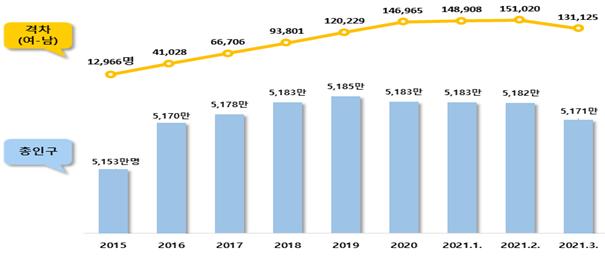
[Asia Economy Reporter Lim Cheol-young] After the population declined for the first time last year, it has continued to decrease for three consecutive months this year. This is the result of the government’s administrative deletion of long-term unregistered residents and the continuous decrease in the population of children, adolescents, and youth, while the elderly population continues to increase.
On the 7th, the Ministry of the Interior and Safety announced that as of the end of March, the registered population of South Korea was 51,705,905, a decrease of 123,118 compared to the end of 2020. Excluding the 116,177 long-term unregistered residents who were administratively deleted, the pure natural decrease was recorded as 10,370. The government, following the revision of the Resident Registration Act, established the basis for ‘fact-finding investigations on unregistered residents’ and conducted investigations on long-term unregistered residents who had not registered their residence for more than five years, leading to administrative deletion.
The number of births (registrations) in the first quarter of this year decreased by 5,614 (7.6%) compared to the same period last year. Compared to ten years ago, it decreased by 57,410 (45.7%). On the other hand, the number of deaths (deletions) decreased by 2,824 (3.5%) compared to the same period last year but increased by 10,525 (15.5%) compared to ten years ago. The sex ratio of births (registrations) has slightly risen since hitting its lowest point of 104.8 in 2016, maintaining a level above 105.0.
By gender, the male population has continued to decline following last year, and the female population also decreased by 69,479 except for a slight increase in February. Until February, the population gap between males and females reached a historic high, but due to more females than males being administratively deleted as long-term unregistered residents, the population gap between males and females as of the end of March slightly narrowed compared to the end of last year.
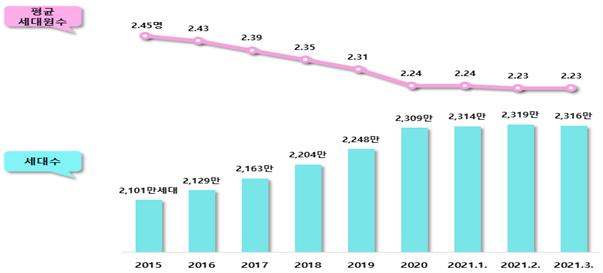
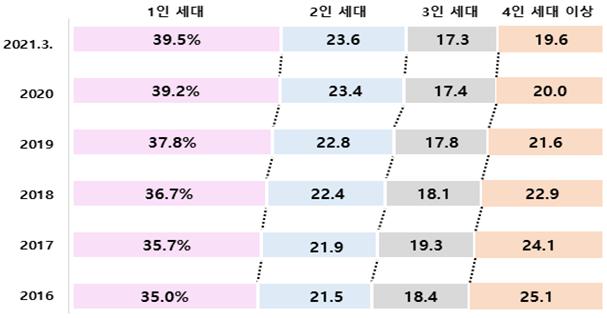
The total number of households increased again following last year, driven by a steady rise in single-person households. As of the end of March this year, the total number of households was 23,157,385, an increase of 64,277 households compared to the end of last year. The average household size in the first quarter of this year dropped to a record low of 2.23 persons, and for the first time, households with four or more members fell below 20%, reaching a historic low of 19.6%. Notably, single-person households numbered 9,139,287, accounting for 39.5% of the total, approaching 40%.
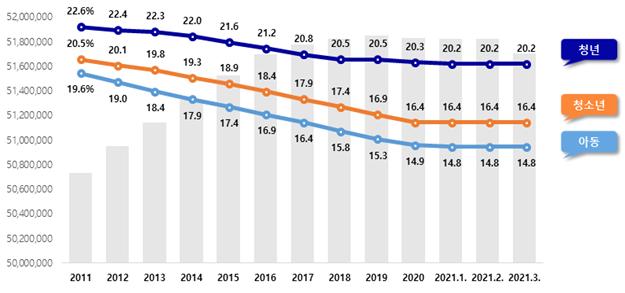
Furthermore, over the past ten years, the population proportions by age group changed as follows: children decreased from 19.6% to 14.8%, adolescents from 20.5% to 16.4%, and youth from 22.6% to 20.2%. While the proportions of children, adolescents, and youth have steadily declined, the proportion of the elderly population aged 65 and over rose sharply from 11.2% to 16.6%.
The elderly population proportion has continuously increased over the past decade. Since entering an aged society in 2017, those aged 65 and over account for 16.6% of the total population, and those aged 70 and over make up 11%. The population aged 65 and over increased by 380,000 (4.7%) compared to the same month last year and by 3.03 million (54.6%) compared to ten years ago. The population aged 70 and over increased by 160,000 (2.9%) compared to the same month last year and by 2.06 million (56.5%) compared to ten years ago.
By the 17 metropolitan cities and provinces, only Sejong (23.3%) had a child population proportion exceeding 20%. Seoul (12.6%) had the lowest. The adolescent population proportion was highest in Gwangju (19.1%), while Busan (14.9%) and Gyeongbuk (14.8%) were relatively low, both below 15%. The youth population exceeded 20% of the total population in five areas: Seoul (23.6%), Daejeon (21.9%), Gwangju (21.3%), Incheon (20.9%), and Gyeonggi (21.0%), with Jeonnam (16.1%) being the lowest.
Four regions?Jeonnam (23.7%), Gyeongbuk (22.0%), Jeonbuk (21.6%), and Gangwon (21.0%)?have entered a super-aged society, with those aged 65 and over accounting for more than 20% of the total population. Additionally, Busan (19.6%) and Chungnam (19.3%) are approaching super-aged society status. Ten regions, including Busan, Chungnam, Chungbuk (18.3%), Gyeongnam (17.7%), Daegu (16.9%), Seoul (16.2%), Jeju (15.9%), Daejeon (14.6%), Gwangju (14.4%), and Incheon (14.2%), have entered an aged society, while Gyeonggi (13.4%), Ulsan (12.9%), and Sejong (9.9%) have entered an aging society.
By city, county, and district, among 75 city areas, 27 are super-aged societies, 25 are aging societies, and 23 are aged societies. Among 82 county areas, 76 (92.7%) are super-aged societies, 5 are aged societies, and 1 is an aging society. Among 69 district areas, 45 (65.2%) are aged societies, followed by 13 super-aged societies and 11 aging societies.
Compared to the end of last year, only two metropolitan areas?Sejong and Gyeonggi?and 45 basic local governments, including Siheung and Pyeongtaek, saw population increases in the first quarter of 2021. Excluding the population of long-term unregistered residents who were administratively deleted, three metropolitan areas?Sejong, Gyeonggi, and Jeju?and 60 basic local governments showed population growth. The number of local governments experiencing population decline is gradually increasing.
Specifically, populations decreased in 15 metropolitan cities and provinces: Seoul (69,981), Busan (19,547), Gyeongnam (9,753), Daegu (9,471), Ulsan (6,763), Jeonnam (6,738), Jeonbuk (6,654), Gangwon (6,441), Incheon (6,367), Daejeon (5,419), among others. At the city, county, and district level, population increased in places such as Siheung City (8,220), Pyeongtaek City (7,061), and Namyangju City (6,961) in Gyeonggi Province, while 181 cities, counties, and districts, including Songpa District in Seoul (6,549), Seongnam City in Gyeonggi (5,756), and Bucheon City in Gyeonggi (5,205), experienced population decreases.
The Ministry of the Interior and Safety explained, "Population changes in most regions were significantly influenced by migration inflows and outflows as well as the administrative deletion of long-term unregistered residents from the resident registration."
© The Asia Business Daily(www.asiae.co.kr). All rights reserved.



















