Oh Hyun-chul's Research Team at Gyeongsang National University Confirms Possibility of Using Liquid Nitrogen with Flexible Porous Materials
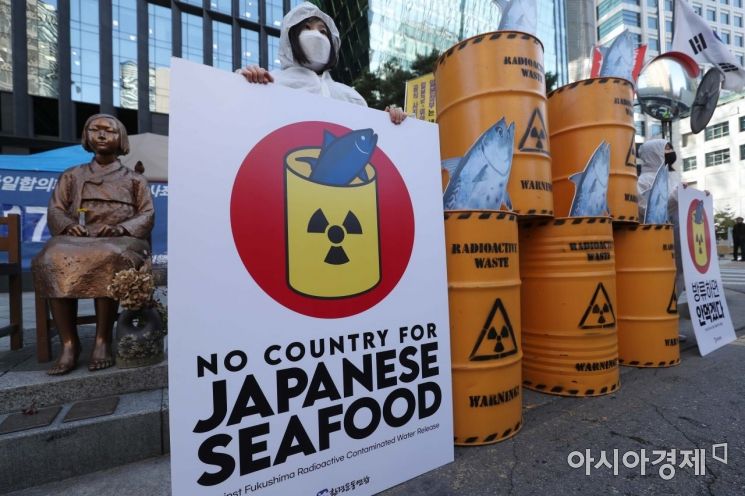 Representatives from the Korea Federation for Environmental Movements held a campaign launch ceremony on the 9th at Peace Road in front of the former Japanese Embassy in Jongno-gu, Seoul, opposing the discharge of radioactive contaminated water from Fukushima, Japan, into the ocean. Photo by Moon Honam munonam@
[Asia Economy Reporter Kim Bong-su] A clue to technology capable of purifying radioactive contaminated water generated by the Fukushima nuclear power plant accident in Japan has been discovered by a Korean research team.
According to the Ministry of Science and ICT on the 7th, Professor Oh Hyun-chul's team at Gyeongsang National University, in collaboration with Dr. Park Ji-tae's research team at Munich Technical University, found that the difference in diffusion rates of hydrogen isotopes in flexible porous materials becomes greater at high temperatures.
Hydrogen isotopes refer to a group of elements such as hydrogen, deuterium, and tritium that have the same atomic number but different atomic masses, resulting in weight differences. Materials containing a mixture of these isotopes exhibit physical differences at extremely low temperatures. Among them, 'tritium' is a major contaminant (radionuclide) included in the Fukushima nuclear power plant contaminated water, making the development of separation and extraction technology urgent.
Scientists have so far made efforts to separate and extract tritium using the Kinetic Quantum Sieving Effect. Because at low temperatures, heavier isotopes diffuse faster than lighter isotopes, porous materials can be used to separate tritium as if sieving it through a mesh.
The problem is that this phenomenon occurs at an ultra-low temperature of minus 254 degrees Celsius, requiring the use of expensive liquid helium, which makes the process economically unfeasible. Due to this, the Japanese government has effectively given up on treating the Fukushima contaminated water and plans to discharge it into the ocean while denying the risks of tritium.
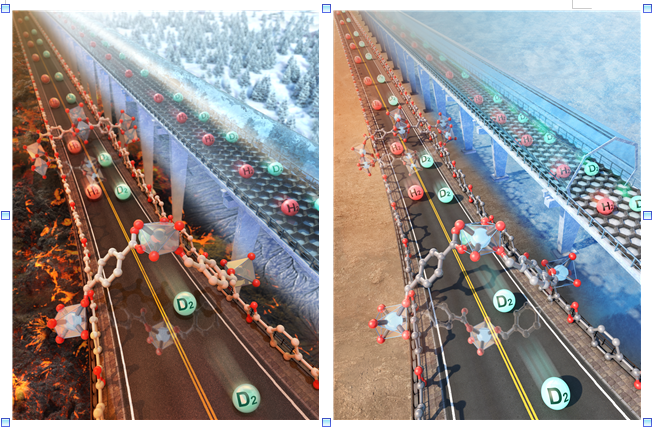
Professor Oh's team and other domestic researchers have found a clue to solve this problem. The decisive factor was using a new porous material with structural flexibility instead of the conventional rigid metallic porous materials. When hydrogen and deuterium were introduced into the flexible porous material, the pore structure initially expanded once, and then the flexible structure selectively responded only to deuterium, causing further expansion. In particular, as the space expanded, the extra space created was occupied by deuterium, which accelerated its movement.
The difference in diffusion rates within such flexible materials was found to increase sharply as the absorption amount of hydrogen isotope gases increased and as the temperature rose. As a result, the research team revealed that by using liquid nitrogen to create a low-temperature environment of about minus 196 degrees Celsius instead of expensive liquid helium, the diffusion rate difference between hydrogen and deuterium exceeds three times.
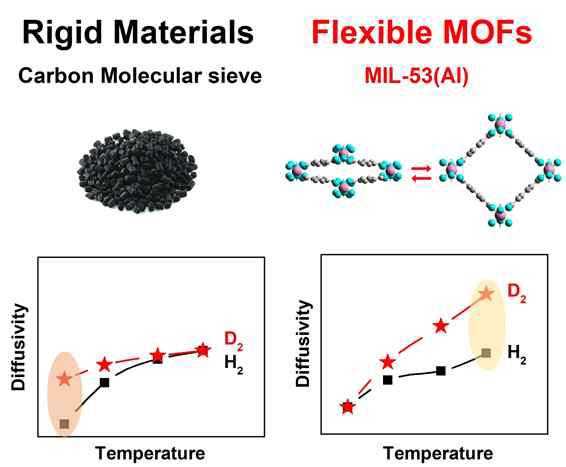 Comparison of hydrogen isotope diffusion coefficients in rigid and flexible structures. Provided by the Ministry of Science and ICT.
Of course, the research team conducted experiments in the gas phase, not in the liquid state like the Fukushima contaminated water. Also, the experiments were conducted in the laboratory using only hydrogen and deuterium without the radioactive tritium, so further research is still needed. However, since tritium is the heaviest among hydrogen isotopes and tends to diffuse faster than deuterium, the research team concluded that the same principle can be applied to develop a separation process.
Professor Oh Hyun-chul said, "Currently, the cooling water used in the Fukushima nuclear power plant contains radioactive tritium (half-life 12.4 years), but the current tritium treatment technology in contaminated water is economically inefficient, leading the Japanese government to dilute the contaminated water and discharge it into the ocean." He added, "Based on this research achievement, it could be a starting point for developing more practical hydrogen isotope separation technology."
This research result was selected as the cover paper of the international journal in the field of new materials, 'Advanced Materials,' and was published online as a priority at midnight on the same day.
© The Asia Business Daily(www.asiae.co.kr). All rights reserved.
![From Hostess to Organ Seller to High Society... The Grotesque Scam of a "Human Counterfeit" Shaking the Korean Psyche [Slate]](https://cwcontent.asiae.co.kr/asiaresize/183/2026021902243444107_1771435474.jpg)


















