Seoul Apartment Price Increase Gradually Shrinks
Causes Include Strengthened Property Tax, Fatigue from Rapid Rise
Incheon with Transportation Benefits Sees Expanded Increase
3rd Phase New Town Siheung Tops Nationwide Growth Rate
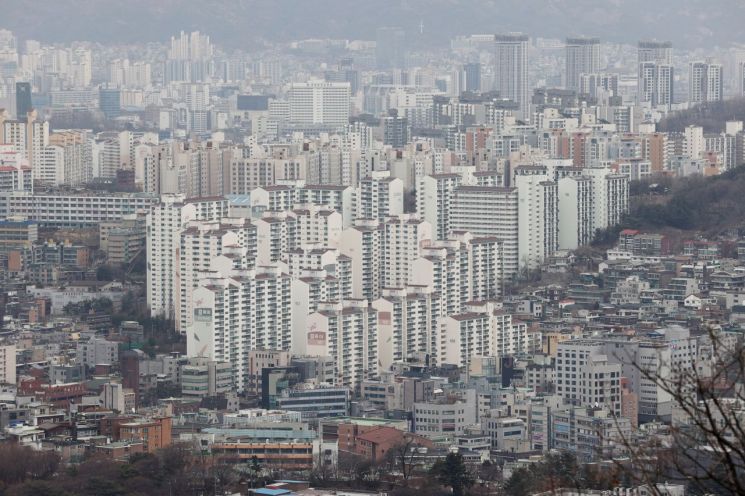
[Asia Economy Reporter Moon Jiwon] Since the government's announcement of the 2·4 measures, the rate of increase in apartment prices in Seoul has been narrowing. Seoul's buying sentiment has declined for seven consecutive weeks, leading to an analysis that the overheated market atmosphere from last year is gradually stabilizing. However, areas such as Incheon and Siheung continue to show strong upward trends as apartment prices have surged recently due to various development prospects.
According to the apartment supply and demand trend statistics for the 5th week of March from the Korea Real Estate Board on the 3rd, Seoul's sales supply and demand index recorded 101.0 this week, showing a decline for seven consecutive weeks after peaking at 111.9 in February. The sales supply and demand index is expressed as a number from 0 to 200; a value below 100 means sellers outnumber buyers, while a value above 100 means buyers outnumber sellers.
In the weekly KB Housing Market Trend data released by KB Kookmin Bank Liv Real Estate, Seoul's buyer dominance index recorded 77.3, down from 79.8 last week. It has remained below 100 for five consecutive weeks. KB Kookmin Bank Liv Real Estate explained, "Seoul apartment weekly sales growth rate has shown a slowdown for six consecutive weeks, recording 0.20%."
The stagnation in Seoul apartment prices is analyzed to be due to multiple factors. Fatigue has accumulated from the rapid price surge since last year, and the government's strengthened property tax and successive housing supply measures have deepened the wait-and-see sentiment. With an overall decrease in buying demand and the recent stabilization of the jeonse (long-term lease) market, the rate of price increase has narrowed.
The Korea Real Estate Board analyzed, "Due to the burden of property taxes, rising market interest rates, and expectations of expanded supply, there has been an overall decrease in buying demand mainly among those in their 30s and younger."
However, unlike the Seoul real estate market, some metropolitan areas such as Incheon and Siheung are still maintaining a high rate of increase. In particular, Incheon's apartment price growth rate over the past three weeks has expanded from 0.36% to 0.46% and then to 0.48%. This is interpreted as a surge in buying demand due to transportation benefits such as the Metropolitan Area Express Train (GTX), the 2nd Gyeongin Line, and the 3rd Yeonryuk Bridge.
Incheon's sales supply and demand index was 110.7 this week, slightly lower than last week's 111.2, but still higher than Seoul's 101.0 and the national average of 109.4. According to KB Kookmin Bank Liv Real Estate's data, Incheon's buyer dominance index recorded 106.7 as of the 29th of last month, indicating stronger buying demand than selling.
The upward trend in Gyeonggi-do areas with development prospects such as Siheung is also steep. According to the weekly apartment price statistics from the Korea Real Estate Board, Siheung's apartment prices rose by 3.69% from the 1st to the 29th of last month. This is the highest increase nationwide during this period. The government announced the Gwangmyeong-Siheung district as the 6th 3rd-generation new town as a follow-up measure to the 2·4 plan, which appears to have caused the rapid price surge.
Therefore, the industry points out that government policies aimed at stabilizing housing prices have instead made the real estate market in this area more unstable. According to the Ministry of Land, Infrastructure and Transport's actual transaction prices, the Hoban Verdiem Centroheim 84㎡ (exclusive area) in Jeongwang-dong, Siheung City, was traded below 600 million KRW in January but was contracted for 685 million KRW on the 27th of last month. The Siheung Central Prugio 84㎡ in Daeya-dong was traded at 688 million KRW in January but rose by about 175 million KRW to 863 million KRW on the 5th of last month after the new town designation.
© The Asia Business Daily(www.asiae.co.kr). All rights reserved.

















