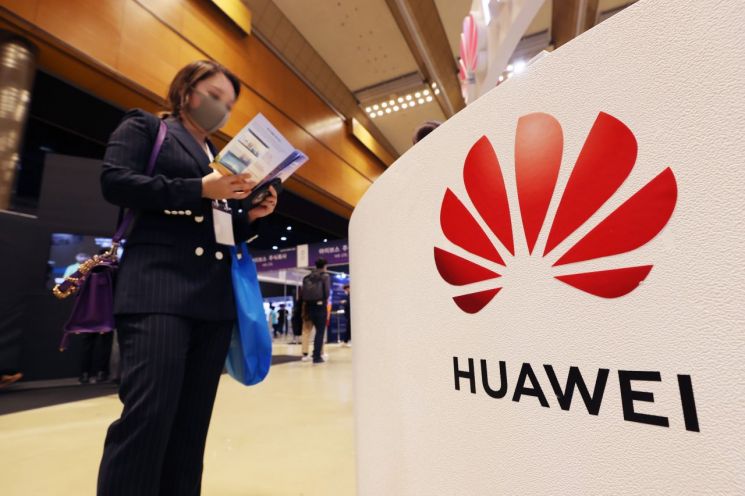
[Asia Economy Reporter Eunmo Koo] Huawei recorded a 3.8% sales growth last year as its revenue in China increased. Meanwhile, it is expected to respond to U.S. sanctions through supply chain diversification.
Huawei's revenue last year was 891.4 billion yuan, up 3.8% year-on-year, operating profit was 72.5 billion yuan, down 6.9%, and net profit was 64.6 billion yuan, down 3.2%. The operating profit margin slightly declined from 9.1% in 2019 to 8.1% last year, and the debt ratio also slightly decreased from 65.6% to 62.3%. Research and development (R&D) investment increased by 7.8% to 14.18 billion yuan, accounting for 15.9% of revenue.
By region, China recorded 58.49 billion yuan, an increase of 15.4% year-on-year. In contrast, Europe decreased by 12.2% to 18.1 billion yuan, the Asia-Pacific region also fell by 8.7% to 6.44 billion yuan, and the Americas dropped by 24.5% to 3.96 billion yuan.
Namgon Choi, a researcher at Yuanta Securities, explained in a report on the 3rd, “The increase in revenue in the China region last year, following 2019, is attributed to strong sales of Huawei flagship smartphones in China, expanded investments by the three Chinese telecom operators, and the growth of digital-related solutions and the cloud market in China.” He added, “However, due to pressure from the U.S. government, flagship smartphone sales outside China decreased, resulting in a sluggish overall sales growth rate compared to previous years. The proportion of revenue from the China region increased from 59% in 2019 to 65.6% last year.”
By business division, consumer segment revenue rose 3.3% to 48.29 billion yuan, carrier segment increased 0.2% to 30.26 billion yuan, and enterprise segment grew 23.0% to 10.03 billion yuan. The enterprise segment's revenue share increased from 9.5% in 2019 to 11.3% last year.
Last year, Huawei's smartphone business suffered a significant blow due to U.S. supply chain sanctions. These supply-side issues are expected to continue this year. To overcome these difficulties, Huawei plans to implement the ‘1+8+N strategy (1=smartphone, 8=screen, speaker, glasses, watch, TV, headphones, car, tablet, N=other IoT devices)’ in the consumer segment, offsetting smartphone sales decline with increased sales of eight other devices.
Regarding U.S. domestic supply chain sanctions, it is anticipated that Huawei will pursue supply chain diversification to other countries. Researcher Choi stated, “Supply chain constraints remain a significant issue, but Huawei plans to release flagship smartphone models as scheduled this year.” He explained, “Regarding chipset supply issues, Huawei has prepared extensively over the past two years to cope with such sanctions and considers it a manageable problem internally.” He added, “Chip design is handled through its subsidiary HiSilicon, which is operating quite stably.”
© The Asia Business Daily(www.asiae.co.kr). All rights reserved.
![Clutching a Stolen Dior Bag, Saying "I Hate Being Poor but Real"... The Grotesque Con of a "Human Knockoff" [Slate]](https://cwcontent.asiae.co.kr/asiaresize/183/2026021902243444107_1771435474.jpg)
















