39.88 Million Borrowers with 98.9 Billion Loans... 36% Surge in 3 Years
Some Institutions See Sharp Increase in Users with Ultra-Low 1-2% Interest Rates
Overlap with Bank Loans, "Likely Perceived as Privileged Loans"
[Asia Economy Reporter Song Seung-seop] Last year, the scale of in-house loans at financial public enterprises and policy banks under the Financial Services Commission increased by 26.2 billion KRW over three years, reaching 98.9 billion KRW. Some public enterprises provided ultra-low interest loans at annual rates in the low 1-2% range, lower than commercial banks. Amid the financial authorities' tightening of loans at commercial banks, concerns about fairness with ordinary citizens facing credit restrictions have been raised.
According to welfare expense data submitted by seven public enterprises under the Financial Services Commission (Deposit Insurance Corporation, Korea Credit Guarantee Fund, Korea Development Bank, Korea Asset Management Corporation (KAMCO), Korea Housing Finance Corporation, IBK Industrial Bank of Korea, and Korea Securities Depository), a total of 3,988 employees of financial public enterprises and policy banks received 98.94888 billion KRW in in-house loans last year. This is a 12.96% increase from the previous year (87.59006 billion KRW) and more than a 36% increase compared to 2017, when 72.7255 billion KRW was used.
By product, living stabilization funds amounted to 77.39138 billion KRW, an increase of 8.78796 billion KRW compared to the same period last year. The number of users also rose to 3,659, an increase of 2,498 (215.15%) in one year. Housing funds amounted to 21.5575 billion KRW, up 2.57085 billion KRW from the previous year. Notably, the number of users increased significantly, with 329 people receiving housing funds, more than four times the 64 in 2017.
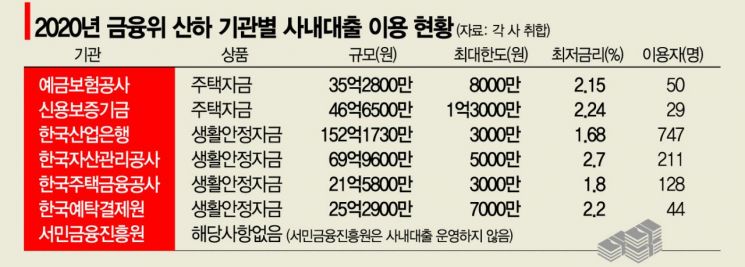
In-house loans increased sharply particularly in companies that lowered interest rates. The Deposit Insurance Corporation reduced the interest rates on living and housing fund loans for in-house employees with more than one year of service from 2.45% to 2.15% last year. Especially for housing fund loans, the amount rose by 882 million KRW to 3.528 billion KRW. Considering the maximum housing loan limit is 80 million KRW and there are 50 users, most borrowers took loans up to the maximum limit.
In the case of the Korea Credit Guarantee Fund, when loan interest rates were between 2.41% and 3.41%, only nine employees with dependents used living stabilization fund loans, borrowing just 205 million KRW. However, in the first half of last year, as interest rates dropped to 2.24%-3.24%, and further to a minimum of 1.87% in the second half, the number of borrowers surged more than 14 times to 129, and the amount jumped to 2.88 billion KRW.
Policy Banks Also See Sharp Rise in In-House Loans...Contrary to Financial Authorities' Actions
In policy banks, in-house loan usage also increased significantly. Korea Development Bank continuously lowered the interest rate on living stabilization fund loans for regular employees with more than six months of service. The rate dropped from 2.71% in 2018 to 1.68% at the end of last year. Benefiting from ultra-low interest rates, the number of users surged. The number of borrowers increased by 291 from the previous year to 747, and the loan amount rose by 4.54328 billion KRW to 15.21738 billion KRW.
At IBK Industrial Bank of Korea, 2,364 people took out living stabilization fund loans (fixed interest rate 5.2%, variable interest rate up to 1.1% preferential), an increase of 212 from the previous year.
The surge in in-house loans at affiliated organizations directly contradicts the financial authorities' tightening measures. The Financial Services Commission introduced a new loan-to-deposit ratio calculation method early last year to curb reckless household loans. Since September last year, it has also started requiring major commercial banks to submit credit loan growth management targets, continuously pressuring loan restrictions. Recently, restrictions have been tightening not only on credit loans but also on jeonse (key money deposit) and mortgage loans.
A financial industry insider said, "Due to soaring housing prices, young people are rushing to 'Yeongkkeul' (borrowing to the limit) to buy their own homes, and ordinary citizens such as self-employed people are knocking on banks and guarantee institutions' doors to borrow even a few million won for living expenses," adding, "In a situation where ordinary people's financial difficulties have grown more than ever, in-house loans at financial public enterprises may appear as 'privileged loans'."
Experts also say the current practice of in-house loans is inappropriate. Professor Kim Sang-bong of Hansung University’s Department of Economics criticized, "It is not right for public institutions operated with taxpayers' money to run in-house loans contrary to government policies. If these loans are used to circumvent government loan regulations for real estate speculation, it is even more problematic."
© The Asia Business Daily(www.asiae.co.kr). All rights reserved.


















