Japanese Game Animal Crossing Mobile Version Gains Massive Popularity
Past Animal Crossing Releases Sold Out Consecutively
Some Mention 'Nono Japan'... Controversy Over 'Boycott Movement' Pressure
'Nono Japan' 2-Year Japanese Car and Uniqlo Sales Slump
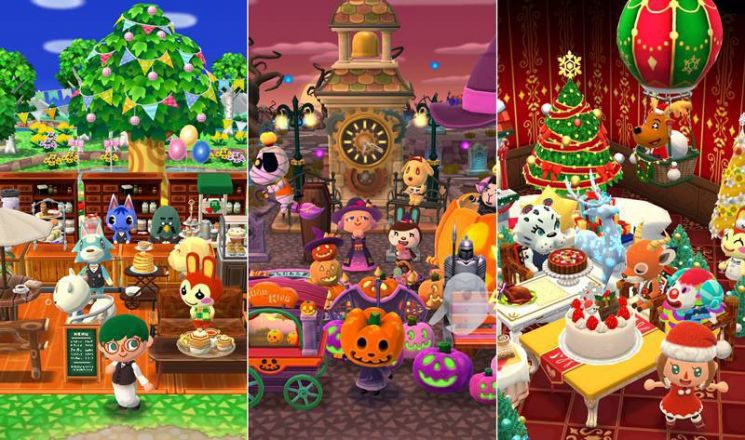 The screen of 'Animal Crossing: Pocket Camp,' officially released in Korea on the 29th by the Japanese game company Nintendo. Photo by Animal Crossing: Pocket Camp capture
[Asia Economy Reporter Han Seung-gon] Nintendo's "Animal Crossing: New Horizons" has gained tremendous popularity with the release of its smartphone application (app) version. However, some have expressed resentment toward those enjoying the game, questioning if it is a "Japanese game," and are even urging people to delete the app, sparking controversy over whether this amounts to forced boycott activism. Previously, there was conflict surrounding the forced nature of the "NoNoJapan" boycott movement against Japanese products, suggesting that tensions over the mobile version of Animal Crossing may intensify.
Released officially in South Korea on the 29th, Nintendo's "Animal Crossing: Pocket Camp" has caused a sensation, ranking first in popularity on Google Play in Korea as of the 2nd. This success is largely attributed to the fame and fandom of "Animal Crossing: New Horizons" (Dongsoop).
Last year, Animal Crossing experienced explosive popularity, leading to sold-out situations daily. When the game was released on May 23rd at Techno Mart in Sindorim, Guro-gu, Seoul, long lines formed even before the store opened, as people eagerly awaited to purchase it.
The event to apply for Animal Crossing was scheduled to start at 10:30 a.m., but by 9 a.m., around 300 people had already gathered, demonstrating the game's immense popularity. Additionally, some online shopping malls sold the product at more than twice the retail price due to high demand.
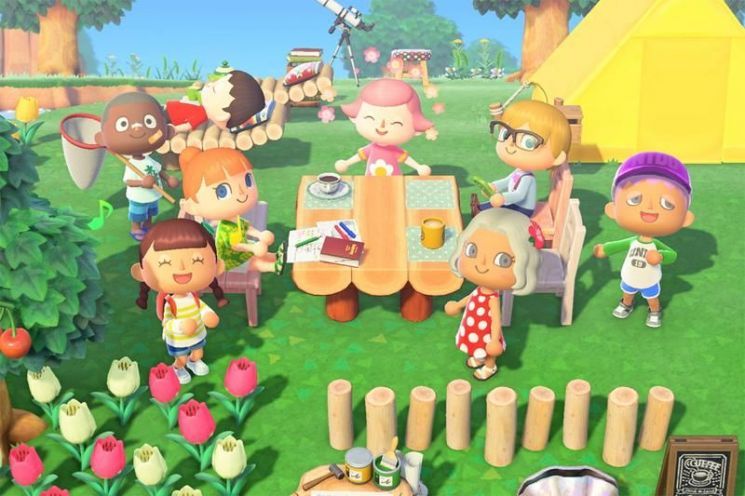 Gameplay screen of the game commonly known as 'Animal Crossing' released by Nintendo. Photo by 'Animal Crossing' user screen capture
However, even then, there was controversy over forced boycott activism, with comments like "Why play a Japanese game?" and "Join the NoNoJapan movement." A similar situation is unfolding with the mobile version of Animal Crossing shortly after its release.
Kim, a company employee in his 30s, said, "I remember there was a big controversy when the original Animal Crossing caused sold-out situations, with people saying it was a Japanese game. Now, with the mobile version, similar conflicts are arising, but I think it should just be a personal choice, even if it can be problematic."
Another office worker in his 40s, Choi, pointed out, "Boycotts should be voluntary. Forcing certain consumption is a form of coercion."
On the other hand, there are rebuttals emphasizing that this is not a simple boycott. Lee, a university student in their 20s, stated, "This is not just a boycott but a call for ethical consumption. Isn't it a response against Japan's historical distortion regarding our country?" emphasizing the legitimacy of the boycott.
The "NoNoJapan" movement refers to the boycott of Japanese products that arose in South Korea in July 2019 following Japan's strengthened export restrictions against Korea. At that time, the website "NoNoJapan," which provided information on Japanese products and alternatives, gained great popularity, reflecting strong national participation.
As a result, even two years into the "NoNoJapan" movement, Japanese products continue to be shunned. Last year, the market share of Japanese cars in Korea dropped by about half compared to the previous year. Sales in January this year were also sluggish. According to the Korea Automobile Importers & Distributors Association (KAIDA) as of February, 20,564 Japanese cars were sold domestically last year, about half of the 36,661 units sold in 2019. Market share plummeted from 14.98% in 2019 to 7.48%.
Uniqlo has been withdrawing from various locations nationwide. According to Uniqlo's website, eight stores including Homeplus Banghak, Mokdong, Gangseo, Seongseo, Asiad, Chilgok, Haeundae, and Donggwangju have closed. Additionally, Lotte Department Store Sangin and Lotte Department Store Gwangju have also ceased operations. This reduces Uniqlo's offline store count to 143.
Uniqlo stated, "Considering external factors such as the prolonged COVID-19 pandemic and changes in consumer trends, this is part of a business strategy to operate stores more efficiently."
However, some believe this is not unrelated to the NoNoJapan movement. At the end of 2019, Uniqlo had 187 stores. But following Japan's export restrictions on Korea and the resulting boycott, compounded by the economic downturn due to COVID-19, the number of stores began to decline.
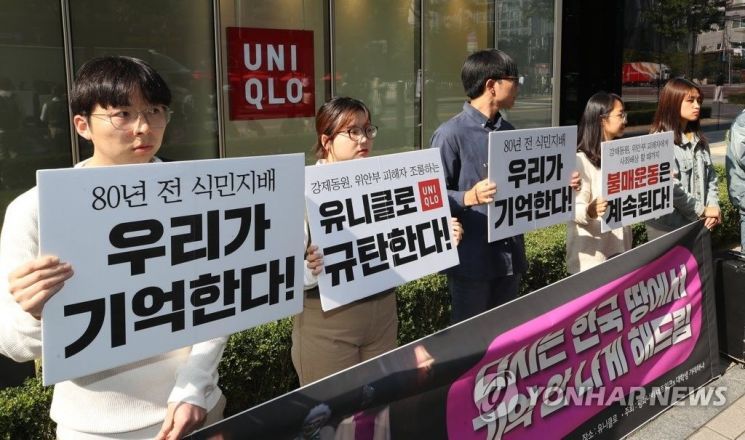 Members of the Peace Butterfly Network and university student group Gyoreh Hana held a press conference on October 21, 2019, in front of a Uniqlo store in Jongno-gu, Seoul, condemning Uniqlo for an advertisement that sparked controversy over allegations of insulting comfort women. [Image source=Yonhap News]
There were many ups and downs during this process. In November 2019, Uniqlo held a "15th Anniversary Winter Appreciation Festival," offering discounts of 10,000 to 40,000 won on its signature products such as fleece, cashmere sweaters, and down vests. Some customers lined up in front of stores to purchase these items, sparking conflicts over forced NoNoJapan activism similar to the controversy surrounding Animal Crossing.
This led to intense clashes between views supporting consumers' legitimate rights and those insisting on boycotting Japanese products. Experts at the time strongly criticized the situation, warning that it could be mocked in Japan.
Professor Seo Kyung-deok of Sungshin Women's University wrote on his Facebook, "Last weekend, people were lining up in front of a Uniqlo store to receive free thermal underwear on a first-come, first-served basis," calling it "shocking."
He added, "Although customers cannot choose size or color for the free thermal underwear, the number of customers has increased significantly. Of course, boycotts should never be forced. I respect individual choices but hope people think twice." Professor Seo also criticized the long lines at Uniqlo stores for free underwear, saying, "How much do you think Japanese right-wingers and media will mock this?"
© The Asia Business Daily(www.asiae.co.kr). All rights reserved.



















