KAIST Professor Choi Won-ho's Research Team Confirms Liquid Surface Stabilization During Plasma Launch
Applicable in Medicine, Life Sciences, Bio, Food, and More
"Usable for Underwater Aircraft and Precise Cancer Surgery"
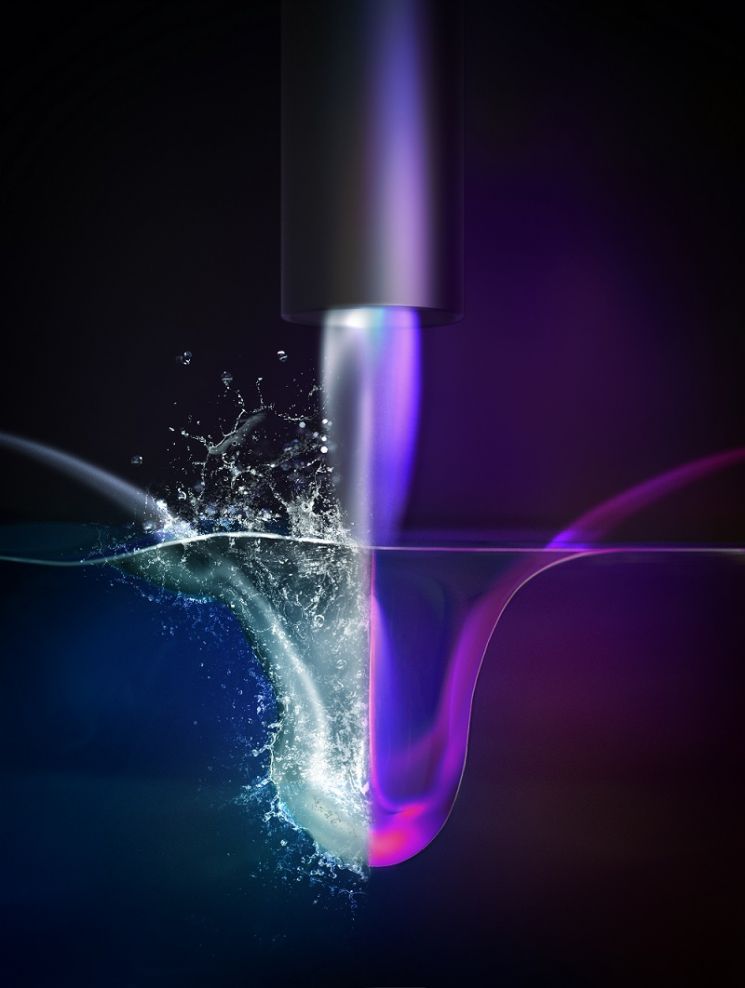 Illustration simulating the stabilization of a liquid surface through ionization of a gas jet. Photo by KAIST
[Asia Economy Reporter Kim Bong-su] An airplane that freely races not only in the sky but also underwater, and surgery that precisely removes even microscopic cancer cells on the human body surface. This kind of 'magical' core technology, seen only in SF movies, has been discovered for the first time by Korean researchers.
The Korea Advanced Institute of Science and Technology (KAIST) announced on the 2nd that Professor Choi Won-ho of the Department of Nuclear and Quantum Engineering and Dr. Park Sang-hoo's research team at the Korea Institute of Fusion Energy have discovered for the first time in the world that when plasma, ionized gas, is sprayed onto a liquid surface, the hydrodynamic stability of the interface between the gas and liquid is maintained. Plasma refers to a state in which gas is heated to high energy and separated into charged electrons and ions. It plays a key role in semiconductor and display manufacturing processes and can be encountered inside fluorescent lamps, neon signs, and air purifiers.
The research team found that when helium gas jets ionized by high voltage to obtain plasma were sprayed onto the water surface, the interface was maintained much more stably than the typical interface between gas and liquid.
For example, when blowing air onto the water surface with a straw, the surface dips inward, and if the air is blown strongly, bubbles and waves form, making the interface between air and water unstable. The instability of the surface also increases in liquids exposed to strong electric fields, such as raindrops in thunderclouds (雷雲). A representative case is the Taylor cone phenomenon resulting from electrohydrodynamic instability in electrospinning.
However, the research team confirmed that when plasma-ionized gas is sprayed onto the water surface, the water resistance weakens, causing the hole to deepen and eliminating bubbles and waves, thus stabilizing the interface between water and gas. This was because the high-speed ionization wave called the 'plasma bullet' and the electric wind stably pushed the water away.
These research results are expected to be applied not only in various academic fields such as medicine, life sciences, agriculture, food, and chemistry but also in the evolution of innovative transportation means. The technology of spraying jet-shaped gas onto liquid surfaces is actively used in many industrial and scientific fields. However, due to the phenomenon of increased hydrodynamic instability at the liquid surface where the gas jet is sprayed, it has not been widely utilized.
Professor Choi explained, "In the case of aircraft, even if hydrodynamic designs are made to reduce air resistance, air resistance occurs in some parts, but if plasma flows on the gas surface, air resistance can be dramatically reduced." He added, "Using plasma jets, surgery to remove cancer cells on surfaces such as the skin can be performed much more precisely without interference from moisture layers."
The research results were published in the international academic journal Nature on the 1st.
© The Asia Business Daily(www.asiae.co.kr). All rights reserved.

















