Six Areas Released from New Town Exit Strategy, Final Puzzle
Public Complex Project Candidate Sites Districts 2, 4, and 15 "Private Redevelopment Promotion"
Resident Confusion Intensifies Amid Private vs. Public Conflict
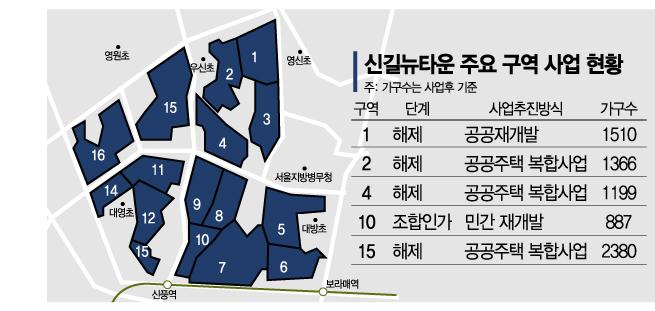
[Asia Economy Reporter Onyu Lim] Shingil New Town in Yeongdeungpo-gu, the largest new town in the southwestern area of Seoul, is emerging as a litmus test for the redevelopment of aging residential areas. Areas that had stalled or were deregulated following Seoul City's new town exit strategy are regaining redevelopment momentum through various project methods, including private and public initiatives. However, there are concerns that public-led project candidate sites may face strong opposition from residents, potentially sparking new conflicts.
According to the Ministry of Land, Infrastructure and Transport and the redevelopment industry on the 2nd, deregulated areas within Shingil New Town, such as the former Shingil 2, 4, and 15 districts, were recently selected as candidate sites for the Urban Public Housing Complex Project following the government's 2.4 supply plan follow-up measures. Unlike surrounding districts that have transformed into new apartments through redevelopment, these areas have severely aged since their redevelopment zones were deregulated in 2014. The government plans to improve project feasibility through various incentives and build a total of 5,000 new apartments here. This approach differs from Shingil 1 district, which is pursuing the construction of 1,510 apartments through 'public redevelopment.'
Among the 16 districts in Shingil New Town, eight districts?3, 5, 7, 8, 9, 11, 12, and 14?are either under construction or have already been occupied, but six districts?1, 2, 4, 6, 15, and 16?were deregulated following Seoul City's exit strategy, causing the projects to collapse. This has resulted in an incomplete new town where new apartments and aging residential areas coexist.
However, with the government announcing plans to develop deregulated areas through public participation or leadership, there is now an opportunity to complete the remaining pieces of the puzzle.
Moreover, recent positive factors such as rising housing prices in Seoul and the upcoming opening of the Shinansan Line are accelerating progress in previously stalled, unstarted districts. For example, Shingil 10 district, consisting of the Nam Seoul Apartments in the 3590 area of Shingil-dong, began public viewing of its project implementation plan on the 1st. This comes 14 years after it was designated as a redevelopment zone in 2007. Last month, Shingil 13 district, composed of Shinmi Apartments, Baekjo, and Taeyang Villas in the 340-1 area of Shingil-dong, also received approval for the establishment of its association.
A representative from Shingil-dong A Real Estate Office said, "Areas where projects had not progressed for a long time are now gaining momentum, and with various transportation benefits such as the Shinansan Line and Sinlim Line, a dramatic transformation of Shingil New Town is expected."
The key issue is the direction of the deregulated districts, which constitute a large part of the Shingil New Town puzzle. While a significant number of residents in Shingil 1 district support public redevelopment, voices advocating for private redevelopment are strong in Shingil 2, 4, and 15 districts, which were selected as candidate sites for the Urban Public Housing Complex Project. A resident of Shingil 4 district said, "I have already submitted a consent form supporting private redevelopment to the district office, so it is baffling that it suddenly became a candidate site for public-led redevelopment."
An official from a redevelopment consulting firm said, "If public-led development proceeds smoothly, Shingil New Town could be completed quickly, but it is doubtful whether two-thirds of the owners' consent can be obtained within a year." He added, "Moreover, with Oh Se-hoon, the People Power Party candidate advocating for redevelopment regulation relaxation, likely to be elected as Seoul mayor, it seems the government's will is not being strongly supported."
© The Asia Business Daily(www.asiae.co.kr). All rights reserved.

















