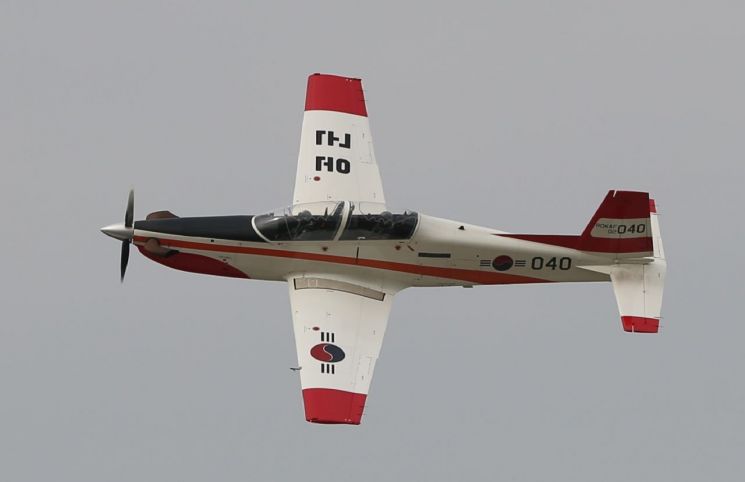
[Monthly Defense Times Editor-in-Chief An Seung-beom] The Air Force's KT-1 trainer aircraft marks its 21st year since entering service in 2000. Developed domestically under the leadership of the Agency for Defense Development and Daewoo Heavy Industries starting in 1988, the KTX-1 was created to replace the American-made T-37C intermediate trainer. The KTX-1 was the first domestically developed aircraft project in Korea.
The design reference and role model was the Swiss-made PC-9 trainer, selected under the JPATS program common to the U.S. Air Force and Navy at the time. The PC-9’s engine was the Pratt & Whitney Canada PT6A-62, the same type chosen for the KT-1. The KT-1 prototype first flew on December 12, 1991, with an engine output of 550 horsepower, which was later increased to 950 horsepower in the production models. Since 2000, 182 KT-1 trainers have been produced and deployed, including for the Air Force and export customers.
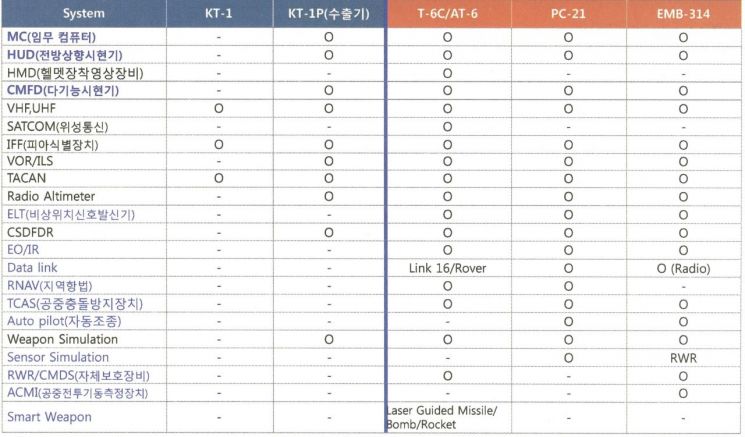
Trainers similar to the KT-1 class, based on engine type, include the U.S. Navy’s T-34C (PT6A-25), Switzerland’s PC-7 (PT6A-25C) and PC-9 (PT6A-62), Brazil’s EMB-312 (PT6A-25C) and EMB-314 (PT6A-68C), and Poland’s PZL-130 (PT6A). Switzerland has also exported the PC-21 trainer as a successor to the PC-7/9 series. The PC-21 is powered by a PT6A-68B engine with 1,600 horsepower. Brazil’s EMB-314, designated the A-29 in U.S. military nomenclature, competes alongside the PC-21 in export markets. The PC-21 and A-29, with their high-output engines and digital cockpits, leave little room for the KT-1.
Of course, the KT-1 trainer has versions with upgraded cockpits and light armaments tailored to the requirements of importing countries. The main challenge is engine power to improve flight performance; replacing the engine with a higher-output model would fundamentally require redesigning the aircraft.
Currently, the export market is seeing the active entry of the U.S. Beechcraft AT-6 armed trainer, which is rapidly growing with the potential to displace the A-29. Turkey, which imported 40 KT-1s, has developed the Hurkus, a domestically produced trainer equipped with the 1,600-horsepower PT6A-68T engine, challenging the market. The United Arab Emirates has developed the B-250, a trainer of similar class, to meet domestic demand and target exports to neighboring countries.
The Korean Air Force’s training system currently lacks a subsonic intermediate trainer phase and instead uses the supersonic T-50 fighter-class trainer for its training progression. As a result, the need for a subsonic trainer has been raised.
Since the introduction of the supersonic T-50 trainer, the M-346 subsonic trainer from Italy, China’s JL-9 and L-15, and Russia’s Yak-130 have entered the field. Fortunately, our export competitor has been limited to the M-346.
However, with the emergence of the U.S. Air Force’s T-X trainer program winner?the jointly developed U.S.-Swedish T-7?the T-50 export market is expected to become even more constrained. Although not intended for export, Taiwan’s T-5 supersonic trainer has also appeared, meaning the T-50 is no longer a unique presence.
Ultimately, to find a niche market, the KT-1’s successor should be developed as a subsonic jet trainer. The latest models of subsonic trainers currently include the Leonardo M-345, adopted and entering production and service with the Italian Air Force, and the Czech L-39NG.
The L-39NG is expected to replace the older L-39 in Vietnam following an order placed by the country.
The engines of the latest subsonic jet trainers commonly use the U.S. Williams FJ-44 engine. The FJ-44 is a small jet engine known for its compact size and economic advantages in maintenance and operation.
The market for trainers at the KT-1 class and above is effectively saturated, so upgrading the KT-1 with electronic equipment carries risks. To break away from this situation, entry into the subsonic jet trainer market with a maximum cruising speed around 800 km/h is necessary.
From now on, through discussions among stakeholders, development of a subsonic jet trainer should be pursued not only to establish a next-generation pilot training system but also to secure aircraft export markets.
© The Asia Business Daily(www.asiae.co.kr). All rights reserved.
![User Who Sold Erroneously Deposited Bitcoins to Repay Debt and Fund Entertainment... What Did the Supreme Court Decide in 2021? [Legal Issue Check]](https://cwcontent.asiae.co.kr/asiaresize/183/2026020910431234020_1770601391.png)

















