Experts Call for Alternative Measures... Government "Utilizing Reserve Stock for Second Vaccination"
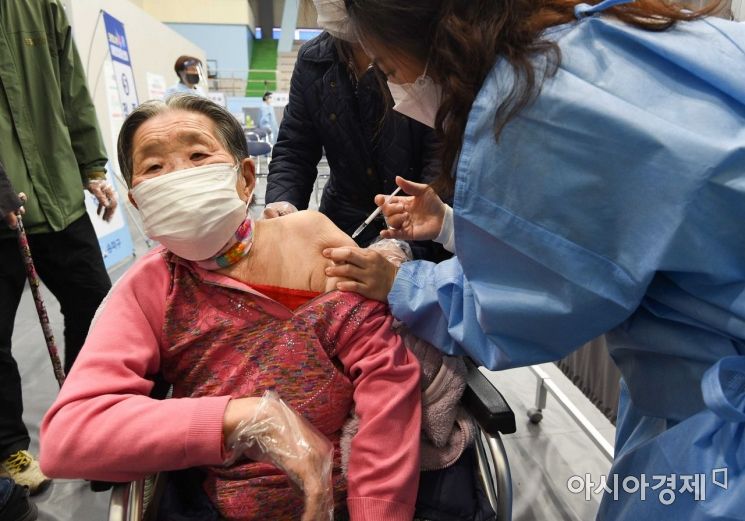 On the 1st, COVID-19 vaccinations for elderly people aged 75 and older began at the vaccination center set up in the Sports and Culture Center in Songpa-gu, Seoul, where seniors are receiving their shots. Photo by Jinhyung Kang aymsdream@
[Asia Economy Reporter Seo So-jeong] The introduction of the AstraZeneca COVID-19 vaccine has been delayed due to supply instability, causing disruptions to the second-quarter vaccination plan. Experts have called for contingency plans in preparation for a reduction or delay in the supply volume of the AstraZeneca vaccine, which accounts for the majority of domestic vaccine supply in the second quarter.
On the 1st, Professor Ki Moran of the National Cancer Center, chair of the Korean Society of Preventive Medicine's COVID-19 Task Force, said in a phone interview with Asia Economy, "Since the AstraZeneca vaccine, a viral vector vaccine, uses the same adenovirus for the first and second doses, the longer the interval between doses, the greater the effectiveness," adding, "As the recommended interval for AstraZeneca vaccination is 8 to 12 weeks, we should consider extending the current 10-week reservation standard to 12 weeks."
Professor Jung Ki-seok of Hallym University Department of Respiratory Medicine (former director of the Korea Disease Control and Prevention Agency) also stated, "We compared the effectiveness between groups with 8-12 week intervals and 9-12 week intervals for the AstraZeneca vaccine, and the 9-12 week interval group showed better effectiveness," adding, "There is no problem with changing the reservation date to 12 weeks."
With the supply volumes of Janssen, Moderna, and Novavax vaccines scheduled for the second quarter still unconfirmed, voices are emerging that additional vaccines should be considered to broaden options.
Professor Ki said, "Russia is expected to soon approve the ‘Sputnik Light’ vaccine, which provides an estimated 85% preventive effect with a single dose," and asserted, "Our government also needs to consider introducing it in preparation for vaccine supply situations."
The government is actively considering using the reserved doses for the second AstraZeneca vaccination for first-dose vaccinations. This is based on the judgment that, in a situation of vaccine shortage, vaccinating more people with a single dose rather than fully vaccinating fewer individuals with two doses would be more beneficial.
However, there are considerable counterarguments. Professor Jung Ki-seok pointed out, "Since Korea does not have a surge of confirmed cases like the UK or the US, opting for only the first dose is like telling people to survive on just one meal," adding, "If people become complacent without sufficient antibody production after only the first dose, it could rather hinder quarantine efforts."
Professor Jung Jae-hoon of Gachon University College of Medicine's Department of Preventive Medicine added, "Extending the vaccination interval or using low dead space syringes (LDS) to increase the number of vaccinated people may provide slight help, but it is not a fundamental solution to the gap period," emphasizing, "While concerns about adverse reactions to the AstraZeneca vaccine persist, it is important to increase vaccination rates and simultaneously secure and verify additional vaccines in advance."
© The Asia Business Daily(www.asiae.co.kr). All rights reserved.

















