UNIST Professor Daesik Kim's Team Develops Microstructure Deformation Technology Determining Metamaterial Functions
Applicable to High-Sensitivity Biomolecule Detection Sensors and 6G Communication ... Published in Nano Letters
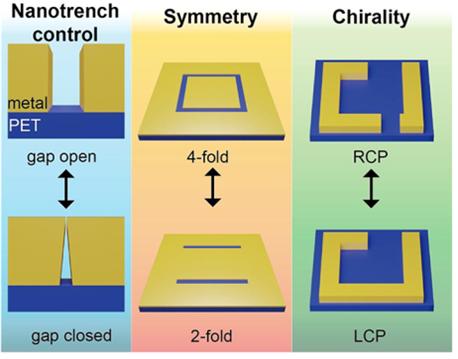 Developed metasurface microstructure deformation technology and the altered microstructure. [Image source=UNIST]
[Asia Economy Yeongnam Reporting Headquarters Reporter Kim Yong-woo] When will we be able to wear an invisibility cloak? A domestic research team has developed a new technology that can easily transform ‘metamaterials,’ considered the material to realize invisibility cloaks.
Metamaterials are materials that can specially alter the properties of light, making them candidates for realizing 3D holograms seen in science fiction movies and invisibility cloaks created by controlling the refractive index of light.
The function of metamaterials is determined by the microstructure on the surface of the material.
Since microstructured materials are expensive and difficult to manufacture, if the microstructure can be repeatedly transformed after being made once, commercialization becomes possible.
A domestic research team has developed a new technology that can be easily transformed even by hand.
The research team led by Distinguished Professor Kim Dae-sik of the Department of Physics at Ulsan National Institute of Science and Technology (UNIST, President Lee Yong-hoon) secured a core technology that can deform the surface microstructure of metamaterials by applying pressure.
 From the left, Researcher Hyungseok Yoon (co-first author), Research Assistant Professor Deokhyung Lee, Professor Daesik Kim, Researcher Bamadeb Das (co-first author). [Image source=UNIST]
The method involves creating thin gaps in the microstructure that open and close under pressure. It can be deformed simply by lightly bending it by hand, and the metamaterial is not damaged even after repeated deformation. The research team succeeded in controlling the characteristics of various electromagnetic waves using this technology.
By utilizing metamaterials, it is possible to change the frequency, wavelength, phase, and other properties of electromagnetic waves (light). These phenomena occur simply by irradiating electromagnetic waves onto the material.
This is because the microstructures covering the metamaterial surface are designed to interact specifically with electromagnetic waves. Therefore, when the microstructure is fixed, there is a limitation in the operating electromagnetic wave wavelength range and the controllable electromagnetic wave properties (frequency, wavelength, phase, etc.).
The technology developed by Professor Kim’s team can variably change the metamaterial microstructure into various shapes such as linear and square ring structures.
This is possible thanks to gaps with widths of several tens of nanometers (10^-9 m) created in the microstructure. The microstructure is fabricated on a flexible plastic substrate, and when pressure is applied by moving the substrate, the gaps open and close, changing the shape of the microstructure.
The width of the microstructure gaps can be adjusted to the picometer (10^-12 m) scale depending on the amount of pressure applied. Quantum phenomena such as tunneling can also be controlled.
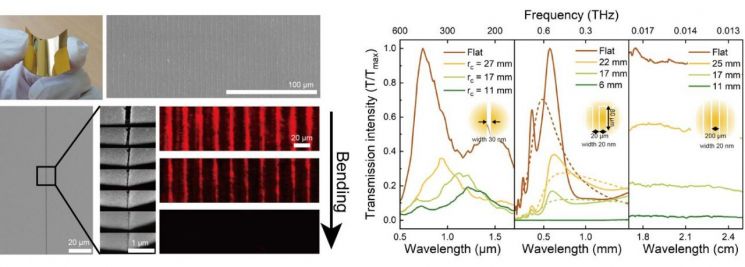 Performance study of the developed metamaterial deformation technology (light intensity and broadband frequency variation). [Image source=UNIST]
The metamaterials applying this technology can control intrinsic light properties such as frequency, intensity, phase (wave shape), and polarization of electromagnetic waves across various wavelength ranges (visible light, terahertz waves, millimeter waves, etc.).
Experimental results showed that in most ranges including visible light, the resonance frequency changed by more than twice, and in the terahertz range, which is considered the 6G communication frequency band, the intensity of light could be controlled by more than 99.9%. Control of light phase and polarization was also possible.
Co-corresponding author Research Assistant Professor Lee Deok-hyung predicted, “Using the resonance frequency characteristics of the developed metamaterials will be advantageous for measuring blood sugar changes and virus testing.”
This is because biomolecules such as proteins on the virus surface have their own natural vibration frequencies, which can be amplified and detected using the resonance frequency of metamaterials. Variable resonance frequencies can allow a wider variety of substances to be tested at once.
Professor Kim said, “This metamaterial deformation technology can change the properties of electromagnetic waves in various wavelength ranges such as visible light and terahertz, so it is expected to be applied to 6G communication technology, 3D hologram technology, and more.”
This research, with joint first authors Researcher Kim Da-som and Researcher Yoon Hyung-seok, was published online on March 12 in the international nanoscience journal ‘Nano Letters.’
The research was conducted with support from the National Research Foundation of Korea (NRF) and was a collaborative study among UNIST, Seoul National University, Incheon National University, and Seoul National University of Science and Technology.
© The Asia Business Daily(www.asiae.co.kr). All rights reserved.
![Clutching a Stolen Dior Bag, Saying "I Hate Being Poor but Real"... The Grotesque Con of a "Human Knockoff" [Slate]](https://cwcontent.asiae.co.kr/asiaresize/183/2026021902243444107_1771435474.jpg)


















