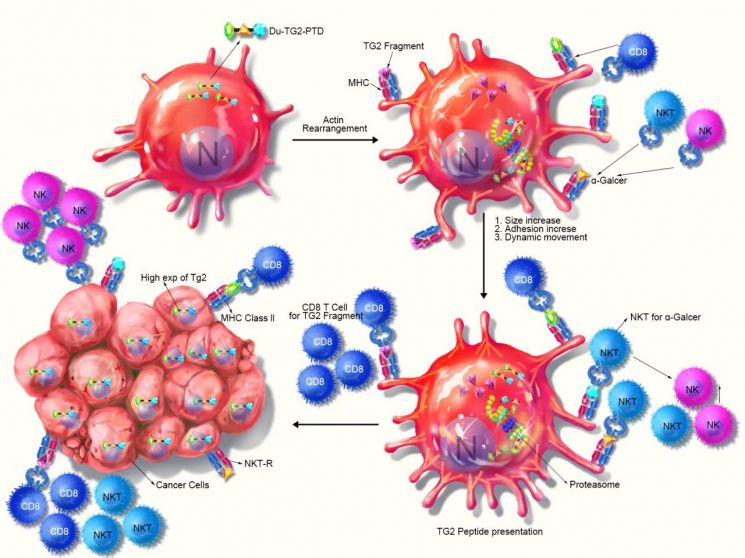
[Asia Economy Honam Reporting Headquarters Reporter Lee Gwan-woo] The research team led by Professor Jeon Chang-deok of the Department of Life Sciences at Gwangju Institute of Science and Technology (GIST) announced on the 1st that they have developed a next-generation anticancer immune cell therapy substance that activates immune responses in the body using star-shaped immune cells called dendritic cells to treat diseases.
This study overcomes the disadvantages of existing biomolecule introduction using viruses, such as high cost and low introduction efficiency, by pharmaceuticalizing biomolecules to easily introduce them into cells. It is expected to be used as a drug that can be immediately applied to dendritic cells of cancer patients with weakened immune function, thereby enhancing the effectiveness of anticancer treatment.
Dendritic cells are cells in the mammalian immune system that convey information about external invaders to T cells, enhancing the attack power of T cells.
Anticancer immune cell therapy is a method that activates immune responses in the body using dendritic cells, natural killer cells, T cells, etc., strengthening weakened immune functions and enhancing the body's natural healing power. It involves harvesting immune cells centered on cancer resistance, cultivating and activating them strongly, and then reintroducing them into the body to attack cancer.
When external invaders (antigens) enter the body or cancer cells grow, dendritic cells capture the antigens or cancer cells and go through a series of processes to make immune cells recognize them well, then move to lymphoid organs and deliver the antigens to immune T cells.
At this time, the mobility of dendritic cells and their binding with immune T cells (immune synapse formation) are regulated by the actin cytoskeleton, which acts like the bone of the cell, continuously moving the cell and regulating immune responses, making it a very important component.
The research team has been studying the protein ‘Transgelin-2,’ which regulates the function of actin, for several years and has identified that it is involved not only in the activation of various immune cells but also in cell mobility.
The research results proved that dendritic cells deficient in Transgelin-2 cannot migrate to secondary lymphoid organs and fail to induce normal immune cell activation and growth, thus failing to trigger immune responses. This newly revealed that the expression of Transgelin-2 is an indispensable factor for maintaining the normal function of dendritic cells.
Based on this fundamental mechanistic research, the team produced a recombinant Transgelin-2 protein that can be introduced into cells and stably maintained intracellularly. They treated dendritic cells deficient in Transgelin-2 with this protein, successfully re-expressing Transgelin-2 and restoring the abnormal function of dendritic cells.
Additionally, when normal dendritic cells were pre-injected into experimental mice to create an immune-activated environment and then tumors were induced, the tumor size was reduced by more than 50% compared to the control group, demonstrating effective suppression of tumor formation.
Professor Jeon Chang-deok said, “This research achievement is significant as it is the first case showing anticancer enhancement effects through intracellular substances that perform major functions inside dendritic cells in therapeutic research using dendritic cells.” He added, “We plan to develop a combination therapy with cell vesicles transporting immune checkpoint inhibitory proteins currently underway and establish a next-generation dendritic cell-based vaccine anticancer strategy.”
© The Asia Business Daily(www.asiae.co.kr). All rights reserved.
![From Bar Hostess to Organ Seller to High Society... The Grotesque Con of a "Human Counterfeit" [Slate]](https://cwcontent.asiae.co.kr/asiaresize/183/2026021902243444107_1771435474.jpg)
















